
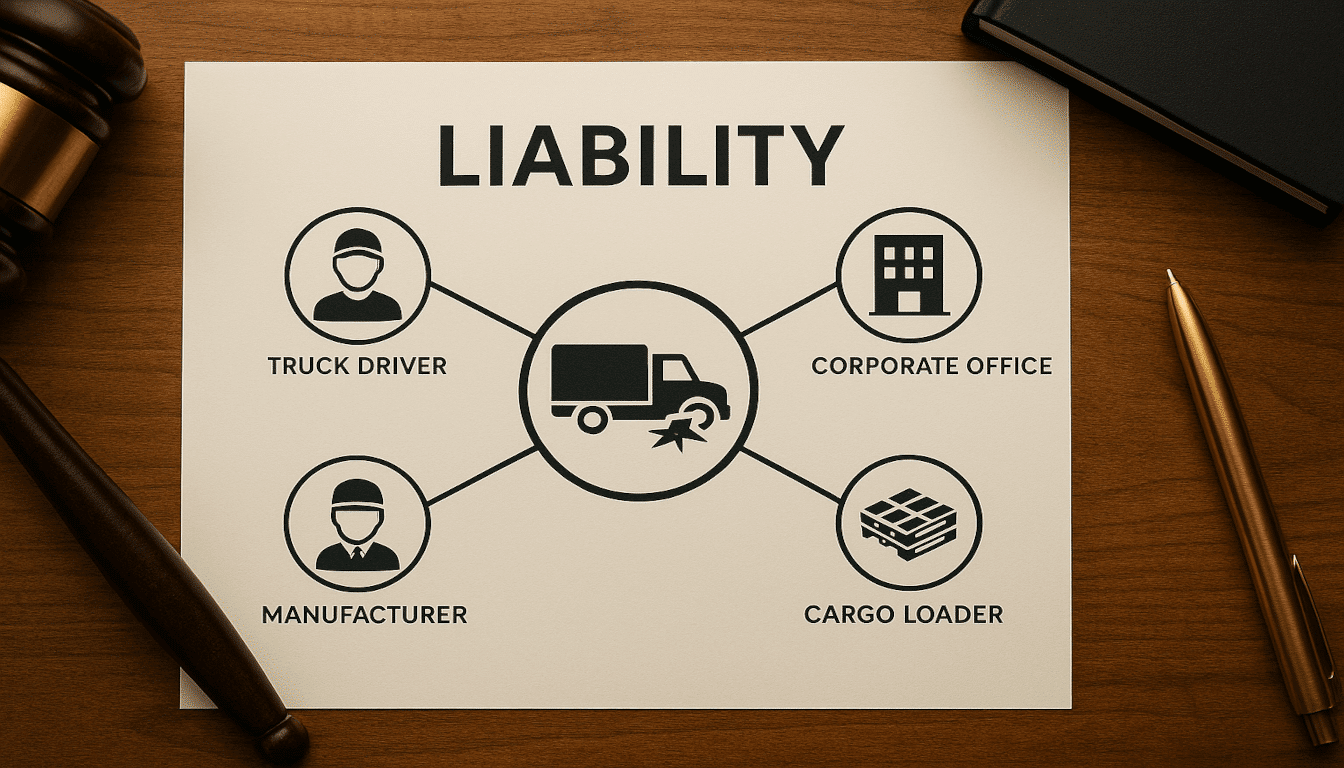
⚠️ Important: Liability laws for semi-truck accidents are based on federal regulations and state-specific negligence principles. While the parties listed below can be held responsible nationwide, the specific application of these laws varies by state. Consulting with a lawyer licensed in your state is essential.
Determining legal and financial responsibility after a semi-truck accident is complex, but it is the most critical step for victims and families seeking recovery. These cases involve multiple potential defendants—from the driver and trucking company to cargo loaders, maintenance providers, and manufacturers—each governed by strict federal and state regulations.
This guide provides a clear, actionable framework to help you understand who can be held liable, how fault is proven, and what immediate steps you must take to protect your rights. You will learn how key evidence establishes negligence, how insurance companies operate, and how to build a strong claim for maximum compensation.
For a detailed list of possible defendants and how cases typically unfold, see Legal Liability in Semi-Truck Accidents.
Key Takeaways
- Multiple parties can share liability after a major truck crash.
- Federal safety rules and state negligence law shape how fault and recovery work.
- Quick action preserves black-box data, logs, and maintenance records as evidence.
- Insurance carriers may try to shift blame; careful tactics limit damage to claims.
- Comparative fault rules can reduce but not always bar compensation.
Understanding Semi-Truck Accident Liability in the United States
Determining fault after a catastrophic semi-truck accident requires a thorough investigation that goes beyond the basic rules of the road. It involves analyzing compliance with federal safety regulations and the operational practices of every party involved.
Liability is the legal term for who is financially and legally responsible for the damages. Courts determine this by applying state negligence laws alongside specific federal safety standards for the trucking industry.
The Role of Federal Regulations: The Federal Motor Carrier Safety Administration (FMCSA) sets mandatory rules for driver hours (HOS), vehicle maintenance, and cargo securement. A violation of these regulations is powerful evidence of negligence and is central to building a claim against a trucking company or owner. For official standards, see the FMCSA regulations.
Multiple Parties, Shared Responsibility: The modern trucking industry operates on a complex model. A single semi-truck accident may involve the driver, the motor carrier, a freight broker, a cargo loading company, and a third-party maintenance provider. This structure means multiple parties can share legal liability. For a deeper breakdown, see our guide on Vicarious Liability in Semi-Truck Accidents.
The Interstate Challenge: Many semi-trucks are involved in interstate commerce, adding a layer of jurisdictional complexity. An accident in one state involving a driver licensed in another, and a carrier based in a third, affects which state’s negligence laws and insurance systems apply. This directly impacts your legal strategy and potential compensation.
Key Takeaway for Your Case: From the first moment, understand that evidence is everything. Electronic Control Module (ECM) and Electronic Logging Device (ELD) data, driver logs, and dispatch records are the objective proof needed to establish violations like driver fatigue, speeding, or improper loading. Securing this data quickly is critical, as insurance carriers and defendants will simultaneously be reviewing it to limit their own liability.
Parties Who Can Be Legally Responsible for a Semi-Truck Accident
A semi-truck accident is rarely a simple event with a single cause. Due to the size, complexity, and regulated nature of the commercial trucking industry, legal responsibility is often shared among multiple parties. Identifying all potentially liable entities is not just an academic exercise—it is the most critical step in ensuring you can recover full and fair compensation. Your claim’s strength depends on uncovering the chain of responsibility, which extends far beyond the driver behind the wheel to include the companies and professionals who controlled the vehicle’s condition, the driver’s schedule, and the cargo’s safety.
Semi-Truck Drivers: Negligence, Hours of Service, and Road Rules
Truck drivers have a duty to obey traffic laws and strict federal hours-of-service (HOS) limits. Common negligence includes speeding, distraction, and tailgating. Driver fatigue, a leading cause of crashes, is directly proven by violations of HOS rules found in logbooks and Electronic Logging Device (ELD) data. For the official federal rules, see the FMCSA Hours-of-Service Regulations.
Trucking Companies and Owners: Hiring, Supervision, and Maintenance Duties
A trucking company can be held directly liable for its own negligence, such as hiring an unqualified driver, providing inadequate training, or enforcing unsafe schedules that cause fatigue. Under the legal principle of vicarious liability, a company is also typically responsible for the negligent acts of its drivers performed within the scope of their employment. Furthermore, companies have a non-delegable duty to maintain their vehicles in safe operating condition. Lapses documented in maintenance records are powerful proof of negligence. Explore this further in our guide on Negligent Hiring and Training in Semi-Truck Accidents.
Other Liable Parties: Cargo Loaders, Manufacturers, Repair Shops, and Government Entities
Liability often extends to third parties:
- Cargo Loaders/Shippers: Improper securement or overweight loads can cause catastrophic loss of control.
- Manufacturers: Defective parts (e.g., brakes, tires, steering systems) can lead to product liability claims under strict liability laws.
- Maintenance & Repair Shops: Negligent repairs or inspections that lead to mechanical failure create direct liability.
- Government Entities: Municipalities or contractors may share fault if unsafe road design, poor signage, or lack of maintenance contributed to the accident.
How Shared Fault Can Affect Your Claim
Fault in semi-truck accidents is rarely absolute. Multiple parties often share responsibility, which directly impacts your compensation. Most states follow comparative negligence rules, meaning your financial recovery is reduced by your own percentage of fault. A thorough investigation, therefore, has a dual purpose: to prove the negligence of others and to accurately establish the facts to minimize any unfair blame shifted to you. The goal is to maximize the liability of every other responsible party.
4 Steps to Determine Fault After a Semi-Truck Accident
After a major crash involving a commercial rig, prompt actions shape how fault is proved and claims proceed. Follow these steps in order:
Step 1: Secure Safety, Medical Care, and the Scene
Your first priority is safety. Call 911, move to a safe location if possible, and seek medical attention even for minor injuries—this also creates a medical record. Do not disturb evidence unless necessary for safety. Photograph vehicle positions, debris fields, skid marks, cargo spills, and road defects. Collect contact and insurance details for all drivers, witnesses, and the carrier.
Step 2: Document Evidence and Send Preservation Letters for Critical Data
Time‑sensitive electronic data can be lost. Immediately send spoliation letters to the motor carrier and related parties to secure ECM/ELD downloads, dashcam footage, dispatch records, and maintenance files. Continue documenting by photographing injuries, vehicle damage, and road conditions. Record DOT numbers, carrier names, and visible company identifiers on trailers. For official guidance on electronic logging devices, see the FMCSA ELD regulations.
Step 3: Avoid Giving Statements to the Other Side’s Insurers
Insurance carriers may seek early statements to limit liability. Avoid detailed communications with the trucking company’s insurer. Let your counsel handle all negotiations to protect the value of your claim.
Step 4: Hire an Experienced Semi-Truck Accident Lawyer to Lead the Investigation
Retain legal specialists who can direct a comprehensive investigation. They will engage experts to reconstruct the accident, download and analyze black‑box data, compare logs to FMCSA regulations, and track all medical and financial damages to build your claim for full compensation.
Crucially, your lawyer has the authority to pursue evidence when companies resist. If records are withheld, they can use subpoenas or court orders to obtain critical files. This coordinated investigation aligns all evidence with regulatory breaches and identifies every party tied to fault, creating maximum leverage for settlement or trial.

Federal and State Laws That Govern Truck Accident Liability
Federal and state regulations create the concrete legal duties for carriers, drivers, and all supporting parties in the trucking industry. Violations of these rules do more than just result in fines—they form the bedrock of civil liability in injury claims, directly impacting which parties are held responsible and the scope of damages victims can recover.
FMCSA Rules: Hours of Service, Maintenance, and Load Safety
The Federal Motor Carrier Safety Administration (FMCSA) sets mandatory, nationwide standards for commercial vehicles. Key areas include:
- Hours of Service (HOS): Limits driving time to combat fatigue.
- Vehicle Maintenance & Inspection: Requires systematic upkeep and pre-trip inspections.
- Cargo Securement: Mandates proper loading to prevent shifting loads.
A violation of these FMCSA regulations can be used as evidence of negligence per se—meaning the act of violating the statute is itself proof of a breached duty of care. Electronic Logging Device (ELD) data, driver logbooks, and maintenance records are the primary evidence used to prove these violations and hold companies accountable. For the official source, review the official FMCSA regulatory code.

State Comparative Fault and Recovery Rules in Semi-Truck Accident Cases
While federal rules set the safety standard, state tort laws determine how fault affects financial recovery. Most states use a comparative fault system:
- Your compensation is reduced by your percentage of fault (e.g., 20% at fault = 80% of total damages).
- In many states, you are barred from recovery if you are 50% or 51% or more at fault (depending on the state’s specific rule).
A thorough investigation must therefore do two things: prove the trucking party’s regulatory violations and protect against inflated allegations of fault against you. Understanding your state’s specific rule is crucial for valuing your claim. For a detailed analysis, see our guide: How Comparative Fault Affects Semi-Truck Accident Settlements.
Strategic Takeaway: Aligning Evidence with Legal Frameworks
Early legal involvement is not just about filing paperwork. It is a strategic necessity to:
- Preserve & Analyze Evidence: Immediately secure ELD data, logs, and maintenance records to document FMCSA violations.
- Navigate Jurisdiction: Determine which state’s comparative fault law applies, especially in interstate crashes.
- Coordinate Insurance Layers: Identify and initiate claims against all applicable policies from multiple potentially liable parties.
This coordinated approach aligns technical regulatory proof with the correct liability framework, building the strongest possible case from the outset.
Key Evidence That Proves Liability in Semi-Truck Accident Cases
In truck accident litigation, the strongest cases are built on objective, technical evidence. The following categories of proof are critical for establishing not just that a crash happened, but why it happened and who is legally at fault. Securing this evidence quickly is paramount.

ECM, ELD, and Dispatch Logs: The Digital Timeline
Electronic Control Module (ECM) and Electronic Logging Device (ELD) data provide a precise, digital record of the truck’s operation and the driver’s schedule in the moments, hours, and days leading to a crash.
- ECM Data: Reveals exact speed, braking force, engine RPM, and other vehicle dynamics.
- ELD Records: Verifies compliance—or violations—of federal Hours-of-Service (HOS) rules, proving driver fatigue.
- Dispatch Logs & Messages: Can reveal unsafe scheduling pressure from the company that led to rushed decisions.
Immediate Action: This data is often automatically overwritten. Issuing a spoliation letter to the carrier to preserve it is one of the most urgent post-accident steps.
Maintenance Records and Inspection Histories
Pre-trip and post-trip inspection reports, repair invoices, and scheduled maintenance logs are the paper trail of a vehicle’s roadworthiness. Gaps, missed inspections, or documented but unfixed defects are powerful evidence of negligence by the trucking company or a third-party maintenance facility. These records can prove a known mechanical failure was the probable cause of the accident.
Cargo Loading and Securement Documentation
Improper loading is a major cause of rollovers and loss-of-control crashes. Key documents include:
- Bills of Lading & Shipping Orders: Identify the shipper and loader.
- Load Diagrams & Weight Tickets: Prove weight distribution and total load.
- Securement Checklists: Show whether proper protocols were followed.
Violations of cargo securement standards can shift liability to cargo loaders, shippers, or the motor carrier itself. For related workplace safety standards, see the OSHA Trucking Industry guidelines.
Corroborating Evidence: Video, Witnesses, and Expert Reconstruction
To transform technical data into a compelling narrative for a judge or jury, you need corroborating evidence:
- Video Footage: Dashcams, traffic cameras, and surveillance video provide undeniable visual context.
- Witness Statements: Independent accounts from other drivers or bystanders bolster credibility.
- Accident Reconstruction Experts: These specialists synthesize all physical evidence (skid marks, vehicle damage, ECM data) to authoritatively explain the sequence of events and establish causation. For a deeper dive on building this technical proof, see our guide: How to Prove Negligence in Semi-Truck Accident Lawsuits.
Evidence Summary Table
| Evidence Type | What It Proves | Who It Implicates |
|---|---|---|
| ECM / ELD Data | Speed, braking, HOS violations, driver activity | Driver (negligence); Trucking Company (vicarious liability) |
| Maintenance Records | Repair history, missed inspections, known defects | Trucking Company (direct negligence); Repair Shop; Parts Maker |
| Cargo Documents | Weight, securement method, loading party | Shipper; Cargo Loader; Carrier (for oversight) |
| Video & Reconstruction | Sequence of events, impact forces, causation analysis | All involved parties; supported by Expert Testimony |
Crucial Takeaway: A documented chain of custody and prompt preservation of this evidence is what turns a collection of files into an unassailable liability claim, effectively limiting an insurer’s ability to deny or shift blame.
How To Handle Insurance Companies And Protect Your Semi-Truck Accident Claim
Trucking insurance adjusters initiate contact quickly as a standard tactic to control the narrative and settle claims before the full scope of injuries and liability is known. Victims should be prepared for early settlement offers, requests for recorded statements, and questions designed to limit the insurer’s payout. Protecting your claim requires a strategic, informed response.

Recognizing Common Insurance Tactics: Quick Offers and Blame-Shifting
Adjusters often employ several strategies to minimize their company’s exposure:
- Low-Ball Settlement Offers: Pushing for a fast settlement before long-term medical prognosis or total wage loss is known.
- Shifting Blame: Attempting to assign partial fault to you to invoke comparative negligence laws and reduce their liability.
- Downplaying Evidence: Minimizing the significance of clear FMCSA violations (e.g., HOS breaches, missed maintenance).
- Exploiting Gaps: Using pauses in medical treatment to argue injuries are not serious.
Understanding the insurer’s perspective is key. For industry context, see DAT’s Essential Guide to Trucking Insurance Coverage.
Your Strategic Response: Let Your Lawyer Communicate
Your most powerful response is to have legal counsel manage all communications. Here is your action plan:
Step 1: Stay Off Social Media: Do not post about the accident, your injuries, or your recovery. Insurers actively monitor social media to find contradictions they can use against you.
Step 2: Provide Only Basic Facts: At the scene, share insurance and contact information only. Politely decline to give any recorded or detailed statement.
Step 3: Centralize Communications: Once you hire a lawyer, all calls and letters from insurers should be directed to them. This prevents missteps and creates a unified front.
Step 4: Secure the Evidence: Your lawyer will use legal tools (preservation letters, subpoenas) to obtain critical data—ECM/ELD downloads, driver logs, maintenance records—before it can be altered or lost.
Step 5: Document Everything: Meticulously track all medical visits, expenses, lost wages, and how the injuries affect your daily life. This builds the foundation for a full compensation demand.
Why Legal Leverage is Non-Negotiable
Do not accept any settlement offer without a complete understanding of your future medical needs and lifelong costs. An experienced semi-truck accident lawyer prepares your case for trial from the very first day. This readiness is what creates genuine leverage in negotiations. Insurers settle fairly when they know you have the expertise and resources to win in court. Choosing the right legal specialist is therefore the most important decision you can make for your claim’s outcome. Learn what to look for in our guide: Choosing the Best Lawyer for Your Semi-Truck Accident Case.
Navigating Compensation, Shared Fault, and Critical Deadlines
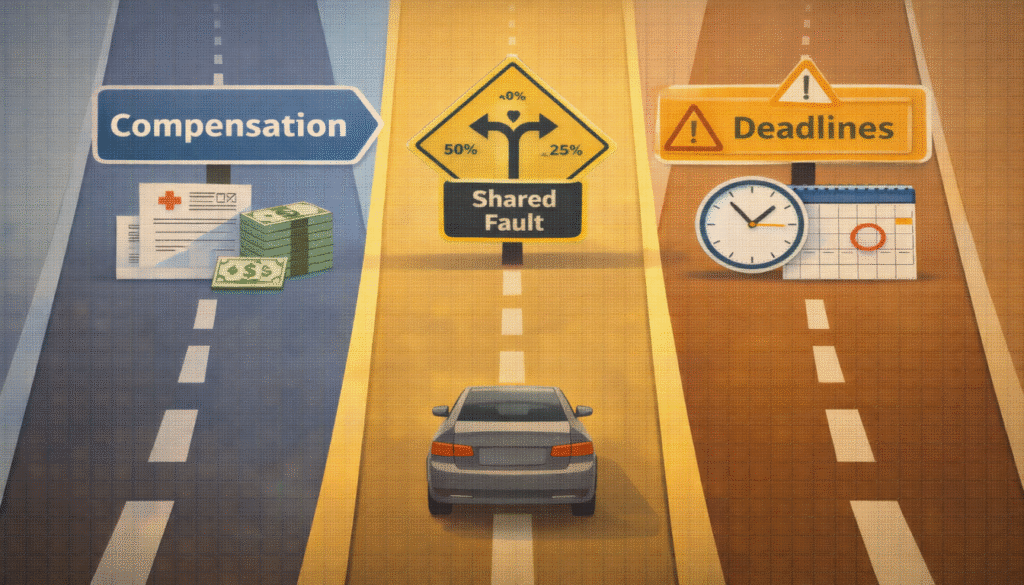
Securing full and fair compensation after a semi-truck accident is a three-part challenge: you must accurately value your damages, navigate laws that reduce payout based on shared fault, and act within strict legal deadlines that can bar your claim entirely. A strategic approach addresses all three simultaneously.
Recoverable Damages in Semi-Truck Accident Claims
Your claim must account for all past, current, and future losses, which typically fall into two categories:
- Economic Damages (Tangible Losses): Medical bills (emergency care, surgery, therapy), lost wages, loss of future earning capacity, property damage, and other out-of-pocket expenses.
- Non-Economic Damages (Intangible Losses): Pain and suffering, emotional distress, loss of enjoyment of life, and disfigurement.
In wrongful death cases, families may seek funeral costs, loss of financial support, and loss of companionship.
How Comparative Negligence Directly Reduces Your Settlement
Most states use comparative negligence rules. This is not just a legal concept—it’s a mathematical formula applied to your settlement:
- If you are found 20% at fault, your total compensation is reduced by 20%.
- In many “modified” comparative fault states, you are barred from any recovery if you are 50% or 51% or more at fault.
This is why the insurance company will aggressively try to shift blame to you. A thorough investigation must proactively defend against these tactics to protect the value of your claim.
The Critical Importance of Deadlines and Immediate Action
Two types of deadlines threaten your claim:
- Practical Deadlines: Critical evidence like Electronic Control Module (ECM) data, dashcam footage, and driver logs can be overwritten or destroyed within days or weeks.
- Legal Deadlines (Statutes of Limitations): Each state sets a strict time limit (often 2-3 years) to file a lawsuit. Missing this deadline forever forfeits your right to compensation.
Your Immediate Action Plan:
- Preserve Evidence: Formalize requests for data and records. For official protocols, see FMCSA guidance on Crash Reporting and Recordkeeping.
- Document Everything: Keep a dedicated file for all medical records, bills, repair estimates, and proof of lost income.
- Identify All Policies: Determine all potentially liable parties (driver, carrier, loader, etc.) and their insurance policies to ensure adequate coverage exists for your damages.
- Consult a Lawyer Early: An attorney will safeguard evidence, navigate comparative fault, and ensure all filing deadlines are met. For a comprehensive post-accident action list, see our guide: What to Do After a Semi-Truck Accident: A Survival Guide.
Final Steps to Protect Your Rights and Your Future
The period following a semi-truck accident is defined by urgency. The steps you take—or fail to take—will determine the outcome of your claim. By understanding the full scope of compensatory damages, proactively defending against allegations of shared fault, and treating every deadline as non-negotiable, you lay the groundwork for a successful recovery. Engaging a lawyer who specializes in this complex area of law is the most effective step to ensure you navigate this process correctly and secure the financial future you and your family deserve.
Your Future After a Semi-Truck Accident: Protecting Rights and Securing Compensation
The path to recovery after a devastating semi-truck accident is paved with urgent decisions. As this guide has outlined, determining liability is a complex process that often extends beyond the driver to include trucking companies, maintenance providers, cargo loaders, and manufacturers—all governed by a web of federal and state regulations.
Your financial recovery depends on two non-negotiable priorities: preserving evidence with speed and securing experienced legal counsel early. From black box data and driver logs to medical documentation and insurance policies, the evidence you secure in the days following the crash forms the unshakable foundation of your claim. A lawyer specializing in this complex field is essential to navigate comparative fault laws, counter insurance tactics, and ensure all critical deadlines are met.
By taking informed, prompt action, you transform from a victim into a protected claimant, empowering yourself to pursue the full and fair compensation necessary to rebuild your life. For guidance on identifying liable parties, see Legal Liability in Semi-Truck Accidents.
Frequently Asked Questions: Semi‑Truck Accident Liability, Evidence, Insurance, and Compensation
Who can be held liable after a semi‑truck accident?
Liability may fall on the driver, carrier, cargo loaders, manufacturers, repair shops, or even government agencies. Each party’s responsibility depends on negligence, maintenance lapses, or regulatory violations.
What immediate steps should a victim take at the scene of a semi‑truck accident?
Secure safety, call emergency responders, and seek medical care. Preserve the scene with photos of vehicles, skid marks, and injuries. Collect driver and witness details, report to police, and notify the carrier.
Which records most often prove fault in semi‑truck accident cases?
ECM and ELD logs reveal speed, braking, and hours worked. Maintenance records show defects or missed repairs. Cargo documents establish loading and securement. Video and witness statements strengthen causation.
How do federal rules affect liability in semi‑truck accidents?
FMCSA regulations govern hours of service, maintenance, driver qualifications, and cargo securement. Violations provide strong evidence of negligence and can make carriers or drivers easier to hold accountable.
What tactics do insurers use after a semi‑truck accident, and how should victims respond?
Insurers may push quick settlements, seek recorded statements, or shift blame. Victims should limit comments, avoid signing releases, and forward communications to counsel. Lawyers protect evidence and strengthen negotiations.
When should preservation letters or spoliation notices be sent in semi‑truck accident claims?
Preservation letters should be sent promptly to carriers, repair facilities, and vendors. They secure ECM downloads, ELD logs, maintenance files, and surveillance footage before data is lost or destroyed.
How does cargo loading affect fault and damages in semi‑truck accidents?
Improper loading, insecurement, or overweight cargo can cause rollovers or jackknifes. Bills of lading, loading logs, and weigh station records help determine whether loaders or shippers violated regulations.
What role do expert witnesses play in semi‑truck accident litigation?
Experts reconstruct crashes using ECM/ELD data, maintenance files, and vehicle dynamics. Their testimony explains causation, liability, and damages, often tipping the balance in complex cases.
Which damages can victims recover after a semi‑truck accident?
Recoverable losses include medical expenses, future care, lost income, property damage, and pain and suffering. Punitive damages may apply in cases of reckless misconduct.
How does comparative fault affect semi‑truck accident settlements or verdicts?
Comparative fault reduces awards by the victim’s percentage of responsibility. In modified systems, recovery is barred if fault exceeds 50% or 51%. Accurate investigation minimizes assigned fault.
What deadlines govern filing semi‑truck accident claims?
Statutes of limitations vary by state and claim type. Deadlines may be shorter against government entities. Missing a deadline can bar recovery, so victims should consult counsel quickly.
When should a claimant hire a semi‑truck accident lawyer?
Victims should consult a lawyer immediately, especially when injuries are serious or liability is disputed. Early involvement preserves evidence and navigates complex federal and state rules.
Can manufacturers be liable for component failures in semi‑truck accidents?
Yes. Defective brakes, tires, steering systems, or electronics can trigger product‑liability claims. Recovery may involve design defect, manufacturing defect, or failure‑to‑warn theories.
Are there special considerations for accidents involving interstate semi‑truck carriers?
Interstate carriers operate under federal safety rules and national insurance programs. Cross‑jurisdictional issues and federal preemption complicate claims, making specialized counsel essential.
Can state law change recovery options after a semi‑truck accident?
Yes. State laws directly govern recovery. Comparative fault rules reduce your financial award based on your percentage of responsibility. In no-fault states, you must first use your own Personal Injury Protection (PIP) insurance to cover medical costs. For serious injuries, you may then step outside the no-fault system to file a tort claim against the at-fault trucking party for additional damages.
For more resources, visit:
- Federal Motor Carrier Safety Administration (FMCSA): https://www.fmcsa.dot.gov
- National Highway Traffic Safety Administration (NHTSA): https://www.nhtsa.gov
Disclaimer: The information provided in this article is for general informational purposes only and does not constitute legal advice. While we strive to ensure the accuracy and reliability of the content, laws and regulations may vary by state, and individual cases may have unique circumstances. For advice tailored to your specific situation, please consult a lawyer. The inclusion of links to external resources does not imply endorsement or guarantee of the information provided therein.
Related Articles
- Punitive Damages in Semi-Truck Accident Cases: When Are They Awarded?
- The Differences Between Trucking Accidents and Regular Car Accidents
- Navigating Multi-Party Lawsuits in Semi-Truck Accidents
- Insurance Company Tactics to Watch Out for in Trucking Accident Cases
- Who Can Be Held Responsible in a Semi-Truck Accident Case?
More from This Category
- How to Prove Negligence in Semi-Truck Accident Lawsuits
- What You Need to Know About the Statute of Limitations for Truck Accident Cases
- Top Reasons Semi-Truck Accident Claims Are Denied and How to Fight Back
- The Importance of Evidence in Semi-Truck Accident Claims: Building a Strong Case
- How Comparative Fault Affects Semi-Truck Accident Settlements and Compensation
Additional Resources
- Understanding Vicarious Liability in Trucking Accidents
- How Federal Trucking Regulations Impact Your Semi-Truck Accident Case
- FAQs for Semi-Truck Accident Victims: Answers to Your Most Pressing Questions