

Multi‑party liability in semi‑truck accidents raises complex legal questions when more than one party shares fault. From trucking companies and drivers to manufacturers and maintenance crews, determining who’s responsible — and to what extent — can shape the outcome of a lawsuit. Understanding how courts handle these layered claims is essential for victims seeking full and fair compensation.
The layered defenses and multiple insurers change how settlement talks play out. A seasoned lawyer with trucking experience secures records quickly and coordinates experts to protect compensation and case value. For a practical guide to how these lawsuits unfold and who may be responsible, see Semi‑Truck Accident Lawsuits Explained.
Key Takeaways
- Multiple parties can share fault in a semi‑truck accident; identify them early to protect claims.
- Black box data, logbooks, and maintenance records are often decisive evidence.
- Layered insurance and shifting defenses complicate settlement timing and outcomes.
- Experienced counsel acts quickly to secure files and guide coordinated legal representation.
- State rules and doctrines affect how damages are allocated and recovered.
Multi‑Party Liability in Semi‑Truck Accidents: What It Means for Your Claim
When you’re injured in a crash with a semi-truck, you might assume the driver is the only one at fault. In reality, multiple companies and individuals often share legal responsibility. Understanding this concept—called multi-party liability—is crucial because it directly determines how much compensation you can recover and how your legal team will build your case.
Why Multiple Liable Parties Change Everything for You
More responsible parties mean two key things for your claim:
- Access to More Insurance: You can potentially recover from the insurance policies of the driver, the trucking company, the cargo loader, and the maintenance shop. This is often necessary to cover the catastrophic costs of a serious truck accident.
- Increased Case Complexity: With more parties come more defenses, more legal maneuvers, and longer negotiations. This is why you need a lawyer who specializes in navigating these exact battles.
How Violations of Federal Rules Prove Fault
Trucking companies and drivers must follow strict federal safety rules. Violations of these regulations are powerful evidence that can prove multiple parties were negligent.
- Driver Fatigue: Violations of the Federal Hours-of-Service Rules can prove a driver was illegally fatigued. You can review the official FMCSA Hours-of-Service Regulations for more detail.
- Company Negligence: Missing maintenance records or proof of negligent hiring can directly implicate the trucking company.
- Expert Analysis is Key: Specialized lawyers use expert witness testimony to translate these technical violations into clear proof of fault. For a deep dive into how this works, see our guide: How Expert Witnesses Strengthen Semi-Truck Accident Claims.
How State Laws Affect Your Recovery
States have different rules for dividing fault and damages among multiple defendants. In some states, you can recover your full compensation from one defendant (like the trucking company), and they must then chase the others for their share. In other states, your recovery may be reduced by your own percentage of fault. Your lawyer’s strategy is built around these specific state laws.
Identifying the Web of Responsibility
Your lawyer will investigate to identify every party that may share blame. This table shows common examples:
| Party Type | Typical Issue | Why It Matters to Your Claim |
|---|---|---|
| Truck Driver | Fatigue, distraction, logbook violations | Provides direct evidence of the immediate cause of the crash. |
| Trucking Company | Negligent hiring, training, or maintenance policies | Holds the deep-pocketed employer liable for its employee’s actions and its own failures. |
| Manufacturer/Maintenance | Defective parts, poor repairs | Opens a separate “product liability” or negligence claim, adding another source of compensation. |
| Cargo Shipper/Loader | Improperly secured or overweight cargo | Proves that loading errors caused a rollover or loss of control, adding another defendant. |
Your Next Steps: This complexity is why immediate action is non-negotiable. For urgent guidance on what to do in the days following a crash, review our Semi-Truck Accident FAQs.
Who Can Be Liable in Your Semi‑Truck Accident
A semi‑truck accident often reveals a chain of failures, not just a single mistake. Identifying every potentially responsible party early is crucial to mapping fault and maximizing your recovery.
1. The Truck Driver
As the operator, the driver must follow hours-of-service rules, remain sober, and operate the vehicle safely. Common breaches like fatigue, speeding, distraction, or impairment can directly cause a crash. Evidence such as electronic logbook (ELD) data, driver logs, and witness statements often support claims against the driver.
2. The Trucking Company
The trucking company can be liable in two key ways. First, they can be held vicariously responsible for the actions of their employee drivers. The concept of vicarious liability, explained by resources like the Cornell Law School Legal Information Institute, shows how employers are often accountable for their employees’ conduct. Second, the company bears direct fault for negligent hiring, inadequate training, poor supervision, or creating pressure through unrealistic schedules. Dispatch records and company policies can be strong proof of this corporate-level wrongdoing.
3. Cargo Loaders and Shippers
These parties are responsible for properly securing and balancing cargo, as well as complying with weight regulations. Improper load securement or overweight trailers can lead to catastrophic rollovers or jackknife accidents. The bill of lading, load plans, and photos of the cargo are typical evidence.
4. Truck and Parts Manufacturers
Defects in critical components like brakes, tires, or steering systems can lead to product liability claims. Design flaws or manufacturing errors in these parts may be central to your semi‑truck accident case.
5. Maintenance and Service Providers
Mechanics and maintenance facilities owe a duty to properly inspect, repair, and maintain commercial vehicles. Missed defects or shoddy repairs that directly contribute to a crash can make these providers liable. Their service records are key evidence.
6. Government Entities
Roadway authorities must maintain safe roads by repairing hazards and ensuring traffic signals and signs function properly. Dangerous conditions like major potholes or a malfunctioning traffic light can make a government agency a responsible party.
In many crashes, more than one actor shares the blame—a drowsy driver, an overloaded trailer, and a defective brake part can all play a role. Identifying all parties early in your semi‑truck accident case widens insurance coverage and strengthens your path to full compensation.
For a crucial overview of the legal deadlines that apply to your claim, please review our page on the Statute of Limitations for Semi‑Truck Accidents.
| Party | Common Breach | Typical Evidence | Why It Matters |
|---|---|---|---|
| Truck Driver | Fatigue, distraction, impairment | ELD data, logs, witness statements | Shows direct fault and causal conduct |
| Trucking Company | Poor hiring, pressure, lack of training | HR files, dispatch records, policies | Expands recovery and proves corporate fault |
| Cargo Loaders/Shippers | Improper loading, overweight trailers | Bill of lading, load plans, photos | Can explain instability or rollover |
| Manufacturers & Maintenance | Defective parts; missed repairs | Service records, recall notices, expert reports | Creates product or negligence claims |
Vicarious liability is a core doctrine when assessing a trucking company’s responsibility for a driver’s actions. The Cornell Law School Legal Information Institute: Vicarious Liability explains how employers can be held accountable alongside individual drivers.
How Liability Is Determined In Your Complex Semi-Truck Accident Case
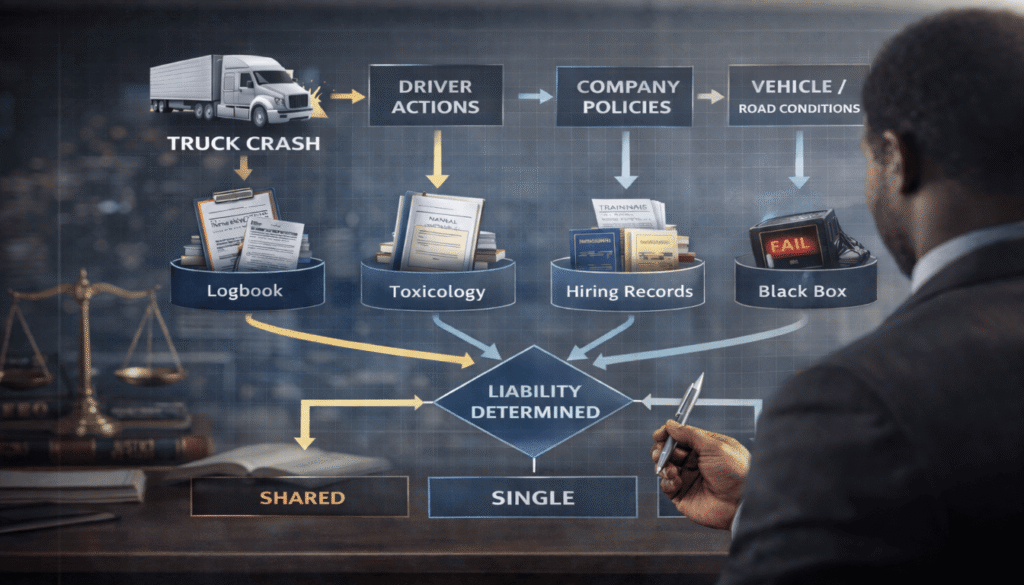
In high-stakes semi-truck cases, the court requires clear proof that links a party’s conduct directly to the harm you suffered. This process focuses on four legal elements and relies heavily on objective records that show what happened before, during, and after the crash.
The Four Elements of Negligence
To establish liability, your legal team must demonstrate:
- Duty: Showing that the driver, trucking company, or other party owed you a legal duty of care under federal regulations and common law.
- Breach: Proving they violated that duty through actions like breaking safety rules, poor hiring, or inadequate maintenance.
- Causation: Linking that specific breach directly to the accident and your injuries.
- Damages: Documenting the full extent of your harms and losses.
For a deeper breakdown of how negligence is proven in these complex lawsuits, see our guide on How to Prove Negligence in Semi‑Truck Accident Lawsuits.
Key Evidence: Black Box Data, Logbooks, and Testimony
Critical evidence often includes Electronic Logging Device (ELD) and “black box” data, which reveal speed, braking, and hours-of-service compliance. Driver logbooks and witness statements then fill in the gaps, corroborating timelines and painting a full picture of the events.
Accident Reconstruction and Expert Analysis
Reconstruction experts merge scene photos, vehicle dynamics, and electronic records to scientifically recreate the crash sequence. Their authoritative reports are essential for connecting a specific mechanical failure or human error to the collision forces and your resulting injuries.
Linking Breach to Causation and Damages
Maintenance files, pre-trip inspection reports, and driver qualification records help attribute fault to companies or service shops. An experienced lawyer coordinates evidence preservation and expert analysis to ensure each defendant’s role is clearly linked to the harms you’ve claimed. For a foundational legal overview, the Cornell Law School Legal Information Institute: Negligence explains how courts apply these elements in complex cases.
| Proof Type | What It Shows | Why It Matters |
|---|---|---|
| ELD/Black Box Data | Speed, braking, engine hours, HOS compliance | Provides objective, digital facts about truck operation |
| Maintenance Records | Repairs, missed inspections, parts history | Establishes company or maintenance vendor responsibility |
| Expert Reconstruction Report | Scientific sequence of events, causation analysis | Authoritatively ties a specific breach to the crash and your damages |
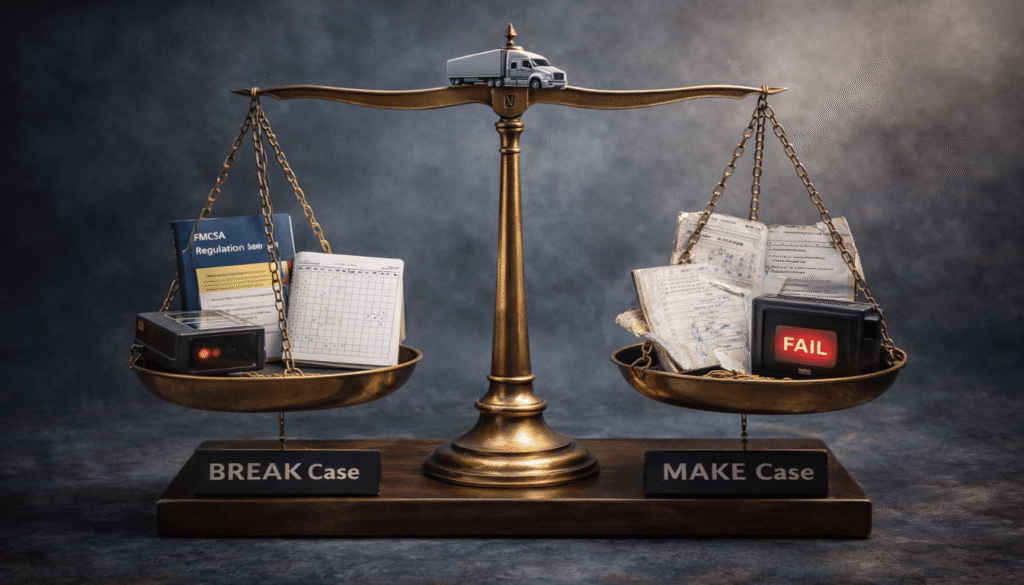
Regulations, Records, and Data That Can Make or Break Your Case
The outcome of your semi-truck accident claim often hinges on the electronic records and regulatory documents that reveal whether the trucking operation met basic safety standards. Securing and analyzing this evidence early is critical to shaping a strong legal strategy.
FMCSA Rules and Hours‑of‑Service Compliance
The Federal Motor Carrier Safety Administration (FMCSA) sets the baseline rules for driver duty and rest. A clear hours-of-service violation is powerful, direct evidence that a driver or company failed in their duty of care. Violating these mandated limits on driving time and rest is frequently a decisive factor in both settlement negotiations and at trial. Lawyers use the official FMCSA Hours‑of‑Service Regulations as the framework to prove these breaches.
Electronic Logging Devices (ELDs) and Vehicle Telematics
ELDs and onboard telematics systems record vital data like speed, braking force, location, and exact drive time. This objective electronic evidence can confirm or refute competing stories about what caused the crash. For a deeper look at how this “black box” data strengthens a claim, see our page on Evidence in Semi‑Truck Accident Cases.
Maintenance Records, Inspection Reports, and Training Files
Carriers are legally required to maintain detailed maintenance and inspection reports. Missing, incomplete, or inconsistent files can support a powerful inference of negligence against the trucking company or repair shop. By integrating ELD logs, maintenance histories, and cargo documents, your legal team can build a precise timeline that ties driver conduct and vehicle condition directly to the collision.
Key Advice: Preserve all records through legal demand as early as possible; delays can permanently lose access to decisive proof.
A comprehensive review of this data often determines whether a case settles favorably or must proceed to trial. Prompt preservation requests and coordinated expert analysis are essential to strengthen your claim and pinpoint exactly which parties breached safety rules.
| Evidence Type | What It Reveals | Strategic Importance |
|---|---|---|
| ELD/Telematics Data | Real-time speed, braking, hours-of-service compliance | Provides irrefutable, digital facts about driver behavior. |
| Maintenance & Inspection Logs | Repair history, missed inspections, parts used | Proves or disproves proper vehicle upkeep and company diligence. |
| Driver Qualification File | Training records, medical certification, past violations | Exposes failures in hiring, training, and supervision. |
Read Liability in Semi-Truck Accidents for more on the full scope of carrier and driver obligations in truck accident cases.
When Multiple Parties Share Fault In Your Semi-Truck Accident
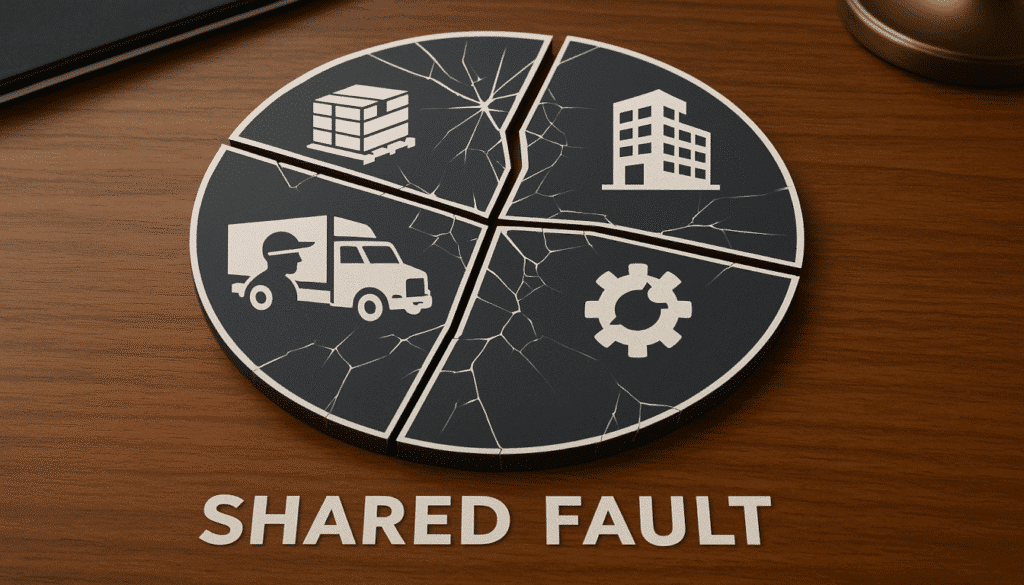
When more than one party contributes to a collision, determining how to recover full compensation becomes legally complex. The court must sort through competing claims of fault and insurance coverage to establish who is responsible for your damages.
Vicarious Liability and Employer Responsibility
A core principle known as vicarious liability holds an employer legally accountable for the negligent acts of an employee committed within the scope of their job. This means if a trucking company’s policies pressured a driver into violating hours-of-service rules, resulting in fatigue and a crash, the company can be directly sued for its corporate fault. For a deeper overview, see our page on Vicarious Liability in Semi‑Truck Accidents.
Joint and Several Liability vs. Comparative Fault
State laws differ significantly in how they handle shared fault:
- Joint and Several Liability: In some states, this rule allows you to seek the full amount of your recoverable damages from any one responsible defendant, who must then seek contribution from other at-fault parties.
- Comparative Negligence: Most states use some form of this rule, which reduces your compensation by your own percentage of fault in causing the accident. Thresholds vary; for instance, you may be barred from recovery if you are found 50% or 51% at fault, depending on the state.
These doctrines critically affect the value and strategy of your claim. For a detailed explanation of how they work in trucking cases, please review Comparative Fault in Semi‑Truck Accident Cases.
Real‑World Overlap: Driver Fatigue, Loading Errors, and Defective Parts
Crashes often result from a chain of failures. Consider an accident caused by a drowsy driver and improperly secured cargo and a defective brake part. Maintenance lapses can further shift blame toward carriers or repair shops. In such scenarios, insurers for the different at-fault parties will vigorously contest their share of fault, which can prolong negotiations and increase litigation complexity. The American Bar Association’s overview of comparative negligence provides further context on how these rules shape outcomes.
“Correctly apportioning fault among multiple defendants directly affects who pays for your losses and whether one party can seek reimbursement from others.”
Your lawyer will design a legal strategy based on your jurisdiction’s specific rules to protect your right to full recovery and press for a fair settlement when blame is shared.
| Scenario | Potentially Liable Parties | Legal Strategy Focus |
|---|---|---|
| Fatigue + Unsecured Load | Driver, Trucking Company, Cargo Loader | Prove vicarious liability and independent negligence in loading practices. |
| Maintenance Failure + Driver Error | Driver, Trucking Company, Repair Facility | Isolate the mechanical cause and breach of maintenance duty alongside driver conduct. |
| Defective Part + Company Negligence | Parts Manufacturer, Trucking Company (for failure to inspect/recall) | Pursue a product liability claim while also arguing negligent vehicle upkeep. |
How Truck Accident Lawyers Manage Multi-Party Lawsuits: A Step-by-Step Strategy
When a semi-truck accident involves multiple potentially liable parties, the legal process becomes a complex coordination challenge. A specialized truck accident lawyer follows a disciplined, step-by-step strategy to ensure no responsible party escapes accountability and that you recover maximum compensation from all available insurance policies.
Step 1: The Immediate Investigation & Evidence Lockdown
Time is the enemy. Within the first 72 hours, your lawyer’s team executes a critical evidence preservation plan:
- Sends Spoliation Letters to the trucking company, maintenance providers, cargo loaders, and data custodians demanding they preserve all evidence. This legally compels them to save black box (ECM) data, ELD logs, GPS history, maintenance records, and communications before they are overwritten or destroyed.
- Secures the Physical Scene: Dispatches investigators to photograph the scene, download data from the truck’s systems, and identify witnesses before memories fade.
- Documents Injuries: Ensures you receive a comprehensive medical evaluation to establish a baseline for your injuries.
This rapid action prevents defendants from destroying the evidence that proves their negligence.
Step 2: Identifying and Filing Against All Liable Parties
A thorough investigation reveals the full chain of responsibility. Your lawyer will identify and name all potentially liable entities in the lawsuit, which may include:
- The truck driver for immediate negligence.
- The trucking company for vicarious liability and direct negligence (e.g., poor hiring/training).
- The cargo loader/shipper for improper loading.
- The maintenance provider for negligent repairs.
- The parts manufacturer for a defective component.
Filing against all parties ensures access to multiple insurance policies and prevents defendants from shifting blame to an unnamed entity.
Step 3: Navigating Discovery and Coordinating Multiple Defendants
Once the lawsuit is filed, the “discovery” phase begins. Your lawyer manages this complex exchange of information by:
- Issuing Targeted Subpoenas and Requests: Demanding specific records from each defendant (e.g., driver logs from the carrier, loading manifests from the shipper).
- Coordinating Depositions: Scheduling and conducting depositions of drivers, company safety directors, mechanics, and corporate representatives.
- Managing “Cross-Claims”: When defendants blame each other, your lawyer ensures these internal fights don’t delay your recovery and can actually strengthen your position by highlighting systemic failures.
Step 4: Settlement Negotiations and Allocation
Most multi-party cases settle before trial. Your lawyer’s strategy here is to maximize the total recovery.
- Negotiating with Each Insurer: They engage with each defendant’s insurance company, using the evidence gathered to establish their client’s liability.
- Structuring the Settlement: They work to ensure the settlement funds are allocated correctly, covering all your damages, and navigate complex issues like Medicare/Medicaid liens to maximize your net recovery.
- Using Leverage: The strength of the evidence against one party can be used to pressure others to settle, creating a domino effect toward a global resolution.
Special Considerations for Tanker Spills & Multi-Victim Claims
These catastrophic events introduce additional layers of complexity.
- Hazardous Materials (HazMat) Regulations: Tanker spills often involve environmental damage and federal HazMat regulations, which can create additional defendants (cleanup contractors, chemical shippers) and significantly increase damages.
- Coordinating Multiple Victims: When many people are injured, your lawyer must coordinate with other victims’ counsel to ensure consistent claims and prevent defendants from “divide and conquer” tactics. This may involve multi-district litigation (MDL) or class actions.
- Government Involvement: Tanker spills often trigger immediate involvement from agencies like the EPA or DOT, whose findings can provide powerful evidence for your claim.
By following this structured approach, a specialized lawyer transforms a chaotic accident with multiple responsible parties into a coordinated legal strategy designed to secure full and fair compensation for you.
Settlement and Insurance Dynamics in Multi‑Party Semi‑Truck Accident Cases
Settlement negotiations can become stalled when multiple insurers argue over whose policy should pay first, leaving victims waiting for the compensation they need. Layered coverage, varying policy limits, and complex exclusion clauses create a challenging path to recovery. Effective legal counsel must evaluate every applicable insurance policy early and anticipate which insurer is most likely to pay.
Policy Limits and Layered Coverage in Semi‑Truck Accident Claims
Your leverage in negotiations is heavily influenced by the structure of the trucking company’s insurance. Primary policies must pay first, up to their limit. Only after that limit is exhausted will excess or umbrella coverage apply. Settlement offers are often capped by these policy limits, even when your total damages far exceed them. Furthermore, exclusions for certain cargo or punitive damages can further restrict recovery. Mapping all available coverage is essential to understanding the true potential value of your claim.

Conflicting Defenses, Longer Negotiations, and Litigation Risk
When multiple parties are at fault, their insurers often engage in tactics to shift blame and reduce their own share of the payout. These conflicting defenses can prolong negotiations for months. To preserve your rights and press for full compensation, your lawyer may need to file a lawsuit, using litigation to break the stalemate and move toward a fair resolution.
“A strong, well-documented demand package often accelerates resolution despite competing defenses.”
When insurer tactics escalate into unreasonable delays or outright wrongful denials of valid claims, victims may need to address Bad Faith Insurance Tactics in Semi‑Truck Accident Claims.
| Issue | Effect On Your Settlement |
|---|---|
| Layered Coverage | Can cause significant delays until primary policy limits are formally exhausted. |
| Conflicting Defenses | Leads to longer negotiations and a higher risk that litigation will be necessary. |
| Strong Damages Proof | Increases your leverage to demand fair compensation from all responsible parties. |
For a broader industry perspective on insurer obligations and trucking-specific coverage issues, the DAT Essential Guide to Trucking Insurance Coverage outlines policy types, limits, exclusions, and compliance factors relevant when insurers delay or deny valid claims.
Damages and Valuation in Multi‑Party Semi‑Truck Accident Cases
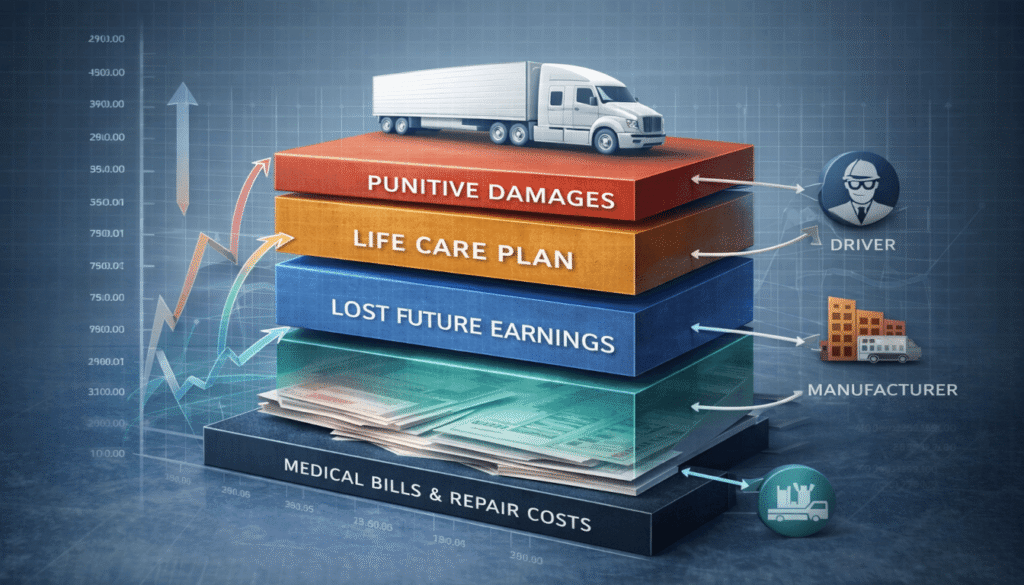
Determining fair recovery in a complex multi-party crash begins with a detailed accounting of your medical care, lost income, and projected future needs. A thorough, evidence-based valuation transforms your records and expert opinions into a precise and compelling demand for full compensation. For a deeper look at what victims can recover, see Compensation in Semi‑Truck Accident Cases.
For broader context on the insurance obligations that underpin these claims, the Federal Motor Carrier Safety Administration (FMCSA) Insurance Requirements outline minimum coverage levels and how they affect claim valuation.
Economic Losses: Medical Bills, Lost Wages, and Future Earning Capacity
Economic damages cover your tangible financial losses. This includes all immediate and ongoing medical expenses, rehabilitation, necessary medical devices, and property repair or replacement. It also encompasses lost wages from missed work and, critically, compensation for your diminished future earning capacity if your injuries prevent you from returning to your previous occupation or working at full capacity. Life care planners and vocational experts are often used to scientifically quantify these ongoing needs, making future costs clear and defensible in negotiations or at trial.
Non‑Economic and Punitive Damages
Non-economic damages compensate for the very real human toll of an accident, including pain, suffering, emotional distress, and loss of enjoyment of life. Because these impacts don’t have a direct invoice, their valuation depends on the severity of your injuries, the course of treatment, and powerful testimony about how your life has changed. Persuasive documentation and expert testimony are key to securing fair compensation for these losses.
In rare cases involving egregious misconduct or an extreme disregard for safety, punitive damages may be available. These damages are intended to punish the wrongdoer and deter similar conduct in the future. The possibility of a punitive award can significantly alter settlement dynamics, raising the stakes for defendants. For a deeper examination, see Punitive Damages in Semi‑Truck Accident Cases.
“A data-driven valuation, grounded in comprehensive records and credible experts, strengthens both negotiation leverage and trial outcomes.”
| Damage Type | Common Elements | Why It Matters |
|---|---|---|
| Economic | Medical bills, lost wages, future care costs, property damage | Documents and proves your actual, calculable financial loss. |
| Non-Economic | Pain and suffering, emotional distress, loss of enjoyment of life | Compensates for the personal, human impact beyond medical bills. |
| Punitive | Gross negligence, willful misconduct, conscious disregard for safety | Serves to punish extreme wrongdoing and deter future misconduct. |
Step‑By‑Step: What to Do After a Semi‑Truck Accident
In the immediate aftermath of a large truck crash, taking clear and timely actions is crucial to protect your health and preserve the decisive proof needed for your case. Here is a practical guide to the essential steps you should follow.
Quick Checklist
- Call 911 and Document Treatment – Ensure an official report is filed and get immediate medical attention. Keep detailed records of all visits, bills, diagnoses, and symptoms.
- Photograph the Scene and Gather Witnesses – Capture vehicle positions, damage, skid marks, road conditions, and visible injuries. Collect names and contact details from witnesses.
- Avoid Recorded Statements to Insurers – Do not provide detailed or recorded interviews to any insurance adjuster before consulting with your lawyer.
- Hire Counsel to Secure ELD and Records Fast – A lawyer can immediately send legal preservation letters to secure critical evidence like Electronic Logging Device (ELD) data, telematics, and maintenance files before they are lost.
- Track Medical Visits, Work Loss, and Expenses for Damages – Maintain a centralized file or journal to document all treatment, missed work, and accident-related costs.
For a detailed guide that expands on these steps and provides essential practical context, see What to Do After a Semi‑Truck Accident.
How an Experienced Semi‑Truck Accident Lawyer Strengthens Your Claim
A skilled lawyer transforms scattered facts into a focused legal strategy that protects your right to full recovery and drives your case forward. Taking prompt legal action is critical to securing fragile electronic records and preventing their alteration or loss. Your counsel will act immediately to send preservation demands for Electronic Logging Device (ELD) data, “black box” telematics, maintenance logs, and driver qualification files.
Identifying All Liable Parties and Preserving Critical Evidence
A lawyer experienced in trucking litigation investigates to identify every potentially responsible party—from the driver and trucking company to cargo loaders, manufacturers, or maintenance providers. They then take steps to “freeze” vital proof, collecting records, interviewing witnesses, and preserving telematics data to ensure the complete factual picture remains intact for your claim.
Managing Insurance Companies and Maximizing Compensation
Law firms with deep trucking experience negotiate from a position of strength against powerful insurance carriers. Your counsel will counter common delay tactics, present a unified theory of liability that ties all defendants to your damages, and utilize medical and vocational experts to build a compelling valuation of your losses, maximizing your potential compensation.
Preparing for Trial When Settlement Falls Short
When insurers refuse to offer a fair settlement, experienced counsel diligently prepares your case for court. Through detailed pleadings, discovery, depositions, and a clear trial strategy, they demonstrate a readiness to present your case to a jury. This thorough preparation often pressures insurers to improve their settlement offers and ensures you are ready to win at trial if necessary.
| Action | What Counsel Does | Client Benefit |
|---|---|---|
| Immediate Investigation | Secures ELD/black box data, maintenance records, and driver logs. | Protects the key evidence that proves liability, for trial or settlement. |
| Insurance Management | Handles all negotiations, counters delays, and presents a unified liability theory. | Maximizes the compensation available from all responsible parties. |
| Expert Coordination | Retains reconstruction, medical, and vocational experts. | Scientifically strengthens the case on causation and the full value of damages. |
| Litigation Readiness | Advances the case through pleadings, discovery, motions, and trial prep. | Signals seriousness to the defense, improving settlement offers or securing a trial victory. |
Most reputable firms work on a contingency fee basis, meaning you pay no upfront costs; lawyer fees are only collected if you recover compensation. This structure, combined with clear communication and dedicated legal representation, allows you to focus entirely on your recovery while your lawyer pursues the full and fair compensation you deserve.
For guidance on selecting the right advocate, see How to Choose the Best Lawyer for a Semi‑Truck Accident Case.
Building Strong Semi‑Truck Accident Lawsuits for Maximum Recovery
A successful outcome in your case hinges on strategically linking the driver’s conduct, the carrier’s practices, and the vehicle’s condition directly to the harm you suffered. Building a disciplined fact-based case ties these elements—from specific driver actions and company policies to maintenance lapses and cargo issues—clearly to your damages. Robust evidence, including ELD data, maintenance records, and training files, is essential to clarify fault among all liable parties and support the full value of your claim.
Because states apply different legal doctrines, the at-fault parties in your case may face joint and several liability or have fault allocated under comparative negligence rules. Taking swift action within your state’s statutory deadlines and setting up your claim early is crucial to preserving your rights and improving your leverage during negotiations with insurance companies. Your compensation can cover medical care, lost wages, and broader personal injury harms, with potential punitive awards in the most egregious cases.
Engaging a lawyer experienced in trucking litigation ensures your investigation and legal advocacy are aligned from day one. For a deeper look at how lawsuits progress from filing to settlement, see Semi‑Truck Accident Lawsuits Explained.
Frequently Asked Questions About Semi‑Truck Accident Claims
What Does It Mean When Multiple Parties Are Held Responsible After a Semi‑Truck Accident?
When multiple parties are held responsible for a semi‑truck accident, it means the crash was caused by a chain of failures from more than one person or company. You are not limited to a claim against just the driver.
Potentially liable parties can include:
1. The truck driver for a driving error (e.g., fatigue, distraction).
2. The trucking company for negligent hiring, training, or scheduling.
3. A cargo loading company for an improperly secured load.
4. A maintenance provider for faulty repairs.
5. A parts manufacturer for a defective component (e.g., brakes, tires).
Each party’s role is evaluated to determine their percentage of fault. This approach is crucial because it widens the sources of insurance coverage available for your recovery and can significantly strengthen the value of your claim.
Who Are the Common Defendants in Semi‑Truck Accident Injury Cases?
In your injury case, common defendants typically include:
1. The Semi-Truck Driver for direct negligence like fatigue, speeding, or distraction.
2. The Trucking Company for vicarious liability and its own negligence in hiring, training, or pressuring drivers.
3. Cargo Shippers and Loaders for improper loading, securing, or overloading.
4. Parts or Vehicle Manufacturers for defects in brakes, tires, steering, or other systems.
5. Maintenance and Repair Shops for faulty repairs or missed inspections.
6. Government Entities when hazardous road conditions, poor design, or malfunctioning signals contributed to the crash.
Identifying all potential defendants is a critical step, as it expands the sources of insurance coverage and liability, strengthening your path to full compensation for your injuries.
How Do Lawyers Prove Negligence in Semi‑Truck Accident Cases?
Lawyers prove negligence by establishing four legal elements and supporting them with specific evidence:
1. Duty: Showing the defendant had a responsibility to act safely.
2. Breach: Proving they failed in that duty (e.g., a fatigued driver, poor maintenance).
3. Causation: Linking that failure directly to the crash.
4. Damages: Documenting the resulting injuries and losses.
Key evidence used includes:
A. Electronic logs (ELD) and “black box” data.
B. Maintenance and inspection records.
C. Driver training files and witness statements.
D. Expert accident reconstruction reports.
This structured approach ties specific violations directly to the harm suffered in the accident.
What Role Does Electronic Data Play in Semi‑Truck Accident Investigations?
Electronic data serves as the objective, digital witness in your investigation. Devices like Electronic Logging Devices (ELDs), telematics systems, and “black box” event data recorders capture crucial facts about the truck’s operation in the moments before, during, and after the crash.
This data is pivotal because it can:
1. Prove Hours-of-Service violations, demonstrating driver fatigue.1.
2. Show exact speed, hard braking, and sudden maneuvers.
3. Confirm or refute the driver’s version of events.
4. Reveal patterns of unsafe driving or company pressure to violate rules.
By providing an unalterable record, this electronic evidence is often the most powerful tool for establishing fault and proving violations of Federal Motor Carrier Safety Administration (FMCSA) regulations in your semi‑truck accident case.
Can a Maintenance Provider or Parts Maker Be Responsible for a Semi‑Truck Accident?
Yes. A repair shop or parts manufacturer can be held legally responsible if their negligence or a defective product contributed to the crash. Liability can arise from:
1. A maintenance provider who performed negligent repairs, failed to fix known issues, or missed critical defects during an inspection.
2. A parts manufacturer that produced a defective component—such as brakes, tires, steering systems, or axles—that failed and caused or worsened the accident.
These parties can be named in your lawsuit alongside the driver and trucking company. Determining their responsibility often hinges on evidence like maintenance records, shop work orders, and expert analysis of the failed part. Holding them accountable is crucial, as it expands the sources of compensation available for your recovery.
How Does Shared Fault Affect Compensation in Semi‑Truck Accident Claims?
Shared fault directly impacts your financial recovery through legal principles that allocate responsibility. The two key doctrines are:
1. Comparative Negligence: If you are found partially at fault, your total compensation is reduced by your percentage of blame. For example, if you are 20% at fault in a $100,000 case, you would recover $80,000.
2. Joint and Several Liability: In some states, you can recover the full value of your claim from any one responsible party, even if they were only partially at fault. This is crucial if other at-fault parties have insufficient insurance.
These rules make accurately determining and proving fault percentages essential to maximizing your compensation in a multi-party truck accident case.
Why Do Semi‑Truck Accident Cases With Several Defendants Take Longer to Resolve?
Your case takes longer because each additional defendant introduces more complexity and strategic delays, including:
1. Multiple Insurers: Each defendant has its own insurance carrier, all negotiating to minimize their own payout.
2. Competing Defenses: Parties often blame each other, requiring extensive investigation to disprove shifting allegations.
3. Extended Discovery: More parties mean more depositions, document requests, and expert examinations.
4. Coordinated Delays: One defendant’s motions or requests can stall progress for everyone involved.
This multi-party process requires meticulous coordination to build a unified case against all responsible entities, inevitably extending the timeline before a fair settlement or trial.
What Damages Can Victims Pursue in Semi‑Truck Accident Claims?
Victims can pursue three primary categories of compensation to recover their losses:
1. Economic Damages: For verifiable financial losses, including medical expenses (past and future), rehabilitation costs, lost wages, loss of future earning capacity, and property damage.
2. Non-Economic Damages: For the personal and human impact, including pain and suffering, emotional distress, loss of enjoyment of life, and loss of consortium.
3. Punitive Damages: In rare cases involving egregious or reckless misconduct, these damages may be awarded to punish the wrongdoer and deter similar behavior in the future.
A thorough claim accounts for all past, present, and future impacts of the accident to ensure full and fair compensation.
What Immediate Steps Should You Take After a Semi‑Truck Accident?
To protect your health and your legal rights, take these critical steps immediately:
1. Seek Medical Attention: Get a full evaluation, even if you feel fine. Some injuries have delayed symptoms, and medical records are vital evidence.
2. Document Everything: Take photos of the scene, vehicle damage, road conditions, and visible injuries. Collect contact information from all witnesses.
3. Preserve Evidence: Keep your vehicle as-is and do not discuss fault or give a recorded statement to any insurance adjuster.
4. Contact a Specialized Lawyer: Consult with a semi‑truck accident lawyer immediately to handle insurance communications, secure critical data, and ensure all legal deadlines are met.
These actions help build the strongest possible foundation for your injury and compensation claim.
How Does an Experienced Semi‑Truck Accident Lawyer Improve Your Claim?
An experienced lawyer strengthens your claim by applying specialized knowledge and resources to build a powerful case, including:
1. Conducting a Comprehensive Investigation: Identifying all potentially liable parties—not just the driver—and immediately securing critical evidence like electronic log data, maintenance records, and black box information.
2. Employing Expert Analysis: Hiring accident reconstructionists, medical experts, and economists to scientifically prove causation and validate the full value of your damages.
3. Navigating Complex Negotiations: Dealing strategically with multiple insurance companies and their adjusters to counter lowball offers and bad-faith tactics.
4. Ensuring Trial Readiness: Preparing your case thoroughly for litigation, which increases leverage in settlement talks and ensures you are ready to win at trial if necessary.
This strategic approach maximizes your compensation and protects your rights throughout the legal process.
Resources for Victims of Semi-Truck Accidents
For further information on trucking regulations and safety, visit:
- Federal Motor Carrier Safety Administration (FMCSA): Official resource on federal trucking laws.
- National Highway Traffic Safety Administration (NHTSA): Provides data on vehicle safety and accident prevention.
- Occupational Safety and Health Administration (OSHA): Offers insights into workplace safety, including trucking.
These authoritative resources provide valuable information without bias, helping victims understand their rights and the regulatory environment surrounding their case.
Disclaimer: The information provided in this article is for general informational purposes only and does not constitute legal advice. While we strive to ensure the accuracy and reliability of the content, laws and regulations may vary by state, and individual cases may have unique circumstances. For advice tailored to your specific situation, please consult a qualified lawyer. The inclusion of links to external resources does not imply endorsement or guarantee of the information provided therein.
Related Articles
- Punitive Damages in Semi-Truck Accident Cases: When Are They Awarded?
- The Differences Between Trucking Accidents and Regular Car Accidents
- Navigating Multi-Party Lawsuits in Semi-Truck Accidents
- Insurance Company Tactics to Watch Out for in Trucking Accident Cases
- Who Can Be Held Responsible in a Semi-Truck Accident Case?
More from This Category
- How to Prove Negligence in Semi-Truck Accident Lawsuits
- What You Need to Know About the Statute of Limitations for Truck Accident Cases
- Top Reasons Semi-Truck Accident Claims Are Denied and How to Fight Back
- The Importance of Evidence in Semi-Truck Accident Claims: Building a Strong Case
- How Comparative Fault Affects Semi-Truck Accident Settlements and Compensation
Additional Resources
- Understanding Vicarious Liability in Trucking Accidents
- How Federal Trucking Regulations Impact Your Semi-Truck Accident Case
- FAQs for Semi-Truck Accident Victims: Answers to Your Most Pressing Questions