

Punitive damages in semi‑truck accident cases raise a sharp question: when does conduct cross the line from careless to punishable?
Because of their size and weight, semi‑trucks make collisions uniquely severe. Courts may look beyond medical bills to punish outrageous or reckless conduct by drivers or carriers. The Illinois Department of Transportation reported 11,922 tractor‑trailer crashes in 2022, including 138 fatalities, underscoring why scrutiny of trucking behavior matters.
This guide explains what victims must prove — such as conscious disregard for safety or corporate ratification of misconduct — and how federal rules like the FMCSR (Federal Motor Carrier Safety Regulations) shape liability. Readers will see practical examples of willful violations that can push a case toward punitive damages, along with strategies for evidence preservation and proving reprehensibility.
For a focused legal overview of recoverable damages, see Compensation in Semi‑Truck Accident Cases.
Key Takeaways
- What They Are: Exceptional awards meant to punish and deter egregious conduct.
- What To Prove: Outrageous behavior, conscious disregard, or company policies that ratify risky acts.
- Why Trucks Matter: Severity from size and weight raises scrutiny of conduct and safety records.
- Evidence Tips: Preserve logs, inspection records, and witness accounts early.
- Legal Framework: FMCSR rules and state law limits affect how claims proceed.
Punitive Damages in Semi‑Truck Accident Cases: Key Concepts and Context
When driver or carrier behavior crosses from careless to flagrantly unsafe, courts may impose punitive damages. According to the Cornell Law School Legal Information Institute’s overview of punitive damages, these awards are reserved for conduct that shows clear indifference to public safety, making them rare but powerful in semi‑truck accident cases.
Why Punitive Damages Exist and When They Matter
- Purpose: Punitive damages punish outrageous acts and deter future harm. Examples include DUI, extreme speeding, willful regulatory violations, and company policies that pressure unsafe schedules.
- Timing: Some jurisdictions, like Ohio, wait to consider punitive damages until after fact‑finders set compensatory amounts. California requires proof of fraud, malice, or oppression by clear and convincing evidence.
- When They Matter: They arise in crashes tied to texting, DUI, falsified driver logs, or willful safety rule violations.
- Company Role: A carrier’s policies can elevate an individual’s act into corporate culpability.
- Practical Effect: Strong evidence of egregious conduct can change settlement negotiations early in a case.
Victims should know these awards are rare and require a heightened showing. Because trucking operations magnify risk due to vehicle mass and momentum, courts view extreme behavior with special concern. For more on how evidence strengthens liability, see Evidence in Semi‑Truck Accident Cases.
Semi‑Truck Accident Punitive vs. Compensatory Damages: What’s the Difference?
Compensation after a semi‑truck accident often spans clear medical bills and harder‑to‑value losses tied to long‑term recovery. As ConsumerSafety explains, compensatory damages are designed to make victims whole, while punitive damages punish reckless or willful misconduct and deter future violations.

Economic and Non‑Economic Compensation After a Semi‑Truck Accident
- Economic compensation covers measurable losses: emergency care, surgeries, rehabilitation, lost wages, and property repair. These are documented with bills, pay records, and receipts.
- Non‑economic compensation addresses pain and suffering, loss of enjoyment, and emotional harm. These require narrative evidence, testimony, and corroborating medical notes.
- In severe collisions, injuries can be catastrophic and extend to vocational limits. Claimants often document ongoing therapy and altered work capacity to quantify total compensation.
How Punitive Damages Punish and Deter Egregious Conduct
By contrast, punitive damages in semi‑truck accident cases are not tied to a plaintiff’s financial loss. Courts evaluate the defendant’s mindset, prior violations, and whether conduct showed conscious disregard for safety. Even where compensation is high, an additional punitive award requires a heightened legal showing focused on misconduct.
For more detail on recoverable damages, see Economic and Non‑Economic Damages in Semi‑Truck Accidents.
| Feature | Compensatory | Punitive | Evidence Needed |
|---|---|---|---|
| Primary Purpose | Make the victim whole | Punish and deter misconduct | Bills, testimony, records vs. proof of recklessness |
| Measures | Medical costs, lost wages, pain | Not tied to loss amount | Itemized expenses vs. corporate policies, prior violations |
| Typical Outcome | Reimbursement and support | Additional penalty on defendant | Receipts, expert reports, compliance audits |
| Standard of Proof | Preponderance of evidence | Higher standard (varies by state) | Medical records vs. clear and convincing proof |
Legal Standards for Punitive Damages in Semi‑Truck Accident Lawsuits
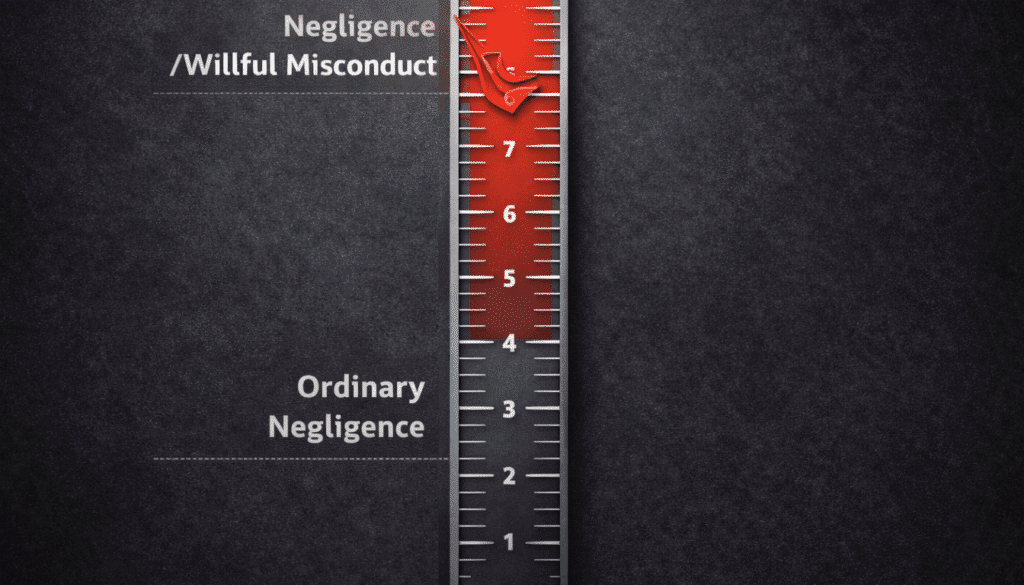
Courts treat extreme operator or carrier misconduct differently when it shows a conscious choice to ignore safety. As Investopedia explains, punitive damages are awarded only when conduct rises above ordinary negligence, requiring proof of recklessness, malice, or willful disregard for safety. This section outlines how mental state, proof standards, and regulatory breaches elevate a claim from ordinary compensation to an enhanced remedy.
Recklessness, Malice, and Willful Misconduct Explained
- Recklessness involves a known risk the actor chose to ignore.
- Malice and willful acts imply a deliberate or flagrant disregard for safety.
Courts often look at patterns of prior violations and company policies to decide whether such conduct justifies extra penalties.
Clear and Convincing Evidence and Bifurcated Trials
Many states require a higher proof level, often called clear and convincing evidence, before an enhanced award is allowed. Judges may order a bifurcated trial: one phase covers liability and compensation, while the second determines punitive damages and reviews the defendant’s ability to pay.
Regulatory Violations Under FMCSR and State Laws
The Federal Motor Carrier Safety Regulations (FMCSR) set minimum standards for interstate trucking on training, records, inspection, repair, maintenance, and hours of service. Illinois follows FMCSR; California requires proof of fraud, malice, or oppression; Ohio focuses on reckless or intentional behavior after compensatory awards.
Willful log falsification, service and maintenance lapses, or hours‑of‑service abuses can show conscious disregard and strengthen a case. Courts then test the nexus between the breach and the crash and apply proportionality and due process safeguards.
For more on how federal rules shape liability, see How Federal Trucking Regulations Affect Semi‑Truck Accident Cases.
What Victims Must Prove to Win Punitive Damages in Semi‑Truck Accident Claims
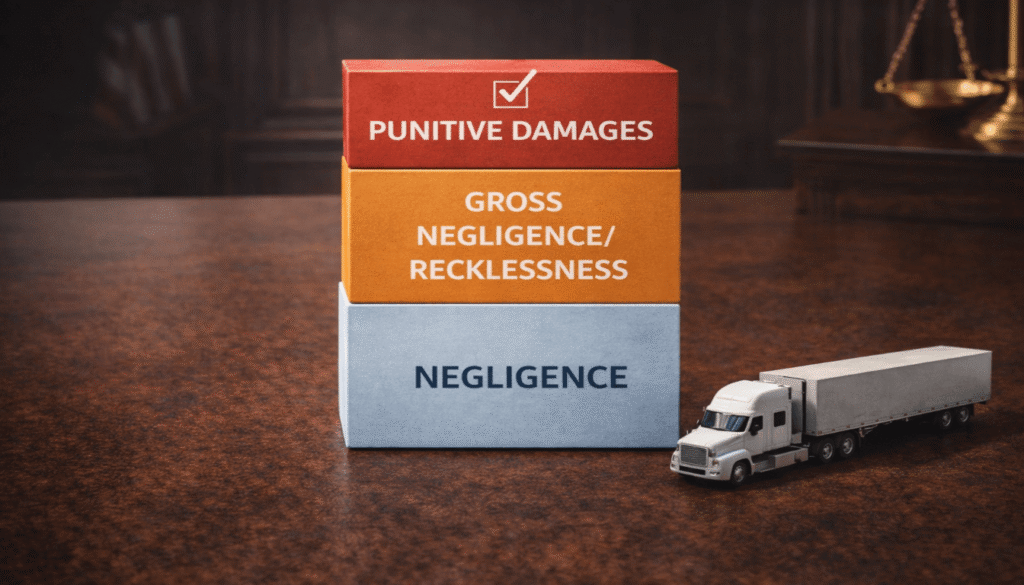
To obtain an enhanced award, a plaintiff must tie blatant misconduct directly to the crash through clear, targeted proof. As the Ninth Circuit Jury Instructions on punitive damages explain, courts focus on three elements: a causal link, proof of conscious disregard, and corporate fault or ratification.
Linking Outrageous Conduct To The Crash
Plaintiffs must show how the driver’s or company’s conduct caused the accident. Logs, telematics, and eyewitness testimony are vital. Judges look for a direct chain from the unsafe choice to the collision and resulting losses.
Showing Conscious Disregard for Safety
Victims must demonstrate the actor knew of a risk—fatigue, brake defects, or alcohol use—and acted anyway. Proof may include prior violations, training gaps, or dispatch orders that pressured unsafe behavior.
Demonstrating Corporate Knowledge or Ratification
Internal emails, safety score histories, and complaints can show the company knew about hazards. Evidence that management endorsed or ignored the conduct strengthens liability and the odds of an enhanced award.
Connecting Defendant’s Conduct to Your Specific Damages
Plaintiffs must tie the defendant’s choices to medical bills, lost income, and pain. Early preservation of records prevents spoliation and helps the court assess both fault and remedy.
| Proof Area | Key Documents | What It Shows |
|---|---|---|
| Driver Behavior | Logs, telematics, citations | Reckless speed, HOS violations |
| Company Role | Emails, policies, safety scores | Knowledge or ratification |
| Link To Harm | Medical records, wage records | Direct causation of losses |
For more on how liability is established, see Employer vs Driver Liability in Semi‑Truck Accidents.
Common Semi‑Truck Accident Scenarios That Lead to Punitive Damages
Certain recurring fact patterns often push conduct past ordinary negligence and into behavior courts view as reckless. As the Federal Motor Carrier Safety Administration (FMCSA) notes, violations of safety rules such as hours‑of‑service abuses or impaired driving are among the most serious red flags that can elevate liability into punitive territory.

DUI, Texting, and Extreme Speeding by a Truck Driver
Alcohol or drug impairment, texting while driving, and excessive speed are frequent catalysts for harsh penalties. A truck driver who trades safety for haste creates a clear narrative of conscious risk.
Hours‑of‑Service Abuse, Fatigue, and Logbook Manipulation
Falsifying logs or pressuring a driver to exceed legal hours of service shows intentional evasion of safety rules. Evidence of extended shifts, fabricated records, or dispatch pressure often indicates planning rather than simple error.
Negligent Maintenance and Knowing Use of Unsafe Equipment
Operating with defective brakes, bald tires, or ignored inspection warnings signals a disregard for safety. Such choices link directly to serious accidents and strengthen claims where the operator or owner kept unsafe equipment active. Investigators should probe maintenance logs and the vehicle’s safety history.
Trucking Company Policies That Prioritize Profit Over Safety
Companies that reward speed, ignore repeated violations, or hire underqualified drivers expose themselves to heightened liability. Internal incentives and ignored complaints can show corporate ratification of risky behavior.
Look for Patterns: Repeated violations often outweigh isolated mistakes.
Document Pressure: Records showing unrealistic delivery windows matter.
Explore History: Prior citations or complaints that were ignored strengthen claims.
| Fact Pattern | Common Proof | Why It Matters |
|---|---|---|
| Impaired Driving | Toxicology, witness statements | Shows conscious risk taking |
| Hours Violations | Logs, ELD data | Demonstrates willful rule evasion |
| Maintenance Failures | Repair records, inspections | Proves known equipment hazards |
| Corporate Pressure | Emails, pay policies | Links conduct to company decisions |
Explore more on liability issues in Multi‑Party Liability in Semi‑Truck Accidents.
Evidence and Investigation Strategies to Strengthen Punitive Damage Claims in Semi‑Truck Accidents
Prompt, methodical investigation turns scattered facts into a coherent narrative for court. Early action preserves raw data that often disappears after a truck accident. As the FMCSA Regulations emphasizes, compliance records and safety data are critical in proving violations that may justify punitive damages.

Securing Black Box Data, Driver Logs, And Maintenance Records
Securing Black Box Data, Driver Logs, and Maintenance Records
- Preserve ECM/black box files, ELD logs, and dispatch communications immediately. These records show speed, braking, and hours of service.
- Request maintenance files and parts purchase records to link defects to the crash.
- Compare logbooks to fuel receipts and toll data to spot falsification.
Capturing Scene Evidence: Photos, Video, and Police Reports
- Document skid marks, debris, and vehicle positions with timestamped photos and video.
- Collect police reports and witness statements before memories fade.
- Canvass for nearby surveillance or dashcam footage to corroborate timelines and speeds.
Using Experts: Accident Reconstruction and Regulatory Compliance
- Accident reconstructionists recreate the event and estimate speeds and impact.
- FMCSR compliance experts map breaches of federal regulations to operator conduct.
- Attorneys coordinate subpoenas, expert work, and depositions to align technical proof with legal standards.
Building a History: Prior Violations, Complaints, and Safety Scores
- Compile inspection results, prior violations, and complaint logs to show a pattern.
- Safety scores and audit reports often reveal systemic problems at a company.
- Issue preservation letters quickly; trucking firms may deploy rapid‑response teams to control evidence after a crash.
| Item | Source | What It Shows |
|---|---|---|
| ECM / Black Box | Carrier, OEM | Speed, braking, engine data |
| ELD / Logs | Driver, fleet | Hours, possible falsification |
| Maintenance Records | Shop invoices, parts receipts | Known defects, repair history |
| Scene Media | Photos, surveillance, police report | Road marks, damage, timeline |
| Regulatory History | FMCSA, inspection reports | Prior violations, safety score trends |
For more on preserving critical records, see Preserving Evidence in Semi‑Truck Accident Cases.
How Courts Award and Limit Punitive Damages in Semi‑Truck Accident Cases
Courts weigh extra remedies only after close scrutiny of conduct and a clear record tying misconduct to the harm. As the U.S. Supreme Court has outlined in BMW of North America, Inc. v. Gore, punitive damages must meet constitutional guideposts such as proportionality, reprehensibility, and the relationship between the award and actual harm. Judges control legal thresholds while juries often assess blameworthy behavior and the need for deterrence.
When Punitive Damages Are Considered And By Whom
Process: Courts commonly wait until juries set compensatory awards before considering enhanced relief. Judges then review whether the evidence meets the higher legal standard.
- Fact-finders evaluate reprehensibility, intent, and the nexus to the crash.
- Trial courts may order a separate phase to decide on extra awards and the defendant’s ability to pay.
- Appellate courts review excessiveness and legal guideposts like proportionality.

State-Specific Rules, Caps, And Financial-Condition Review
Across the United States, courts apply constitutional guideposts to ensure punitive damages remain proportionate and fair. Judges and appellate courts review awards for excessiveness, due process, and deterrence value, while juries weigh the defendant’s conduct and intent.
States vary in how they apply these principles:
- California requires clear and convincing proof and considers deterrence alongside the defendant’s financial resources.
- Ohio often reviews punitive damages only after compensatory sums are set and may impose statutory caps.
- Illinois allows enhanced relief for egregious conduct and considers breaches of federal trucking regulations (FMCSR).
- Texas and Florida provide additional examples, with statutory limits or heightened standards depending on the severity of misconduct.
By presenting these differences as illustrations of broader nationwide practice, victims and families can see how courts balance punishment, deterrence, and fairness across jurisdictions.
For a deeper look at how liability frameworks intersect with damages, see Legal Liability in Semi‑Truck Accidents.
Building a Strong Punitive Damages Claim After a Semi‑Truck Accident
Acting quickly after a serious truck crash gives victims the best chance to preserve evidence and shape a strong, strategic claim. Preserve ECM data, driver logs, and maintenance records immediately, and document medical care from day one to link injuries directly to the event.
An experienced truck accident attorney coordinates experts, meets critical deadlines, and builds a timeline of the vehicle, driver choices, and dispatch pressure. Targeting proof of reckless driving and company policies that enabled it strengthens exposure to enhanced awards.
For a detailed legal overview on pursuing enhanced relief, see Compensation in Semi‑Truck Accident Cases.
Prompt consultation preserves rights, protects compensation potential, and positions victims to hold drivers and companies accountable.
Frequently Asked Questions About Punitive Damages in Semi‑Truck Accident Cases
What must a victim prove to obtain punitive relief after a semi‑truck accident?
Victims must show the defendant acted with extreme disregard for safety — such as knowingly breaking hours‑of‑service rules, driving a semi‑truck while drunk, or hiding mechanical defects — and that this misconduct directly caused the semi‑truck accident. Courts require evidence beyond simple negligence, demonstrating conscious indifference.
How does punitive relief differ from compensation for medical bills and lost wages after a semi‑truck accident?
Compensatory awards cover tangible losses like medical care, rehabilitation, lost income, and pain and suffering. Punitive relief serves a different purpose: it punishes and deters egregious behavior by the semi‑truck driver or trucking company rather than reimbursing the victim.
What level of proof do courts demand for punitive awards in semi‑truck accident cases?
Most jurisdictions require clear and convincing evidence to justify punitive measures. This higher standard often leads to a separate hearing or bifurcated trial to evaluate culpability before deciding on additional penalties.
Can regulatory violations under FMCSA rules support a punitive claim in a semi‑truck accident?
Yes. Violations of Federal Motor Carrier Safety Administration (FMCSA) standards — such as hours‑of‑service breaches, falsified logs, or inadequate maintenance — can show conscious disregard for safety and bolster a request for punitive relief when tied to the semi‑truck accident.
What types of semi‑truck driver conduct most often trigger punitive consideration?
Severe misconduct includes driving a semi‑truck under the influence, texting while operating a large truck, extreme speeding, and deliberate log falsification. Repeated or willful violations that created foreseeable risk to others are central to these claims.
How can plaintiffs tie a trucking company to a semi‑truck driver’s reckless actions?
Plaintiffs must show the company knew of dangerous practices, ratified the conduct, or maintained policies that prioritized deliveries over safety. Evidence may include incentive pay structures, ignored complaints, prior violations, and training records.
What evidence do lawyers collect to strengthen punitive allegations in semi‑truck accident cases?
Counsel pursues event data recorder downloads, driver logs, maintenance files, black box records, CCTV or dashcam footage, witness statements, and police reports. Experts in reconstruction and regulatory compliance then connect that evidence to the company’s safety culture.
How do prior violations and safety scores affect a semi‑truck accident claimant’s case?
A history of citations, poor safety ratings, or unresolved complaints helps establish a pattern of disregard. Regulators’ inspections and prior enforcement actions can show corporate knowledge and support requests for extra penalties.
Are there limits or caps on punitive awards in semi‑truck accident lawsuits?
Many states impose statutory caps or constitutional limits on excessive penalties. Courts also consider the trucking company’s financial condition and proportionality to the harm. Local rules vary, so outcomes depend on state law and judicial discretion.
Who decides whether to award punitive relief in semi‑truck accident cases — judge or jury?
Either can decide, depending on jurisdiction and case procedure. Juries commonly make the factual finding of egregious conduct, while judges may rule on legal sufficiency, apply caps, and oversee bifurcated proceedings.
How soon should a victim consult an attorney about seeking punitive sanctions after a semi‑truck accident?
Early consultation is crucial. Preserving evidence like logs, electronic data, and maintenance records is time‑sensitive. An experienced semi‑truck accident lawyer will act quickly to secure vital materials and plan an investigation.
Can settlements include punitive‑type compensation in semi‑truck accident cases without a formal award?
Yes. Defendants may agree to higher settlements to avoid a punitive finding at trial. These negotiated amounts can reflect punishment and deterrence even when no court‑issued penalty occurs.
What role do experts play in proving willful misconduct or conscious disregard in semi‑truck accident claims?
Specialists in accident reconstruction, human factors, trucking operations, and regulatory compliance translate technical records into clear proof of dangerous conduct. Their testimony links the defendant’s choices to the semi‑truck accident and measurable harm.
Can a victim claim punitive measures against leased semi‑truck drivers or independent contractors?
Yes, but the claimant must show the hiring carrier exercised control, knew about risky behavior, or ratified misconduct. Liability theories focus on agency, vicarious responsibility, and corporate policies that permitted the danger.
Resources for Victims
For more information on trucking safety and regulations, visit these authoritative resources:
- Federal Motor Carrier Safety Administration (FMCSA): A comprehensive guide to federal trucking laws and safety regulations.
- National Highway Traffic Safety Administration (NHTSA): Insights into vehicle safety and accident prevention.
- Occupational Safety and Health Administration (OSHA): Information on workplace safety standards, including trucking.
Disclaimer: The information provided in this article is for general informational purposes only and does not constitute legal advice. While we strive to ensure the accuracy and reliability of the content, laws and regulations may vary by state, and individual cases may have unique circumstances. For advice tailored to your specific situation, please consult a qualified attorney. The inclusion of links to external resources does not imply endorsement or guarantee of the information provided therein.
Related Articles
- Punitive Damages in Semi-Truck Accident Cases: When Are They Awarded?
- The Differences Between Trucking Accidents and Regular Car Accidents
- Navigating Multi-Party Lawsuits in Semi-Truck Accidents
- Insurance Company Tactics to Watch Out for in Trucking Accident Cases
- Who Can Be Held Responsible in a Semi-Truck Accident Case?
More from This Category
- How to Prove Negligence in Semi-Truck Accident Lawsuits
- What You Need to Know About the Statute of Limitations for Truck Accident Cases
- Top Reasons Semi-Truck Accident Claims Are Denied and How to Fight Back
- The Importance of Evidence in Semi-Truck Accident Claims: Building a Strong Case
- How Comparative Fault Affects Semi-Truck Accident Settlements and Compensation
Additional Resources
- Understanding Vicarious Liability in Trucking Accidents
- How Federal Trucking Regulations Impact Your Semi-Truck Accident Case
- FAQs for Semi-Truck Accident Victims: Answers to Your Most Pressing Questions