
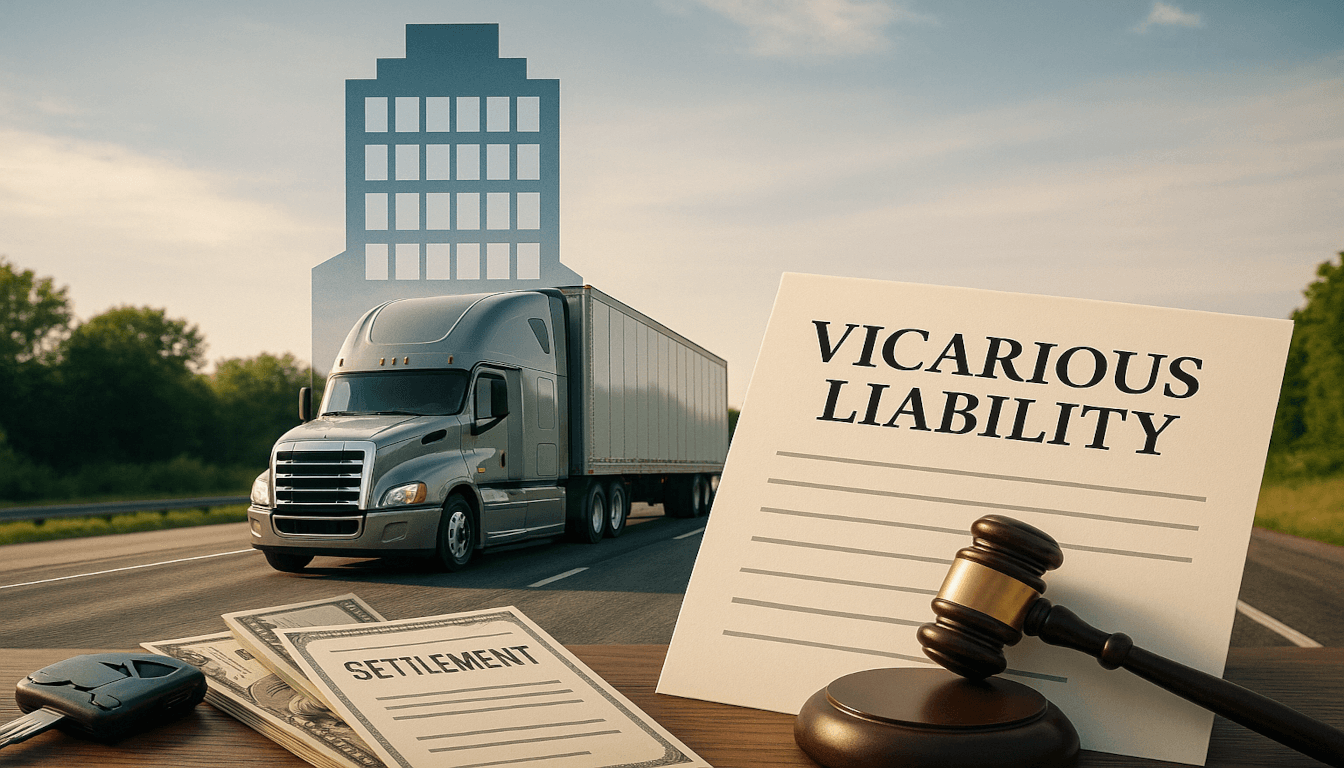
After a devastating crash with a semi-truck, a critical question will determine your financial recovery: Can you hold the trucking company responsible, not just the driver?
The answer is often yes. Understanding vicarious liability—the legal rule that makes a company liable for its employee’s actions—can be the key to securing the full compensation you need for medical bills, lost income, and your suffering. This is crucial because a corporation’s insurance coverage is typically far greater than an individual driver’s.
But a company can also be directly negligent for its own reckless decisions: hiring an unsafe driver, failing to provide proper training, ignoring maintenance, or pressuring drivers to violate safety laws. Proving these failures requires specific evidence and an understanding of complex federal regulations.
This guide explains how vicarious liability works, what evidence proves a company’s fault, and how this legal strategy can significantly increase your potential recovery. You will learn about the roles of electronic data (like black boxes and driver logs), how major delivery networks (like Amazon and FedEx) can be held accountable, and the immediate steps you must take to protect your claim.
For a broader overview of the legal process, see our guide: Semi-Truck Accident Law Explained.
Key Takeaways: Vicarious Liability in Semi‑Truck Accidents
- Holding a trucking company accountable can increase available compensation after a Semi‑Truck Accident.
- A company may be legally responsible when a driver causes a crash while performing work duties.
- Negligence is established by proving duty, breach, causation, and damages with clear evidence.
- Multiple parties—such as brokers, loaders, or manufacturers—may also share liability.
- FMCSA compliance failures often strengthen claims against carriers and motor carriers.
- Preserving electronic data and records early is crucial to protect a personal injury claim.
Understanding Vicarious Liability In Semi-Truck Accident Cases
If a truck driver causes an accident while performing their job, the law can hold their employer—the trucking company—financially responsible for your injuries. This legal rule, called vicarious liability, is a powerful tool for victims, as it allows you to seek compensation from the company, which typically has much deeper insurance coverage than an individual driver.
What Vicarious Liability Means for Your Truck Accident Claim
Vicarious liability (often called respondeat superior) means that an employer is liable for the negligent acts an employee commits “within the scope of their employment.” In practical terms:
- If the driver was making a delivery, following a dispatch order, or performing any task that benefited the trucking company at the time of the crash, the company can be held liable.
- This does not require you to prove the company did anything wrong directly. You only need to prove the driver was negligent and was acting as an employee.
Why Proving Vicarious Liability is Critical to Your Recovery
Pursuing a claim against the trucking company is not just a legal tactic—it’s often the only way to secure full compensation. Here’s why:
- Access to Larger Insurance Pools: Trucking companies carry commercial liability insurance policies with limits in the millions of dollars, far exceeding a driver’s personal coverage.
- Targets Deep Pockets: A corporation has more assets to pay a substantial settlement or verdict.
- Uncovers Systemic Negligence: Investigating the company often reveals separate, direct negligence—like poor hiring, inadequate training, or forcing drivers to violate safety rules—which can further increase the value of your case.
How Trucking Companies Try to Avoid Vicarious Liability
Companies will often argue the driver was not acting within the “scope of employment.” They may claim the driver was:
- On a personal errand (“frolic”).
- Significantly deviated from their assigned route.
- An independent contractor, not an employee.
Your lawyer will counter these defenses with evidence like dispatch logs, GPS data, and employment contracts to prove the driver was, in fact, working for the company’s benefit.
Your Next Step: Vicarious liability is one part of a broader liability strategy. For a complete overview of all parties who can be held responsible in a truck accident, read our guide: Legal Liability in Semi‑Truck Accidents.
How State Laws Affect Vicarious Liability Claims
While the core principle of vicarious liability applies across the United States, the specific legal path to proving it—and the ease with which you can hold a trucking company responsible—varies significantly from state to state. Understanding these differences is crucial, as they can directly impact the strategy and strength of your claim.
Two primary areas where state law comes into play are:
1. The “Scope of Employment” Test
Each state uses its own legal standard to determine if a driver was acting within the scope of their job during the accident. Key variations include:
- The “Coming and Going” Rule: Many states do not hold employers liable for accidents that occur during a driver’s ordinary commute to and from work. However, if the driver was already on a delivery run or under dispatch, the company is likely liable.
- Minor Detours: A personal errand (a “frolic”) may break the scope of employment, but a slight deviation from a route (a “detour”) may not. States differ in how they draw this line.
- Example: California applies a broad respondeat superior doctrine that often favors finding the driver was within the scope of employment. Texas, by contrast, uses a more detailed “right to control” test, requiring a closer look at what the driver was specifically doing for the company at the moment of the crash.
2. Statutory Employer & “Borrowed Servant” Laws
Some states have laws that simplify holding a company liable.
- Statutory Employer Laws: In certain states, a trucking company is automatically considered the legal “employer” of any driver operating under its authority, even if that driver is technically an independent contractor or leased from another company.
- Non-Delegable Duty: Some states impose a “non-delegable duty” on motor carriers for safety, meaning they cannot escape liability by claiming the driver was an independent contractor.
Your Key Takeaway: The fundamental rule—that a negligent driver’s company can be financially responsible—is universal. However, the evidence needed and the legal arguments required to win your case are dictated by the laws of the state where the accident occurred.
Always consult with a truck accident lawyer licensed in that state. They will know the precise tests, precedents, and procedures that apply to your claim.
The Legal Framework: Respondeat Superior, Direct Negligence, And FMCSA Duties
To hold a trucking company liable, your lawyer will build a case using two powerful legal theories: vicarious liability (respondeat superior) and direct negligence. Understanding how these work together, along with federal safety rules, is key to maximizing your recovery.
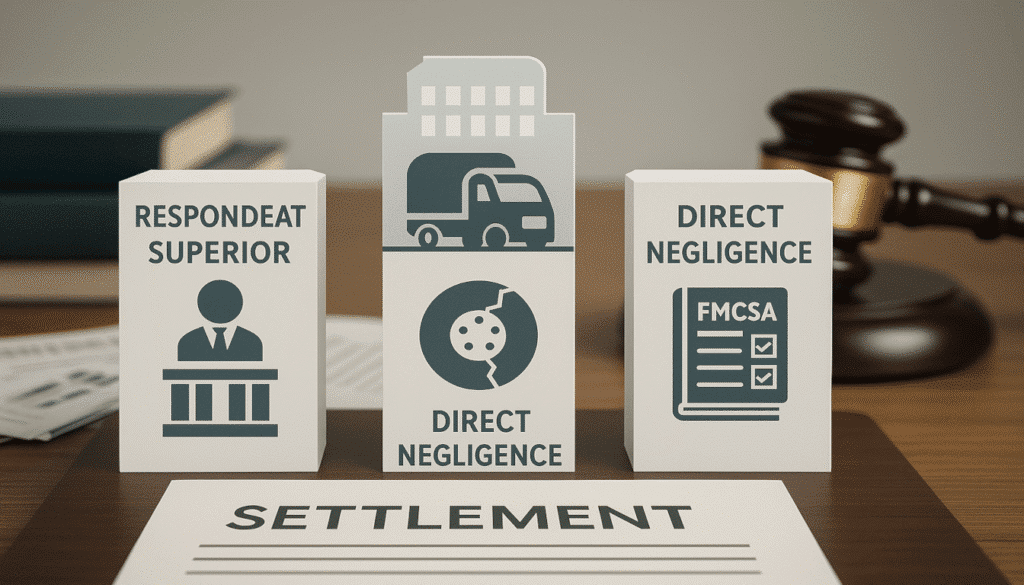
Respondeat Superior: Employer Responsibility for Driver Conduct
This is the legal term for vicarious liability. For it to apply, you must prove the driver was an employee acting “within the scope of employment.” Courts look for evidence that the company had control and benefited from the driver’s work, such as:
- Dispatch logs and GPS data showing an assigned route.
- Pay records or contracts proving an employment relationship.
- Use of a company-owned or branded vehicle.
To understand the full range of liability in these complex cases, see our guide: Liability in Semi-Truck Accidents: What You Need to Know.
Direct Negligence: Suing the Company for Its Own Reckless Decisions
Separately, you can sue the company for its own failures that contributed to the crash. This direct negligence includes:
- Negligent Hiring or Training: Putting an unqualified or poorly trained driver on the road.
- Negligent Maintenance: Failing to repair known vehicle defects.
- Negligent Supervision/Entrustment: Ignoring a driver’s dangerous history or pressuring them to violate safety rules.
Evidence like driver qualification files, training records, and maintenance logs proves this direct liability.
How FMCSA Violations Strengthen Your Case
The Federal Motor Carrier Safety Administration (FMCSA) sets mandatory safety rules. Violations are powerful proof of a company’s negligence. Key regulations include Hours of Service (HOS) to prevent driver fatigue and strict vehicle maintenance standards. If a violation contributed to your crash, it proves the company breached its legal duty. For the official rules, review the FMCSA Hours of Service Regulations.
Comparing the Two Legal Paths at a Glance
| Factor | Respondeat Superior (Vicarious Liability) | Direct Negligence |
|---|---|---|
| Legal Focus | Holds company liable for employee’s negligent acts. | Holds company liable for its own negligent acts. |
| Key Evidence | Dispatch logs, pay records, GPS data proving employment & scope. | Training files, maintenance logs, hiring records proving company failures. |
| Primary Goal | Access the company’s insurance for the driver’s mistake. | Punish the company’s bad policies and access additional compensation. |
The Winning Strategy: Combining Both Legal Theories
The strongest claim accuses the company of both vicarious liability and direct negligence. This dual approach ensures they are accountable for the driver’s error and their own reckless decisions, maximizing your potential compensation from all available insurance policies.
Remember: The company will likely argue the driver was an “independent contractor” or on a “personal detour.” Your attorney uses the evidence outlined above to defeat these defenses and build an unshakable case.
Core Elements Of Negligence And Scope Of Employment In Semi-Truck Accident Cases
To win your truck accident claim, you must prove negligence—that the driver or company failed to act with reasonable care, causing your injuries. This requires proving four legal elements and showing the driver was acting “within the scope of employment” for the company to be liable.

The 4 Elements of Negligence You Must Prove
Your attorney will build a case around these four pillars:
- Duty of Care: The driver and trucking company had a legal duty to operate safely. This duty is defined by traffic laws and federal safety regulations (FMCSA rules).
- Breach of Duty: They violated that duty through an unsafe action or failure. Examples include speeding, driver fatigue, poor maintenance, or negligent hiring.
- Causation: You must prove that this specific breach directly caused your accident and injuries. For example, a failed brake inspection must be linked to the inability to stop.
- Damages: You must document your losses, including medical bills, lost income, vehicle repair costs, and pain and suffering.
For a complete, step-by-step guide to proving these elements, see our detailed resource: How to Prove Negligence in a Truck Accident Case.
Conduct Within the Scope of Employment
For the company to be vicariously liable, the driver must have been acting within their job duties. This typically includes:
- Making a delivery or pickup on an assigned route.
- Following dispatch instructions.
- Performing any task that benefits the employer.
Evidence like dispatch logs, GPS data, and communications is used to prove this scope. For a full breakdown of all potentially liable parties, read: Who Can Be Held Responsible in a Semi-Truck Accident Case?
When the Company Might Avoid Liability
A company may try to escape liability by arguing the driver was not within the scope of employment. Common defenses include:
- Frolic: The driver took a substantial personal detour unrelated to their job.
- Off-Duty Conduct: Using the truck for purely personal reasons.
Your lawyer will counter this by showing the company’s control over schedules, routes, and policies made the trip primarily a work activity, even with minor personal stops.
Key Takeaway: A successful claim requires a tight factual chain linking the company’s records and policies to the driver’s negligent act at the moment of the crash. For a legal definition of this employer responsibility, you can review Cornell Law School’s overview of Respondeat Superior.
Independent Contractors, Control, and Delivery Networks (Amazon, FedEx, UPS)
A major defense used by trucking and delivery companies is to claim the at-fault driver was an “independent contractor,” not an employee, to avoid liability. However, courts look past the contract label and focus on the reality of control. If a company controls the key details of the work, it can be held liable. This is critical in accidents involving major networks like Amazon, FedEx, and UPS.
How Courts Determine “Control” Over a Driver
Courts use a balancing test, examining who has control over:
- Routes, schedules, and delivery times
- The vehicle, uniform, and technology used
- Performance monitoring and the ability to penalize the driver
- Whether the work is integral to the company’s core business
If the company controls most of these factors, a court may rule the driver was effectively an employee for liability purposes, regardless of the “independent contractor” title. Courts often consider factors similar to those used in IRS guidelines for determining employee status.
Amazon DSPs: Can You Sue Amazon?
Amazon deliveries are often handled by Delivery Service Partners (DSPs). Despite this structure, Amazon maintains significant control, including:
- Mandating routes and strict delivery windows via the Amazon Flex app.
- Requiring branded vans and uniforms.
- Enforcing detailed performance metrics.
This high level of control has led courts and juries to hold Amazon or its DSPs liable. A case in South Carolina resulted in a $14.41 million verdict after the jury found Amazon’s control justified holding it accountable.
FedEx and UPS: Different Models, Similar Liability
- FedEx Ground drivers are often independent contractors, but FedEx maintains control over routes, appearance, and service standards, creating liability exposure.
- UPS typically uses employee drivers with company-owned vehicles, making vicarious liability more straightforward.
For both, a history of safety violations in their FMCSA compliance records can be used as evidence of negligent supervision.
Understanding how courts dissect these relationships is key. For a detailed analysis of the legal tests used to assign responsibility, read our guide: How Courts Decide Between Employer and Driver Liability.
Key Evidence to Prove Vicarious Liability
ELD logs, camera footage, dispatch records, and driver files can tie companies directly to a crash. To hold a trucking company liable for their driver’s negligence under vicarious liability, you must prove the driver was acting “within the scope of employment.” The evidence below creates that crucial link.
A Checklist of Evidence to Secure
Your lawyer will need to obtain specific documents that establish the employment relationship and the driver’s “scope of duty.” Focus on securing:
- Driver Employment/Independent Contractor Agreement
- Dispatch Records & Trip Sheets
- Electronic Logging Device (ELD) Data
- Truck Lease or Rental Agreement
- Payroll Records or Settlement Sheets
- Company Safety & Policy Manuals
- Internal Communications
The trucking company is federally required to maintain many of these records. You can review the FMCSA’s recordkeeping requirements for carriers.
Pleading both agency (vicarious liability) and direct negligence expands recovery paths and targets all responsible defendants. To ensure this evidence is not lost, follow our step-by-step guide to preserving this critical evidence.
Beyond The Driver: Other Potentially Liable Parties In Semi-Truck Accidents
In a semi-truck accident, the driver is often just one link in a chain of responsibility. Identifying all potentially liable parties is crucial, as it expands the pool of insurance coverage and increases your chance of full compensation. Responsibility can extend to outside businesses that handled the vehicle, the cargo, or its parts.

Maintenance Providers And Repair Shops: Vehicle Condition And Safety Failures
If a mechanical failure caused the crash, the shop that last serviced the truck could be liable. You must prove they were negligent—for example, by skipping a required inspection, performing a repair incorrectly, or failing to warn of a known defect.
Key Evidence: Work orders, inspection logs, parts receipts, and mechanic testimony.
Cargo Loaders, Shippers, and Brokers: Loading Errors and Carrier Selection
Improperly loaded cargo is a major cause of truck rollovers and instability. Companies involved in loading or selecting the carrier can be held responsible for:
Key Evidence: Loading manifests, weight tickets, broker-carrier contracts, and cargo securement photos.
Improper Loading: Overloading, uneven weight distribution, or insecure tie-downs.
Negligent Selection: A freight broker hiring a carrier with a known poor safety record.
Manufacturers and Component Suppliers: Defective Parts and Product Liability
If a defective part (like brakes, tires, or steering components) caused the failure, you may have a product liability claim against the manufacturer.
- Key Evidence: The failed part itself, recall notices, warranty records, and testimony from a forensic engineer.
- Official Resource: To check for active recalls on trucks or parts, use the National Highway Traffic Safety Administration (NHTSA) recall database.
Proving Liability: Evidence, Preservation, And Expert Analysis
To win a case against a trucking company, you must transform complex evidence into a clear story of negligence. This requires immediate action to preserve fragile data and a strategy for expert analysis. The steps below are what a specialized attorney will execute on your behalf.

Critical Evidence Sources: What You Need
The most powerful evidence often comes from the truck itself and the company’s records. Your legal team will focus on securing:
- Electronic Control Module (ECM / “Black Box”): Records speed, braking, and engine data seconds before impact.
- Electronic Logging Device (ELD) & GPS Logs: Prove driver fatigue (Hours-of-Service violations) and the exact route.
- Dashcam & Surveillance Video: Provides visual proof of the crash from the truck’s perspective or nearby businesses.
- Police Report & Scene Photos: The official record and your own documentation.
- Post-Accident Inspection Reports: Immediate mechanical assessments.
Preservation and Spoliation: The Legal Duty to Save Evidence
Critical digital evidence can be automatically overwritten in as little as 30 days. Your attorney’s first move is to send spoliation letters—legal notices demanding the trucking company, repair shops, and data vendors preserve all relevant evidence. Failure to do so can result in court sanctions.
Acting quickly is non-negotiable. For a detailed checklist of these immediate actions, follow our guide: Preserving Evidence in Semi-Truck Accident Cases.
The Role of Accident Reconstruction and Other Experts
Specialists are hired to interpret technical data and rebuild the crash:
- Accident Reconstructionists: Use physics and data to determine speed, point of impact, and causation.
- Forensic Engineers: Analyze failed parts (brakes, tires) to prove a mechanical defect.
- Trucking Safety Experts: Review company records to show patterns of negligent hiring, training, or maintenance.
Uncovering Negligence in Company Records and Multi‑Party Evidence
Internal documents often reveal the root cause. Your lawyer will subpoena:
- Driver Qualification Files: Hiring history, driving record, and training certificates.
- Maintenance Logs: Records of repairs and missed inspections.
- Internal Communications: Emails or messages showing pressure to violate safety rules.
Evidence at a Glance
| Evidence Type | What It Proves | Key Source |
|---|---|---|
| Black Box (ECM) | Vehicle speed, braking, RPM at crash time | Trucking Company / Manufacturer |
| ELD / GPS Logs | Driver fatigue (HOS violations), route, location | Trucking Company |
| Dashcam Video | Driver’s actions and view prior to crash | Truck’s Onboard System |
| Maintenance Records | History of repairs or ignored defects | Repair Shop / Trucking Company |
The Winning Strategy: A coordinated approach—preserving data immediately, analyzing it with experts, and subpoenaing company records—creates an undeniable narrative of liability that forces a fair settlement or wins at trial.
Compensation, Insurance, And Punitive Damages in Semi-Truck Accident Cases
In a severe truck accident, securing full compensation involves navigating complex insurance layers and understanding all the damages you can recover. This section explains how to maximize your financial recovery by targeting the right insurance policies and, in extreme cases, pursuing punitive damages.
Insurance Coverage: Commercial Policies, Company Limits, And Multiple Defendants
Trucking companies carry commercial liability insurance with limits far higher than personal auto policies (often $1 million or more). A key strategy is identifying all liable parties (driver, company, maintenance shop, cargo loader), as each may have its own insurance policy. This “stacking” of coverage is often necessary to cover the catastrophic losses from a semi-truck crash.
Damages You May Recover: Medical Costs, Lost Earnings, Pain and Suffering, and More
You are entitled to compensation for all past and future losses caused by the accident, which fall into two main categories:
1. Economic (Financial) Damages:
- All medical expenses (emergency care, surgery, rehabilitation, future care).
- Lost wages and loss of future earning capacity.
- Property damage (vehicle repair or replacement).
- Other out-of-pocket costs.
2. Non-Economic (Personal) Damages:
- Pain and suffering.
- Emotional distress.
- Loss of enjoyment of life.
Long-term injuries require testimony from medical and vocational experts to project future medical needs and lost income, ensuring your settlement covers a lifetime of impact.
👉 For national crash data that highlights the scale of injuries and damages in large‑truck collisions, see NHTSA CrashStats.
Punitive Damages: Patterns of Safety Violations, Falsified Records, and Willful Misconduct
Punitive damages are not for every case. They are awarded to punish a defendant for extreme, reckless misconduct and to deter similar behavior. In trucking cases, this can include:
- A company knowingly forcing drivers to violate hours-of-service rules.
- Systematically falsifying driver logs or maintenance records.
- Ignoring egregious safety violations.
Proving this requires evidence of a pattern of willful disregard for safety. A landmark case in South Carolina resulted in a $14.41 million verdict, including punitive damages, due to Amazon’s control over a negligent DSP.
Your Strategy for Maximizing Recovery
- Preserve Evidence Immediately to support all theories of liability, including potential punitive claims.
- Identify All Liable Parties to access every available insurance policy.
- Document Your Damages Thoroughly with medical records, expert reports, and a personal journal.
- Partner with a Specialized Attorney who knows how to investigate corporate misconduct and negotiate with commercial insurers.
For official statistics on the severity of large truck crashes, refer to NHTSA CrashStats. To understand how your own potential fault could affect a settlement, read our guide: How Comparative Fault Affects Semi-Truck Accident Settlements.
Building Strong Semi‑Truck Accident Claims Through Evidence, Liability, and Compensation
A focused legal push can tie company policies to a serious Semi‑Truck Accident and expand recovery options for injured people.
Holding companies accountable allows a claim to reach broader insurance limits and ensures compensation matches long‑term medical and financial needs.
Early preservation of ELD logs, video, and maintenance records shapes both driver fault and corporate responsibility. Naming all responsible parties increases the chance of full recovery.
Control and the scope of employment are decisive, especially with large delivery networks. Victims and families should consult a qualified lawyer or experienced firm promptly to protect evidence and develop strategy.
Timely action, strong proof, and expert guidance provide the best path to a fair resolution after a Semi‑Truck Accident. For more on who may be responsible, see Semi-Truck Accident Law Explained.
Frequently Asked Questions About Semi‑Truck Accident Liability and Compensation
Q. Can a trucking company be held liable for an accident caused by its driver?
A: Yes, absolutely. Under the legal rule of vicarious liability (often called respondeat superior), the company that employs the driver can be held fully financially responsible for the crash. This applies if the driver was acting “within the scope of employment”—meaning they were performing job-related tasks like making a delivery, following a dispatch order, or otherwise working for the company’s benefit at the time of the accident.
Q: How do I prove the driver was “on the job” at the time of the accident?
A: Courts examine several key factors. Your lawyer will gather evidence to show the driver was acting within the “scope of employment” by proving:
1. They were on an assigned route or delivery at the time.
2. They were driving a company-owned or leased vehicle.
3. They were following dispatch instructions or a company schedule.
4. The trip’s purpose benefited the trucking company (e.g., transporting cargo).
The critical element is the company’s control. Short personal detours may not break this link, but a major, unauthorized departure from the job’s duties might. Evidence like GPS data, ELD logs, and dispatch records is crucial to establishing this timeline and purpose.
Q: Can a trucking company be sued for negligent hiring or training?
A: Yes, and this is a powerful legal strategy. Beyond vicarious liability, you can sue the company for its own direct negligence. This means holding them accountable for their poor decisions, such as:
1. Negligent Hiring: Hiring a driver with a dangerous record, a suspended license, or who failed required tests.
2 . Negligent Training: Failing to properly train a driver on safety regulations, cargo securement, or hours-of-service rules.
3. Negligent Supervision/Retention: Ignoring a driver’s known safety violations or keeping a reckless driver on the road.
Proving this requires evidence from the company’s own files (employment records, training logs), but it can significantly increase the value of your case and may even support a claim for punitive damages.
Q: Do federal trucking regulations affect who is at fault?
A: Yes, they are a cornerstone of proving a trucking company’s negligence. The Federal Motor Carrier Safety Administration (FMCSA) rules set the minimum safety standards. Violations of these regulations can be powerful evidence that the company breached its legal duty of care. Key regulations include:
1. Hours of Service (HOS): Limits driving hours to prevent fatigue.
2. Vehicle Maintenance: Requires regular inspections and repairs.
3. Driver Qualification: Mandates proper licensing, training, and background checks.
4. Electronic Logging Devices (ELD): Accurately records driving time.
If a violation (like an over-hours driver or a poorly maintained brake system) contributed to your accident, it strongly supports your claim against the company.
Q: How do the truck’s electronic records prove the company is at fault?
A: The truck’s digital systems are often the most powerful evidence in your case. They provide an objective record that can prove both the driver’s actions and the company’s failures.
1. Electronic Logging Device (ELD): Shows if the driver was fatigued or violating federal driving limits, which can point to the company’s unsafe scheduling.
2. Event Data Recorder (“Black Box”): Records speed, braking, and steering seconds before the crash, proving reckless operation.
3. Dash Cam / GPS: Provides visual proof of the crash and confirms the driver’s route and activity.
This data can be automatically erased in 30 days or less. Your lawyer must send a spoliation letter immediately to preserve it. This evidence is crucial for linking the accident directly to the company’s policies and the driver’s conduct.
Q: Can I sue Amazon, FedEx, or UPS if their contracted driver causes an accident?
A: It is possible, but it’s a complex legal battle. The key is proving the company had “right of control” over the driver’s work. Even if labeled an “independent contractor,” a court may hold the company liable if it controls:
1. Routes, schedules, and delivery times
2. The vehicle’s appearance and branding
3. Specific work procedures and performance standards
Companies like Amazon DSPs, FedEx Ground contractors, and UPS have different models. A specialized lawyer will investigate the specific contract, policies, and day-to-day control to determine if you can pierce the “independent contractor” label and hold the parent company responsible.
Q: Is a delivery company like an Amazon DSP liable for its drivers’ accidents?
A: Very likely, yes. While structured as separate businesses, Amazon DSPs (Delivery Service Partners) are highly integrated into Amazon’s network. Courts often find Amazon or the DSP liable because they exert significant control, including:
1. Mandating delivery routes and strict time windows via the Amazon Flex app.
2. Providing branded uniforms, vans, and technology.
3. Enforcing detailed performance and safety metrics.
This level of control can make the DSP (and potentially Amazon) legally responsible under vicarious liability or direct negligence theories. The specific contract and daily operations will determine liability, which is why an immediate investigation is critical.
Q: Who else can be held liable besides the truck driver and company?
A: Multiple other parties can share blame, which is important for maximizing your compensation. You may have claims against:
1. Maintenance Shops & Parts Manufacturers: For faulty repairs or defective parts (e.g., brakes, tires) that caused mechanical failure.
2. Cargo Loaders & Shippers: For improperly secured or overloaded freight that causes a rollover or loss of control.
3. Freight Brokers: For negligently hiring an unsafe carrier.
4. Government Entities: For dangerous road design or poor maintenance.
Identifying all liable parties requires a thorough investigation but ensures you recover from every source of insurance available.
Q: What evidence is most important to preserve right after the accident?
A: You must act fast to secure two categories of evidence:**
1. Evidence You Can Collect:
Scene Photos/Videos: Vehicle positions, damage, skid marks, road conditions.
Witness Information: Names and phone numbers.
Official Report: The police report number and officer’s details.
2. Evidence a Lawyer Must Secure IMMEDIATELY (Before It’s Erased):
The Truck’s Electronic Data: ELD logs, black box (ECM) data, GPS history, and dashcam footage. This is the most critical evidence and can be overwritten in 30 days or less.
Company Records: Driver’s personnel file, maintenance logs, and dispatch records.
Your lawyer’s first step is sending a spoliation letter to legally require the trucking company to preserve all this data. Delay can mean losing the proof you need to win.
Q: Why are accident reconstruction experts so important in truck accident cases?
A: Experts transform complex data into a clear story of how and why the crash happened, which is essential for winning your case.
1. Accident Reconstructionists: Use physics, vehicle damage, skid marks, and black box data to determine speed, point of impact, and who had the right-of-way.
2. Forensic Engineers: Analyze mechanical failures (like brake or tire defects) to prove a maintenance or manufacturing error.
3. Medical Experts: Link your injuries directly to the forces of the crash, countering insurance arguments that they were pre-existing.
Their independent, scientific testimony is often the deciding factor in proving causation and negligence, especially against well-funded trucking companies and insurers.
Q: What kind of compensation can I recover in a truck accident case?
A: You can seek compensation for all your losses, which typically fall into two categories:
1. Economic (Financial) Damages:
A. All medical bills (emergency care, surgery, therapy)
B. Lost wages and future lost earning capacity
C. Vehicle repair or replacement costs
D. Other out-of-pocket expenses
2. Non-Economic (Personal) Damages:
A. Pain and suffering
B. Emotional distress
C. Loss of enjoyment of life
In cases of extreme negligence (like a company knowingly forcing drivers to violate safety laws), punitive damages may also be available to punish the wrongdoer. A specialized lawyer will calculate the full value of both your current and future losses.
What kind of compensation can I recover in a truck accident case?
A: You can seek compensation for all your losses, which typically fall into two categories:
1. Economic (Financial) Damages:
A. All medical bills (emergency care, surgery, therapy)
B. Lost wages and future lost earning capacity
C. Vehicle repair or replacement costs
D. Other out-of-pocket expenses
2. Non-Economic (Personal) Damages:
A. Pain and suffering
B. Emotional distress
C. Loss of enjoyment of life
In cases of extreme negligence (like a company knowingly forcing drivers to violate safety laws), punitive damages may also be available to punish the wrongdoer. A specialized lawyer will calculate the full value of both your current and future losses.
When should an injured person consult a lawyer after a semi‑truck accident?
A: Immediately. You should consult a specialized truck accident lawyer within the first 24-48 hours if possible. Here’s why time is critical:
1. Evidence Disappears Fast: The truck’s electronic data (black box, GPS, driver logs) can be automatically erased in 30 days or less. A lawyer can secure it with a legal “spoliation letter.”
2. Your Words Can Be Used Against You: Insurance adjusters will contact you quickly. A lawyer shields you from making statements that could harm your case.
3. Complexity Demands Expertise: Trucking cases involve federal regulations, multiple liable parties, and aggressive corporate insurers. An early start gives your lawyer the best chance to build a winning case.
For more information on trucking safety and liability, visit:
- Federal Motor Carrier Safety Administration (FMCSA): https://www.fmcsa.dot.gov
- National Highway Traffic Safety Administration (NHTSA): https://www.nhtsa.gov
By leveraging these resources and working with experienced professionals, victims can take significant steps toward achieving fair compensation and fostering safer roads for all.
Disclaimer: The information provided in this article is for general informational purposes only and does not constitute legal advice. While we strive to ensure the accuracy and reliability of the content, laws and regulations may vary by state, and individual cases may have unique circumstances. For advice tailored to your specific situation, please consult a qualified attorney. The inclusion of links to external resources does not imply endorsement or guarantee of the information provided therein.
Related Articles
- Punitive Damages in Semi-Truck Accident Cases: When Are They Awarded?
- The Differences Between Trucking Accidents and Regular Car Accidents
- Navigating Multi-Party Lawsuits in Semi-Truck Accidents
- Insurance Company Tactics to Watch Out for in Trucking Accident Cases
- Who Can Be Held Responsible in a Semi-Truck Accident Case?
More from This Category
- How to Prove Negligence in Semi-Truck Accident Lawsuits
- What You Need to Know About the Statute of Limitations for Truck Accident Cases
- Top Reasons Semi-Truck Accident Claims Are Denied and How to Fight Back
- The Importance of Evidence in Semi-Truck Accident Claims: Building a Strong Case
- How Comparative Fault Affects Semi-Truck Accident Settlements and Compensation
Additional Resources
- Understanding Vicarious Liability in Trucking Accidents
- How Federal Trucking Regulations Impact Your Semi-Truck Accident Case
- FAQs for Semi-Truck Accident Victims: Answers to Your Most Pressing Questions