
Who pays when a semi‑truck accident leaves victims facing life‑changing harm — and can families truly recover what they’ve lost? This guide provides clear answers, practical steps, and a roadmap through the complex web of liability.
Semi‑truck accident cases are unlike ordinary car accidents because federal FMCSA regulations intersect with state laws, creating unique challenges for victims. From required insurance minimums and stricter BAC limits for commercial drivers to routine inspections and maintenance standards, federal rules set the baseline. Yet state laws vary widely — with North Carolina’s harsh contributory negligence rules standing in sharp contrast to Missouri’s more forgiving comparative system.
In this article, you’ll learn who can be held responsible — drivers, carriers, maintenance shops, manufacturers, and cargo handlers — and what evidence is critical to proving fault. That includes ELD and black box data, police reports, witness accounts, and insurance records that shape settlement outcomes. For a deeper dive into how liability and compensation are built step by step, see our companion resource: Semi-Truck Accident Law Explained, which breaks down liability, compensation, and case-building strategies in detail.
Key Takeaways
- Federal safety rules often affect claim outcomes and available coverage.
- State negligence standards can change a victim’s right to recover.
- Multiple parties may face responsibility after a truck crash.
- Electronic data and swift evidence preservation are vital.
- Timelines matter—statutes of limitations vary by state.
How Legal Liability is Determined in a Semi-Truck Accident
Proving responsibility after a semi-truck accident rests on four core elements of civil claims: duty, breach, causation, and damages. Victims must show that the driver or company had a duty to operate safely, that this duty was breached, that the breach directly caused the accident, and that measurable damages resulted.
Duty, Breach, Causation, and Damages Explained
Evidence guides each element of negligence. Police reports and eyewitness testimony establish what happened at the scene. Electronic logging device (ELD) data and black box records reveal driving patterns and hours of service. Maintenance and inspection logs show whether vehicle upkeep met safety standards.
Violations of FMCSA regulations or traffic laws often support proof of breach and help tie unsafe conduct to resulting harm. Corporate policies, training files, and the relationship between driver and carrier may expand liability to the trucking company itself.
Practical documentation is equally important: medical bills, lost wages, and other damages should be recorded promptly. Technical analysis — from vehicle dynamics to roadway conditions — often strengthens causation arguments. A clear negligence theory aligned with both federal rules and state law increases the chances of recovery.
Consistent evidence collection from day one improves negotiation leverage and trial readiness.👉 For further detail on how courts assess responsibility, see Who’s Legally Responsible in a Semi-Truck Accident?.
The Federal and State Laws Governing Truck Accident Liability
A mix of federal mandates and state statutes defines the safety baseline for commercial trucking operations. This overlap determines the duties of drivers, carriers, and service providers after a semi‑truck accident, and it often shapes who can be held legally responsible.

FMCSA Regulations: Hours of Service, Driver Qualifications, and Safety Rules
The Federal Motor Carrier Safety Administration (FMCSA) enforces strict safety rules for commercial drivers. Under the FMCSA Hours of Service (HOS) Regulations, truckers are limited to 11 hours of driving after 10 consecutive hours off duty, with electronic logging devices (ELDs) required to track compliance. These rules are designed to reduce fatigue and improve roadway safety.
Beyond HOS limits, qualification standards require drivers to hold valid commercial driver’s licenses (CDLs) and maintain medical fitness. Together, these federal requirements form the core compliance checklist for trucking companies and often play a central role in determining liability after a semi‑truck accident.
Commercial DUI Standards and BAC Limits for Semi-Truck Drivers
Federal law sets a 0.04% BAC limit for commercial drivers — half the civilian threshold. A violation can lead to immediate disqualification and often becomes a critical factor in liability and compensation claims. See FMCSA’s Alcohol and Drug Testing Regulations (49 CFR Part 382) for detailed standards.
Insurance Minimums, Inspections, and Maintenance Compliance
Carriers must carry at least $750,000 in liability coverage, with higher minimums for hazardous materials. Routine inspections and maintenance records are mandatory, and failure to document upkeep or comply with state weight and route rules frequently supports negligence claims. For specifics, review FMCSA’s Insurance Filing Requirements.
Tip: How Federal and State Rules Shape Liability
A detailed review of both federal standards and state statutes helps pinpoint where trucking companies fail to meet safety obligations.
Key Takeaways:
- FMCSA sets baseline regulations for Hours of Service, ELDs, and driver qualifications.
- Federal BAC limits and insurance minimums directly shape liability and recovery potential.
- State laws add speed, weight, and route constraints that can shift case outcomes.
- 👉 Learn more about how courts assign responsibility between drivers and companies in Liability in Semi-Truck Accidents: What Victims Need to Know.
Who Can Be Held Responsible After A Semi-Truck Accident
After a major semi‑truck accident, several distinct parties may share responsibility depending on how the crash unfolded. Identifying all potential defendants early is critical to preserving evidence and maximizing recovery.
Semi-Truck Driver Negligence and Unsafe Driving Behaviors
Truck drivers may face direct claims for distracted driving, fatigue, impairment, or speeding. Even simple errors — missed signals, lane drift, or failure to yield — often point to driver negligence.
Trucking Company Liability: Hiring, Training, and Vicarious Responsibility
Trucking company practices matter. Negligent hiring, weak training programs, or schedules that push drivers to violate Hours of Service rules can expose carriers to liability. Employers may also be vicariously responsible for on‑duty conduct under agency law.

Maintenance Providers And Vehicle Roadworthiness
Third‑party maintenance vendors can be accountable if poor service leaves trucks unsafe. Missed inspections or botched repairs often show a direct link to mechanical failure and can expand liability beyond the carrier.
Manufacturers and Defective Parts in Product Liability Cases
Manufacturers may be named when defective brakes, tires, or steering components cause or worsen an accident. Product liability claims examine design flaws, manufacturing defects, and inadequate warnings.
Third Parties: Cargo Loaders, Other Drivers, and Government Entities
Cargo loaders, logistics firms, other drivers, and even government agencies can share fault. Improper securement, overloading, or hazardous road conditions each create separate accountability paths.
Key Evidence to Prove Liability for Each Party
| Party | Common Failures | Typical Evidence |
| Driver | Distracted driving, fatigue, impairment | ELD data, witness statements, toxicology reports |
| Trucking Company | Poor hiring, training, unsafe schedules | Personnel files, dispatch logs, company policies |
| Manufacturer / Maintenance | Defective parts, botched repairs | Maintenance records, parts testing, expert reports |
| Cargo / Third Parties | Improper loading, roadway hazards | Load manifests, inspection photos, government reports |
Tip: Naming all potential parties early preserves discovery rights and supports full compensation.
👉 For a deeper review of who can be held responsible, see Who’s Legally Responsible in a Semi-Truck Accident?
How to Prove Fault: The Critical Evidence for Your Semi-Truck Accident Case
Building a convincing case starts with careful collection of scene evidence and sensor data. Early steps shape the liability narrative and preserve items that can disappear quickly.

Police Reports, Witness Statements, and Crash Scene Documentation
Police reports and citations frame the initial record of the accident. Witness accounts, dashcam footage, and photos of skid marks or debris add context. Detailed crash scene documentation — including measurements, photos, and debris mapping — anchors expert reconstruction and supports admissible testimony.
Electronic Logging Devices and Black Box Data
ELD and black box exports can reveal speed, braking, steering inputs, and Hours of Service compliance before impact. These files often contradict or confirm driver accounts. Prompt preservation letters are vital to secure telematics before routine purges erase critical data.
Maintenance Logs, Inspection Records, and Company Policies
Maintenance records and inspection histories show whether the vehicle was roadworthy or overdue for service. Dispatch logs and training materials reveal operational practices that may conflict with FMCSA regulations, strengthening claims of negligence.
Accident Reconstruction and Expert Testimony
Accident reconstruction blends physical traces, sensor data, and vehicle dynamics to establish causation. Experts translate technical findings into clear testimony that juries and judges can accept, making complex evidence understandable and persuasive.
Strategy: Building a Layered Evidence File to Prove Your Claim
A successful claim requires a strategically layered evidence file. This approach ensures authentication, maximizes admissibility in court, and forces insurers and defendants to recognize the full scope of their liability.
Types of Evidence and Their Role in Your Case
| Evidence Type | What It Shows | How It Helps the Case |
| Police Report & Citations | Initial facts, violations, scene diagram | Frames liability narrative for insurers and courts |
| Witness Accounts & Video | Behavior, sequence, corroborating perspectives | Supports or disputes driver statements |
| ELD / Black Box Data | Speed, braking, HOS, steering inputs | Provides objective timeline of vehicle actions |
| Maintenance & Inspection Records | Service history, defects, missed repairs | Shows whether maintenance failures contributed |
| Reconstruction & Expert Reports | Cause analysis, force vectors, failure modes | Links physical evidence to causation with precision |
👉 For step‑by‑step guidance on gathering and preserving records used to prove fault, see How to Prove Negligence.
How State Negligence Laws Directly Impact Your Settlement
A victim’s ability to collect compensation after a semi‑truck accident depends heavily on the state law that governs the claim. Fault rules and filing deadlines shape whether an injured person recovers damages and how insurers assess exposure.

Contributory Negligence: Strict Rules in Some States
A handful of states, such as North Carolina, apply strict contributory negligence. Under this rule, if a plaintiff bears even 1% fault, recovery is barred entirely. Statutes of limitations are also short — three years for personal injury and two years for wrongful death — forcing rapid case assessment.
Comparative Negligence: Apportioning Fault in Other States
Most states follow some form of comparative negligence, which allows recovery even when the victim shares blame. For example, Missouri applies pure comparative negligence: an injured party may recover compensation reduced by their percentage of fault. Statutes run longer — five years for personal injury and three years for wrongful death — giving victims more time to prepare claims.
Why State Law Matters
State negligence rules determine strategy. Venue choice, expert use, and evidence priorities all shift depending on whether the governing regime is contributory or comparative. This makes early legal analysis critical for victims nationwide.
Navigating Insurance, The Claims Process, and Settlement Strategy
Identifying every available policy and coverage layer early shapes settlement potential and negotiation leverage. Carriers must carry at least $750,000 in primary liability coverage, with higher bands for hazardous loads.
The claims process should pair evidence development with valuation. ELD and black box files, maintenance logs, and policy documents directly inform what a fair settlement looks like. Timely notice and coordinated communication prevent gaps insurers may exploit to reduce compensation.
Commercial Policy Limits and Layers of Coverage
Commercial coverage often includes primary, excess, and umbrella layers. Accurate identification of those limits is essential after a truck accident to ensure full recovery.
Negotiation Pitfalls and When to Escalate a Claim
- Watch for early low offers — insurers may aim to settle fast before full damages are clear.
- Avoid recorded statements or loose admissions without counsel present.
- Align evidence (ELD data, maintenance logs, medical bills) with the demand to support higher compensation.
- Escalate to litigation when companies devalue clear causation or fail to meet reasonable demands.
Tip: Experienced counsel structures demands that tie liability theories to expert proof and detailed damages.
👉 For a deeper look at how insurers delay or deny claims — and what victims can do — see Insurance Company Tactics in Semi-Truck Accident Claims.
Types of Compensation You Can Recover After a Semi-Truck Accident
Victims and families need a practical map of recoverable losses to understand possible compensation. This section outlines the common categories of damages and how each is proven in court or settlement negotiations.

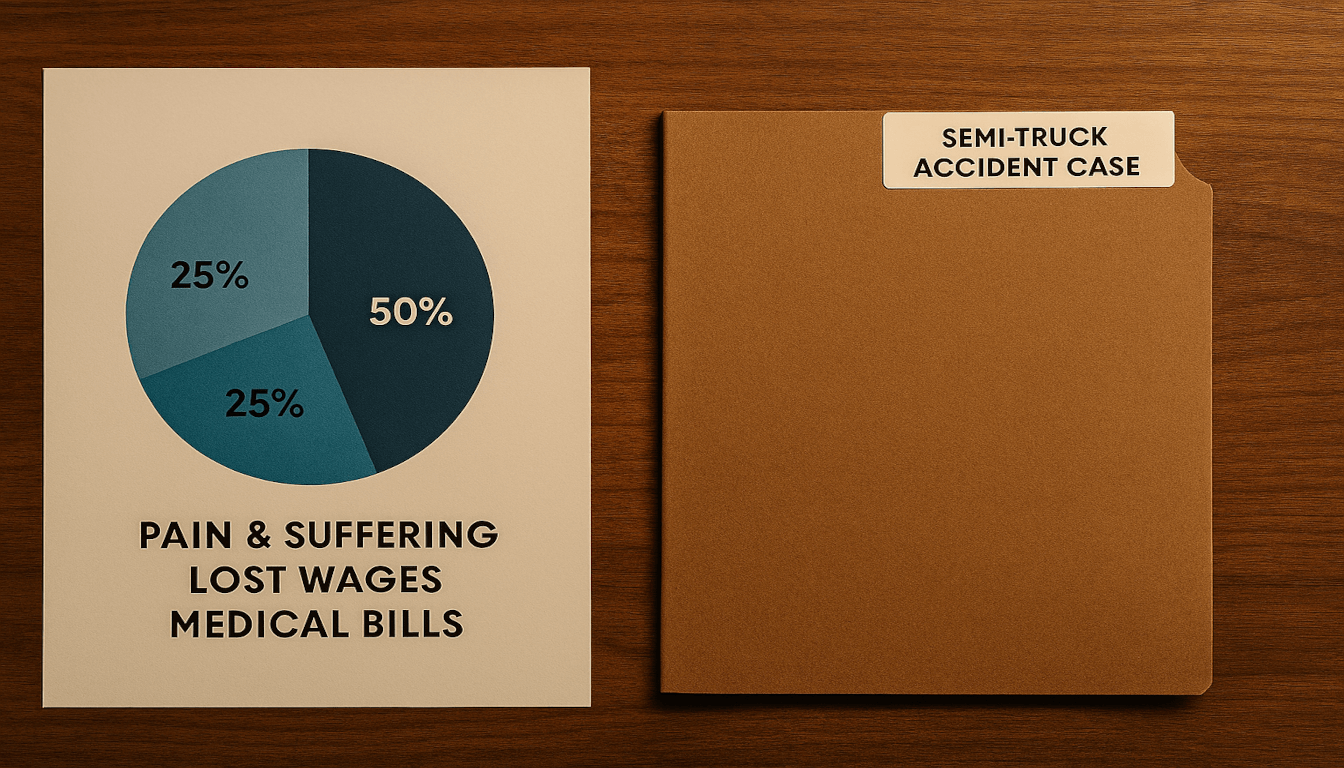
Economic Damages: Medical Bills, Lost Wages, and Property Damage
Economic damages reimburse tangible costs tied directly to the accident.
- Medical expenses include emergency care, rehabilitation, ongoing treatment, and projected future care. Bills, provider notes, and treatment plans document these losses.
- Lost wages cover past earnings, diminished earning capacity, and missed career opportunities. Pay stubs, employer letters, and vocational reports strengthen these claims.
- Property damage includes vehicle repair or total loss, diminished value, and out‑of‑pocket expenses such as towing or rentals.
Non-Economic Damages and Wrongful Death Considerations
Non‑economic damages compensate for pain, suffering, emotional distress, and loss of life’s enjoyment.
Wrongful death claims may recover funeral costs, loss of financial support, and consortium harms under state rules. Filing deadlines vary by jurisdiction — for example, North Carolina allows two years and Missouri three years for wrongful death actions.
For national data on injury costs and rehabilitation needs, see the CDC Injury Center’s WISQARS Cost of Injury.
Tip: Strengthen Valuation with Documentation
Detailed medical records, life care plans, and vocational assessments increase credibility and valuation in serious truck accident cases.
Key Damage Categories
| Damage Type | What It Covers | How to Prove It | Common Notes |
| Medical Expenses | Emergency care, rehab, ongoing therapy | Bills, provider notes, treatment plans | Include future care estimates when needed |
| Lost Wages | Past earnings, diminished earning capacity | Pay stubs, employer letters, vocational reports | Document missed promotions and career impact |
| Property Damage | Vehicle repair, total loss, diminished value | Repair estimates, appraisals, receipts | Keep receipts for rentals and related costs |
| Pain & Suffering / Wrongful Death | Pain, loss of enjoyment, funeral costs | Medical records, testimony, economic analyses | State caps or rules may apply |
👉 For a deeper breakdown of economic and non‑economic damages in semi-truck accident claims, see What Victims Can Recover.
Immediate and Long-Term Steps for Victims and Families
- Track every receipt, employer note, and medical record.
- Address liens and subrogation early to estimate net compensation accurately.
- Pair evidence with valuation to strengthen negotiation leverage.
What to Do After a Semi-Truck Accident
After a crash, the first hours are critical. Prompt steps shape medical outcomes, protect legal rights, and preserve evidence that can vanish quickly. The checklist below guides immediate action and early record preservation.
Immediate Steps: Medical Care, Reporting, and Scene Preservation
- Seek medical care right away and follow treatment plans. Timely notes and bills document injury causation.
- Call law enforcement and obtain the report number.
- Document the scene: take photos, collect witness contacts, and note visible vehicle damage.
Deadlines and Statutes of Limitations You Should Know
Act fast — statutes of limitations vary by state, and missing a deadline can bar recovery entirely.
- In some states, like North Carolina, the window is short: 3 years for personal injury and 2 years for wrongful death.
- Others, such as Missouri, allow more time: 5 years for personal injury and 3 years for wrongful death.
- Across the country, timelines range from 1 to 6 years, depending on the jurisdiction and type of claim.
These differences highlight why victims nationwide must confirm the rules in their state immediately after a semi‑truck accident. Filing deadlines shape strategy, evidence preservation, and negotiation leverage.
Tip: Consult an attorney early to identify the statute of limitations in your state and avoid losing your right to compensation.ight why early action matters nationwide.
Preserving Critical Evidence from Trucking Companies
- Retain an attorney quickly to send a spoliation letter, preserving ELD/black box files, maintenance logs, inspection records, and cargo manifests.
- Track road signs, load securement, and vehicle condition.
- Avoid detailed statements to insurers until counsel reviews the process.
Preserve proof early — records vanish fast, and evidence powers every strong claim.
NHTSA’s CrashStats data portal provides national crash statistics that often support expert testimony in semi‑truck accident cases.
Checklist: Critical Actions and Evidence to Preserve After a Semi-Truck Accident
| Action | Why It Matters | Key Item to Preserve |
| Medical Care | Documents injuries and treatment needs | Medical records, bills |
| Scene Documentation | Captures conditions and damage | Photos, witness info |
| Preservation Letters | Prevents data deletion | ELD exports, maintenance logs, cargo papers |
👉 For further guidance on your rights and answers to common victim questions, see Semi-Truck Accident FAQs: Legal Rights and Answers for Victims.
Essential Takeaways on Semi-Truck Accident Liability and Claims
Combining federal safety rules, state negligence laws, and authenticated evidence provides victims with a clear path to recovery after a semi‑truck accident.
Act quickly: preserve ELD data, maintenance records, and scene documentation before they disappear. These items often determine whether liability rests with a driver, trucking company, manufacturer, or other parties.
Keep the key rules in mind:
- Hours of Service and ELD limits to prevent fatigue.
- 0.04% BAC threshold for commercial drivers.
- $750,000 minimum liability coverage for carriers, with higher requirements for hazardous loads.
- State statutes of limitations, which vary nationwide from 1 to 6 years depending on jurisdiction and claim type.
Strong advocacy aligns regulations, deadlines, and expert testimony to maximize compensation for medical expenses, lost wages, property damage, and non‑economic harms. Engaging an experienced attorney early ensures records are protected and claims are pressed across all responsible parties.
👉 For a comprehensive overview of liability, compensation, and case building, see Semi-Truck Accident Law Explained: Liability, Compensation, and Case Building.
Frequently Asked Questions About Semi-Truck Accident Liability and Claims
What steps should a victim take immediately after a semi-truck accident?
Seek medical care first, report the collision to police, and preserve the scene when safe. Photograph vehicle damage, road conditions, and visible injuries. Contacting an attorney experienced in commercial vehicle cases helps protect rights and ensures evidence collection begins quickly.
Who can be held responsible for an accident involving a semi-truck?
Multiple parties may share fault: the driver, carrier, maintenance shops, parts manufacturers, and cargo loaders. Municipalities can also be liable when road defects or poor signage contribute. Each party’s role is evaluated through evidence such as logs, repair records, and witness statements.
How do federal rules affect these claims?
Federal rules set driver qualifications, hours of service, and safety standards carriers must follow. Violations often strengthen a victim’s case by showing negligence. Regulators like the FMCSA maintain records attorneys use to prove breaches of duty.
What types of evidence matter most in proving fault?
Key items include police reports, eyewitness accounts, ELD data, onboard sensors, maintenance logs, and inspection reports. Accident reconstruction and expert testimony tie these pieces together to show causation and responsibility.
How do insurance limits influence recovery after a semi-truck accident?
Commercial policies often carry higher limits than personal auto insurance, but serious crashes can exceed those limits. Victims may pursue multiple coverage layers, including umbrella policies or additional liable parties, to secure full compensation.
Can a trucking company be held responsible for a driver’s reckless conduct?
Yes. Carriers can be vicariously liable for employees acting within the scope of employment. Courts also examine hiring practices, training, and supervision; poor vetting or pressure to meet schedules can show company fault.
What role do maintenance records play in a semi-truck accident claim?
Maintenance and inspection records show whether the vehicle was roadworthy. Missing or falsified logs, ignored recalls, or sloppy repair work can support claims against operators and service providers.
How do state rules about comparative or contributory fault affect compensation?
States use different standards. Some reduce recovery by a victim’s share of fault, while a few bar recovery if the victim is even slightly to blame. Understanding your state’s rule is vital for estimating damages and strategy.
What damages can victims recover after serious injury or death?
Recoverable losses include medical expenses, lost income and earning capacity, property damage, pain and suffering, and in wrongful death cases, funeral costs and loss of support. Punitive damages may apply when conduct was egregious.
How long does a victim have to file a semi-truck accident claim?
Statutes of limitations vary nationwide by state and claim type. Deadlines can be shorter for certain parties, such as government entities. Victims should consult an attorney promptly to avoid missing critical filing dates.
When should a semi-truck claim be escalated to litigation?
If settlement offers do not cover current and future losses, or if insurers refuse liability, filing suit may be necessary. An experienced trial attorney can evaluate evidence gaps and advise when litigation is the stronger path.
How do electronic logging devices and black box data help the case?
These devices record driving hours, speed, braking, and other metrics. They can reveal fatigue, speeding, and deviations from schedules. Preserved data often proves critical to establishing causation and timeline.
Can manufacturers be held accountable for defective semi-truck parts?
Yes. If a faulty part, such as brakes or steering components, causes a crash, the manufacturer or supplier can face product liability claims. Investigators analyze failed components and recall histories to build such cases.
What common negotiation pitfalls should victims avoid?
Accepting the first offer, giving recorded statements without counsel, and failing to document future medical needs are frequent mistakes. Attorneys handle communications, demand adequate compensation, and negotiate layered coverage.
How is fault apportioned when multiple parties share responsibility?
Courts and insurers allocate fault based on evidence and state rules. Percentages of fault determine each party’s share of damages under comparative systems. Joint and several liability can also affect how plaintiffs recover from multiple defendants.
⚖️ Disclaimer: The content of this article is for informational purposes only and does not constitute legal advice. The information provided is based on general research and is not intended to be a substitute for professional legal advice or consultation with a qualified attorney. Always consult with a lawyer regarding your specific legal situation.