

One shocking number: national semi‑truck accident settlements often fall between $100,000 and $150,000, with wrongful death exposure reaching $5,000,000 or more.
This scale shows why a semi‑truck collision creates a completely different legal landscape than a routine car crash. Multiple parties, federal safety rules, and high‑limit commercial insurance policies change how liability is proven and how damages are pursued.
Victims also face complex evidence challenges. Electronic logging devices, maintenance records, and black box data can determine fault within hours — and insurance companies often deploy aggressive tactics before victims even understand their rights. That’s why early involvement from a semi‑truck accident lawyer matters.
This guide previews what victims need to know: how to preserve critical proof, analyze liability across trucking companies and vendors, value long‑term personal injury losses, and plan settlement strategy and timing.
For immediate steps to take after a crash, see What to Do After a Semi‑Truck Accident.
Key Takeaways
- Settlement values vary widely, driven by injury severity, liability strength, and commercial policy limits.
- Multiple defendants and federal regulations expand both liability and recovery opportunities.
- Preserving electronic and maintenance evidence early is essential to proving fault.
- Insurers use aggressive defense tactics, making timely legal representation critical.
- Most semi‑truck accident claims resolve within 6–16 months, though complex cases can take longer.
Why Semi‑Truck Accident Claims Are More Complex Than Standard Car Accidents
Large commercial rigs produce crash forces that fundamentally change how liability and recovery are analyzed. Federal safety data from agencies like the National Highway Traffic Safety Administration (NHTSA) shows that large trucks create far greater crash energy than passenger vehicles. That energy leads to more severe injuries, more complicated crash scenes, and a greater need for advanced reconstruction.
Size, Weight, and Catastrophic Injuries
The mass and momentum of a heavy vehicle increase stopping distance, jackknife potential, and rollover risk. These dynamics raise the likelihood of catastrophic injuries such as traumatic brain injuries, spinal cord trauma, and complex orthopedic damage.
Medical costs and long‑term care needs often exceed what appears in standard car accident claims. That reality directly affects settlement strategy, expert involvement, and compensation expectations in a semi‑truck accident case.
Multiple Liable Parties and Complex Liability
Liability in a semi‑truck accident rarely stops with the driver. It often extends to the trucking company, shipper, cargo loader, maintenance contractors, and even vehicle or parts manufacturers. Determining who controlled the vehicle, cargo, or safety decisions is essential to maximizing recovery.
Regulatory violations — including hours‑of‑service breaches, maintenance failures, or improper cargo securement — can shift fault and significantly increase case value. These issues rarely arise in routine passenger‑vehicle claims, which is why semi‑truck accident litigation requires a deeper investigation.
Early preservation of driver logs, GPS data, dispatch records, and maintenance files is critical. For a deeper breakdown of what victims should gather and how to protect their rights, see Evidence in Semi‑Truck Accident Cases.
| Factor | Typical Passenger Crash | Commercial Truck Crash | Impact On Recovery |
|---|---|---|---|
| Vehicle Weight | 2,500–4,000 lbs | Up to 80,000 lbs | Greater force → higher injuries and costs |
| Responsible Parties | Usually one driver, one insurer | Driver, company, shipper, maintenance, maker | Multiple insurers → complex negotiations |
| Regulatory Oversight | State traffic laws | FMCSA rules, federal and state regs | Violations can prove negligence |
| Injury Profile | Whiplash, fractures | TBI, spinal injury, polytrauma | Higher long-term medical and lost-earnings damages |
How to Respond After a Semi‑Truck Accident to Protect Your Legal Rights
Immediate steps after a semi‑truck accident shape the strength of any future claim. Federal safety guidance — such as the NHTSA’s general road‑safety resources — emphasizes prompt medical care, careful documentation, and early evidence preservation. These actions create the foundation for proving injuries and liability.

Seek Medical Care and Create a Clear Injury Record
Prioritize emergency evaluation even if injuries seem minor. Early medical records link symptoms to the collision and prevent insurers from arguing that injuries developed later.
Follow‑up visits should be timely and honest about pain, limitations, and functional problems. These notes become key evidence in settlement valuation.
Report the Semi‑Truck Accident and Secure the Police Report
Call law enforcement and request the official report. Police reports often include witness contact information, driver details, and preliminary fault indicators.
Review the report for accuracy and request corrections quickly to avoid losing critical details that may influence negotiations.
Collect Time‑Sensitive Evidence at the Scene
Photograph all vehicles, skid marks, debris, roadway conditions, lighting, and weather. Record the truck’s DOT number and company branding to identify responsible parties.
Gather witness names and brief statements while memories are fresh. Preserve video or dashcam footage and back it up immediately.
Avoid Insurance Company Traps and Premature Statements
Do not give recorded statements or accept quick offers from an insurance adjuster. Early comments can be used to minimize injuries or dispute liability.
Avoid posting about the crash or your medical treatment on social media. Insurers monitor accounts and may use posts to challenge credibility.
Contact an Experienced Semi‑Truck Accident Lawyer Promptly
A skilled semi‑truck accident lawyer will send preservation letters for black box data, logs, GPS records, and maintenance files before they disappear. They also take over communications with insurers and ensure evidence is protected.
Document daily symptoms, save receipts, and track out‑of‑pocket costs. Keep records of vehicle damage, rental expenses, and any replacement transportation.
Do: Seek medical care, photograph the scene, collect witness information.
Don’t: Give recorded statements or post about injuries online.
Next: Contact counsel immediately to preserve logs, black box data, and maintenance records.
For more guidance on avoiding early mistakes that can weaken your claim, see Mistakes to Avoid After a Semi‑Truck Accident.
Understanding Liability in a Semi‑Truck Accident Case
Assigning fault in a semi‑truck accident often requires tracing decisions across multiple companies, contractors, and data systems. Federal rules — including the FMCSA’s financial responsibility and liability requirements — shape how carriers must insure their operations and influence how liability is pursued after a crash.
Truck Driver Negligence and Hours‑of‑Service Violations
Establishing negligence often begins with the driver’s conduct: fatigue, speeding, distraction, or impairment. Electronic logs and dispatch timelines can reveal hours‑of‑service violations, showing when a driver should have been off the road and how fatigue contributed to the collision.
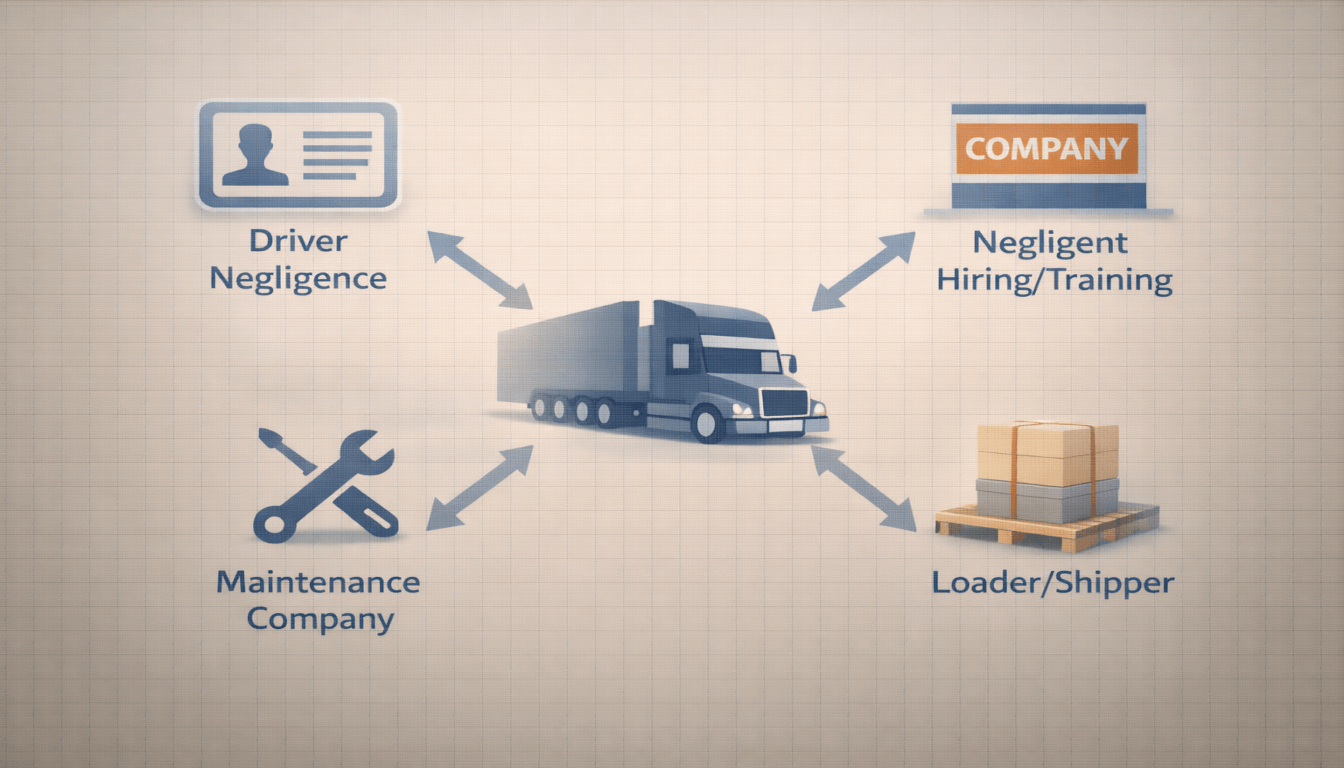
A trucking company may face vicarious liability for the driver’s actions, as well as direct liability for negligent hiring, training, supervision, or unsafe incentive policies that encourage rushed schedules. Well‑supported allegations against employers increase leverage and open additional layers of commercial insurance coverage.
Cargo Loading, Maintenance Providers, and Third‑Party Fault
Liability can shift to cargo loaders who overfilled or improperly secured freight, creating instability or shifting loads. Maintenance contractors may also be responsible if they missed critical inspections or failed to repair known mechanical issues.
Manufacturer Defects and Product Liability Exposure
Defective brakes, tires, steering components, or other mechanical systems can create product liability claims against manufacturers and parts suppliers. These claims often require expert mechanical analysis and detailed maintenance histories.
Data, Technology, and Comparative Fault Issues
Telematics, ELD logs, GPS pings, and maintenance software help reconstruct timelines and identify who controlled key safety decisions. Comparative negligence defenses may attempt to blame the car driver, making clear timelines and expert testimony essential to counter those claims.
Early preservation letters and subpoenas prevent spoliation when trucking companies control critical electronic data. Coordinating experts in reconstruction, human factors, and mechanical engineering turns technical failures into persuasive narratives for settlement or trial.
For a deeper look at how liability works when multiple companies share responsibility, see Multi‑Party Liability in Semi‑Truck Accidents.
The Three Pillars of a Strong Semi-Truck Accident Claim: Evidence, Regulations & Insurance
A semi‑truck accident claim’s strength often depends on how quickly telematics, logs, and maintenance histories are secured. Federal oversight — including the Federal Motor Carrier Safety Administration (FMCSA) — sets the rules that govern driver conduct, vehicle safety, and insurance minimums, all of which shape liability and recovery.
Black Box Data, Driver Logs, GPS, and Maintenance Records
Promptly securing ECM/EDR downloads and electronic driver logs is essential. These data points correlate speed, braking, throttle position, and fault codes with GPS pings to reconstruct the sequence of events.
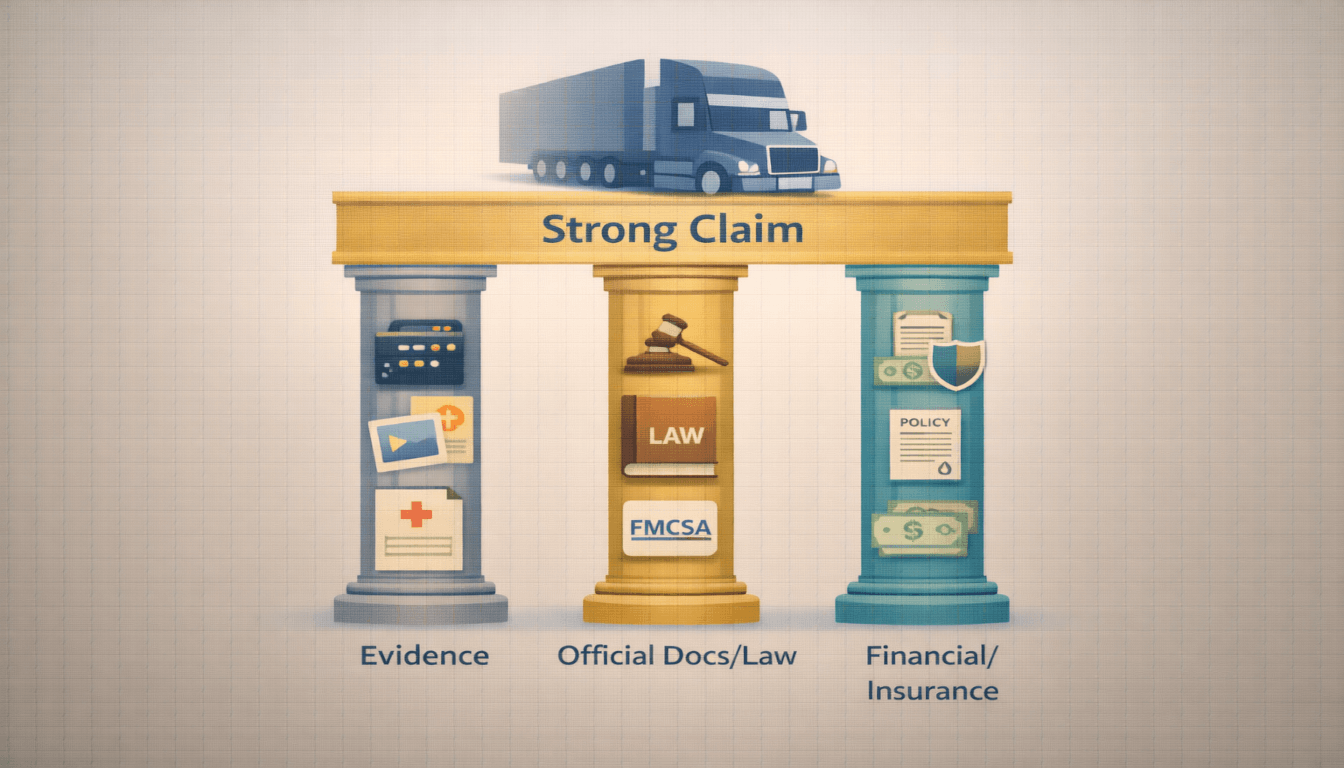
Request pre‑ and post‑trip inspections, repair invoices, and dispatch messages. Missing, incomplete, or altered records can themselves signal noncompliance and strengthen a negligence claim.
FMCSA Minimum Insurance Requirements and Policy Limits
FMCSA insurance tiers matter when valuing recovery. Common minimums include $300,000, $750,000, $1,000,000, and up to $5,000,000 for hazardous materials.
Knowing the vehicle’s GVWR, cargo type, and carrier classification helps a semi‑truck accident lawyer determine realistic settlement ranges and identify all available insurance layers.
Using Regulatory Violations to Establish Negligence
Hours‑of‑service breaches, improper cargo securement, and skipped maintenance link regulatory failures directly to causation. These violations increase leverage with insurers and trucking companies.
- Issue preservation letters immediately to prevent spoliation.
- Triangulate black box data, GPS records, and scene evidence to counter alternate narratives.
- Work with a semi‑truck accident lawyer to coordinate forensic downloads, subpoenas, and expert analysis.
Swift action within days preserves the strongest record before repairs, total losses, or data overwrites weaken the claim.
For a deeper breakdown of how evidence drives liability and compensation, see Preserving Evidence in Semi‑Truck Accident Cases.
How Semi‑Truck Accident Lawyers Value Damages, Settlement Ranges, and Case Timelines
Valuing damages in a semi‑truck accident case requires translating medical records, earnings history, and long‑term life impacts into credible monetary estimates. Federal tax guidance — including the IRS overview of taxable and non‑taxable settlement income — helps clarify how different categories of compensation are treated. A strong valuation blends expert reports with precise billing records and clear documentation to justify a demand.

Economic Losses: Medical Bills, Lost Wages, And Future Earnings
Economic damages include past and future medical expenses, lost wages, diminished earning capacity, and rehabilitation costs. Medical, economic, and vocational experts quantify future needs so settlement demands reflect lifetime care and financial impact.
Non‑Economic Losses: Pain, Suffering, and Loss of Enjoyment
Pain and suffering damages rely on provider notes, symptom journals, and testimony from family or coworkers. Consistent treatment timelines and detailed daily logs strengthen credibility and support higher valuation.
National Settlement Averages, Ranges, and Wrongful Death Exposure
National semi‑truck accident settlement averages often fall between $100,000 and $150,000, with severe injury cases exceeding $500,000. Wrongful death exposure can reach $5,000,000 or more, depending on liability strength, insurance limits, and long‑term financial losses.
Typical Case Duration and Factors That Affect the Clock
Most semi‑truck accident claims resolve within 6–16 months after medical treatment stabilizes. Timelines extend when multiple defendants are involved, lien negotiations are complex, or key evidence requires expert analysis.
Tax Considerations for Personal Injury Recoveries
Compensation for physical injuries is generally non‑taxable, while awards for non‑physical harms may be taxable. A tax professional can clarify net recovery, lien impacts, and how structured settlements may affect long‑term finances.
Early collaboration with a semi‑truck accident lawyer helps align valuation with available insurance limits, coordinate expert input, and optimize the timing of a settlement demand.
For a deeper breakdown of what victims can recover, see Economic and Non‑Economic Damages in Semi‑Truck Accident Claims.
The Dual Strategy for Semi-Truck Accident Claims: Negotiating with Insurers While Preparing for Court
Successful resolution of a semi‑truck accident claim depends on combining technical data with a clear legal narrative that insurers cannot ignore. Federal transportation policy — including safety priorities outlined by the U.S. Department of Transportation — underscores how commercial trucking risks and regulations shape liability and insurance exposure.

Building Leverage With Thorough Investigation And Evidence
Collect ECM/EDR downloads, driver logs, GPS pings, maintenance records, and the police report as soon as possible. Experts then synthesize these files into a detailed timeline that exposes negligence, clarifies causation, and limits the defense’s ability to shift blame.
Countering Lowball Offers and Bad‑Faith Tactics
Insurers often begin with quick, low offers and push for recorded statements before victims understand their rights.
Refuse premature recordings, document every exchange, and use statutory bad‑faith rules where applicable to challenge unfair delays, denials, or misrepresentations.
When Litigation Makes Sense Against Semi‑Truck Companies
Most semi‑truck accident claims settle, but filing a lawsuit becomes appropriate when liability is disputed, injuries are severe, or the trucking company refuses to negotiate in good faith.
Pleadings, discovery, depositions, and trial preparation all increase negotiation leverage while the claim continues forward.
A strong demand package includes:
- Liability summaries
- Medical chronologies
- Damages modeling
- Policy and coverage analysis
Coordinating reconstruction, medical, vocational, and economic experts helps quantify compensation and rebut defense theories. Clear communication with the client about timelines, costs, and risks ensures aligned decisions about settlement versus litigation.
For a deeper look at how insurers delay, deny, and undervalue trucking claims — and how victims can fight back — see Bad Faith Insurance Tactics in Semi‑Truck Accident Claims.
The Legal Complexities That Make Semi‑Truck Accident Cases Unique
Resolving a semi‑truck accident claim requires a precise, evidence‑first strategy that balances medical recovery with legal timing. National safety agencies — including the National Transportation Safety Board (NTSB) — emphasize how commercial‑vehicle crashes involve complex mechanical, human‑factor, and regulatory issues, making early action essential.
The roadmap remains straightforward: seek prompt medical care, report the crash, document the scene, preserve electronic logs, and engage counsel early to protect the integrity of your claim.
Liability may extend to the driver, the trucking company, cargo loaders, maintenance providers, and even manufacturers — creating multiple avenues for recovery across several insurance policies.
Realistic settlement expectations depend on injury severity, clarity of fault, and available coverage. Many cases resolve outside of court, though severe or disputed files may require litigation to secure full compensation.
Disciplined documentation, consistent treatment, and refusal to accept low offers significantly improve outcomes. For immediate guidance on the first steps to take after a crash, see What to Do After a Semi‑Truck Accident.
Frequently Asked Questions About Why Semi‑Truck Accident Cases Are Unique and Legally Complex
How does a semi-truck accident lawsuit work?
A semi-truck accident lawsuit is a multi-phase process defined by immediate evidence preservation, multi-party liability, and strict federal regulations. Here’s how it typically works:
1. Immediate Evidence Lockdown: Securing the truck’s black box data, electronic logs, and maintenance records before erasure.
2. Multi-Party Investigation: Identifying all liable parties (driver, company, shippers, manufacturers).
3. Building a Federal Case: Proving violations of federal trucking regulations (FMCSA rules).
4. Strategic Negotiation/Litigation: Negotiating with commercial insurers or proceeding to trial with expert testimony.
Why are semi‑truck accidents more legally complex than typical car crashes?
Semi‑truck accidents involve greater forces, more severe injuries, and often multiple liable parties. Federal regulations, carrier safety practices, driver hours‑of‑service logs, vehicle maintenance records, and cargo procedures all factor into liability. These cases require specialized evidence — such as electronic control module (black box) data, GPS, and driver logs — to prove negligence, making semi‑truck accident investigations far more complex than standard car crashes.
Who can be held responsible after a semi‑truck accident?
Liability may extend beyond the truck driver to the trucking company, broker, cargo loader, maintenance provider, and vehicle manufacturer. Each entity has distinct duties — training, vehicle upkeep, secure loading, or safe component design — and a semi‑truck accident lawyer will examine violations by any of these parties to build a strong compensation claim.
What immediate steps should a victim take at the scene to protect a claim?
Seek medical care first, then document the semi‑truck accident scene when safe. Photograph vehicles, road conditions, skid marks, and debris. Collect witness names and contact information, and record the carrier’s DOT number. Report the crash to police and obtain the official report. Preserve clothing, medical records, and any damaged personal property as evidence.
How important is timely medical treatment and documentation?
Prompt medical care creates a clear injury record and links symptoms directly to the semi‑truck accident. Detailed medical notes, test results, and treatment plans are essential for proving injury severity, future care needs, and economic damages such as lost wages and rehabilitation costs.
Can insurance companies be trusted to protect the injured party’s interests?
Insurance adjusters represent the trucking company’s interests and often aim to minimize payouts. They may push for recorded statements, request early releases, or dispute causation. Consulting an experienced semi‑truck accident lawyer before speaking with insurers helps avoid traps that could reduce compensation.
What role do federal regulations play in proving negligence?
FMCSA regulations govern driver hours, vehicle maintenance, inspections, and cargo securement. Violations of these rules can serve as powerful evidence of negligence. Investigators and lawyers rely on driver logs, inspection reports, and violation histories to connect regulatory breaches to the semi‑truck accident.
How can black box data and driver logs affect a dispute?
Electronic control module data, onboard cameras, and electronic logging device (ELD) records reveal speed, braking, hours of service, and driver behavior. This objective data is often critical in establishing fault, timing, and whether fatigue or mechanical issues contributed to the semi‑truck accident.
What types of damages can injured people pursue in a semi‑truck accident case?
Victims may pursue economic damages (medical bills, lost wages, future earning capacity) and non‑economic damages (pain and suffering, loss of enjoyment). In fatal semi‑truck accidents, wrongful death claims may include funeral expenses and loss of financial support. A lawyer calculates present and future losses to pursue full compensation.
How long do semi‑truck accident claims typically take to resolve?
Timelines vary widely. Straightforward liability cases may settle in a few months, while complex semi‑truck accident claims with severe injuries, multiple defendants, or extensive discovery can take a year or more. Factors include evidence collection, medical treatment duration, and insurer willingness to negotiate.
Should victims accept the first settlement offer from an insurer?
Early offers are often low and designed for quick resolution. Victims should consult a semi‑truck accident lawyer before accepting any offer. A lawyer evaluates damages, negotiates for higher compensation, and prepares litigation if necessary.
When is filing a lawsuit necessary against a trucking company?
A lawsuit becomes necessary when insurers refuse fair compensation, multiple parties dispute liability, or complex issues require court intervention. Litigation allows lawyers to obtain evidence through discovery, compel testimony, and pursue just compensation when negotiations stall.
How do insurance policy limits affect recovery after a semi‑truck accident?
Commercial carriers typically carry higher policy limits than personal auto insurers, but severe injuries may exceed those limits. When policy limits are insufficient, victims may pursue additional responsible parties or explore bad‑faith claims if insurers underpay legitimate demands.
Can defects in truck parts lead to manufacturer liability?
Yes. Defective brakes, tires, steering components, or other mechanical failures can create product liability claims against manufacturers or parts suppliers. Expert inspection and testing are required to link the defect to the semi‑truck accident.
What evidence builds the strongest negotiation leverage with trucking companies and insurers?
Strong leverage comes from a thorough investigation: crash scene photos, witness statements, surveillance or dashcam footage, black box and ELD data, maintenance records, and comprehensive medical documentation. Expert testimony on accident reconstruction and future care costs strengthens settlement demands.
How do statutes of limitations affect filing a semi‑truck accident claim?
State statutes of limitations set strict deadlines for filing personal injury and wrongful death lawsuits. Missing these deadlines usually bars recovery. Victims should contact a qualified semi‑truck accident lawyer promptly to preserve their rights and meet all procedural requirements.
Disclaimer: The information provided in this article is for general informational purposes only and does not constitute legal advice. While we strive to ensure the accuracy and reliability of the content, laws and regulations may vary by state, and individual cases may have unique circumstances. For advice tailored to your specific situation, please consult a qualified attorney. The inclusion of links to external resources does not imply endorsement or guarantee of the information provided therein.