
Choosing the right lawyer after a devastating semi-truck accident is one of the most important decisions you will make. The difference between a general personal injury lawyer and a true trucking accident specialist can determine whether you recover full compensation or settle for far less than you deserve.
Why does this matter? Trucking companies have deep resources, aggressive defense teams, and complex federal regulations on their side. A lawyer who isn’t a specialist may miss critical evidence, fail to identify all liable parties, or underestimate the true value of your claim.
This guide provides you with a clear, actionable checklist to compare lawyers and find the one with the specific experience, resources, and strategy needed to win your case. You’ll learn what questions to ask, what evidence they must secure immediately, and how to spot the red flags of a lawyer who isn’t equipped for this fight.
Your recovery starts with the right legal partner. Let’s begin.
For immediate steps to protect yourself at the scene, see our guide: What to Do After a Semi-Truck Accident.
Key Takeaways
- A specialist identifies multi‑party exposure and FMCSA issues early.
- Rapid preservation of black box data and logs is critical.
- An experienced team uses accident reconstruction and medical experts.
- Strong case framing counters aggressive insurer tactics.
- Clear processes, milestones, and policy reviews protect compensation.
How to Compare and Choose a Truck Accident Lawyer: A Checklist
Choosing the right lawyer after a serious truck crash is one of the most critical decisions you will make. A true specialist does more than just handle personal injury cases—they understand the complex federal trucking regulations, aggressive insurance tactics, and time-sensitive evidence unique to these crashes.
Use this checklist during your initial consultations to compare lawyers and ensure you hire someone who can truly maximize your recovery.
1. Ask for Their Immediate Action Plan
Within the first 72 hours, critical evidence can disappear. A qualified truck accident lawyer should immediately outline a specific plan that includes:
-
Sending Spoliation Letters to the trucking company to legally preserve black box data, ELD logs, dashcam footage, and maintenance records before they are erased.
-
Launching an Independent Investigation by hiring an accident reconstructionist and securing the crash scene evidence.
-
Shielding You from Insurers by instructing you not to give any statements and handling all communication.
Your Question: “What is your specific 72-hour action plan to secure evidence and protect my claim?”
2. Probe Their Experience with Federal Regulations (FMCSA)
Trucking companies are governed by strict Federal Motor Carrier Safety Administration (FMCSA) rules. Your lawyer must know how to use violations of these rules to prove negligence.
-
Key Areas: Hours-of-Service (fatigue), vehicle maintenance standards, driver qualification files, and cargo securement rules.
Your Question: “How have you used FMCSA violations, like hours-of-service logs or maintenance records, to win past cases?”
3. Evaluate Their Resources and Expert Network
These cases are won with expert testimony. Your lawyer should have a proven network they can call immediately:
-
Accident Reconstructionists
-
Forensic Engineers (for mechanical failures)
-
Medical and Economic Experts (to project future costs)
Your Question: “Which experts do you typically work with on truck accident cases, and how do they help prove fault and damages?”
4. Assess Their Strategy for Multiple Liable Parties and Insurance
A severe crash often involves more than just the driver. Your lawyer should have a strategy to identify and pursue all sources of compensation.
-
Targets: The trucking company, cargo loaders, maintenance shops, parts manufacturers.
-
Insurance: Understanding layered commercial policies to ensure all available coverage is pursued.
Your Question: “How do you identify all potentially liable parties and ensure we access every layer of insurance available?”
5. Request a Clear Client Checklist
A good lawyer will empower you with clear instructions on what to do—and what not to do—while they handle the legal battle.
-
This should include guidance on social media, communicating with insurers, and documenting your recovery.
Your Final Step: For a detailed walkthrough of the lawyer selection process, use our companion guide: How to Choose the Best Lawyer for a Semi-Truck Accident Case.
Why Semi‑Truck Accident Claims Require Specialized Legal Knowledge
If you’ve been in a crash with a semi-truck, you need to understand that these are not ordinary car accident cases. The legal landscape is fundamentally different, governed by a complex web of federal regulations and defended by powerful corporations. A lawyer who specializes in this area isn’t a luxury—it’s a necessity for a fair outcome.
Multiple Liable Parties Beyond the Driver
In a standard car crash, you typically deal with one other driver. In a truck accident, liability can extend to a network of companies:
-
The trucking company that employed the driver.
-
The cargo loader or shipper responsible for unsafe loading.
-
The maintenance contractor that performed negligent repairs.
-
The parts manufacturer if a defect contributed.
A specialized lawyer knows how to investigate and identify all potentially liable parties, which is crucial for accessing the full range of insurance coverage available for your claim.
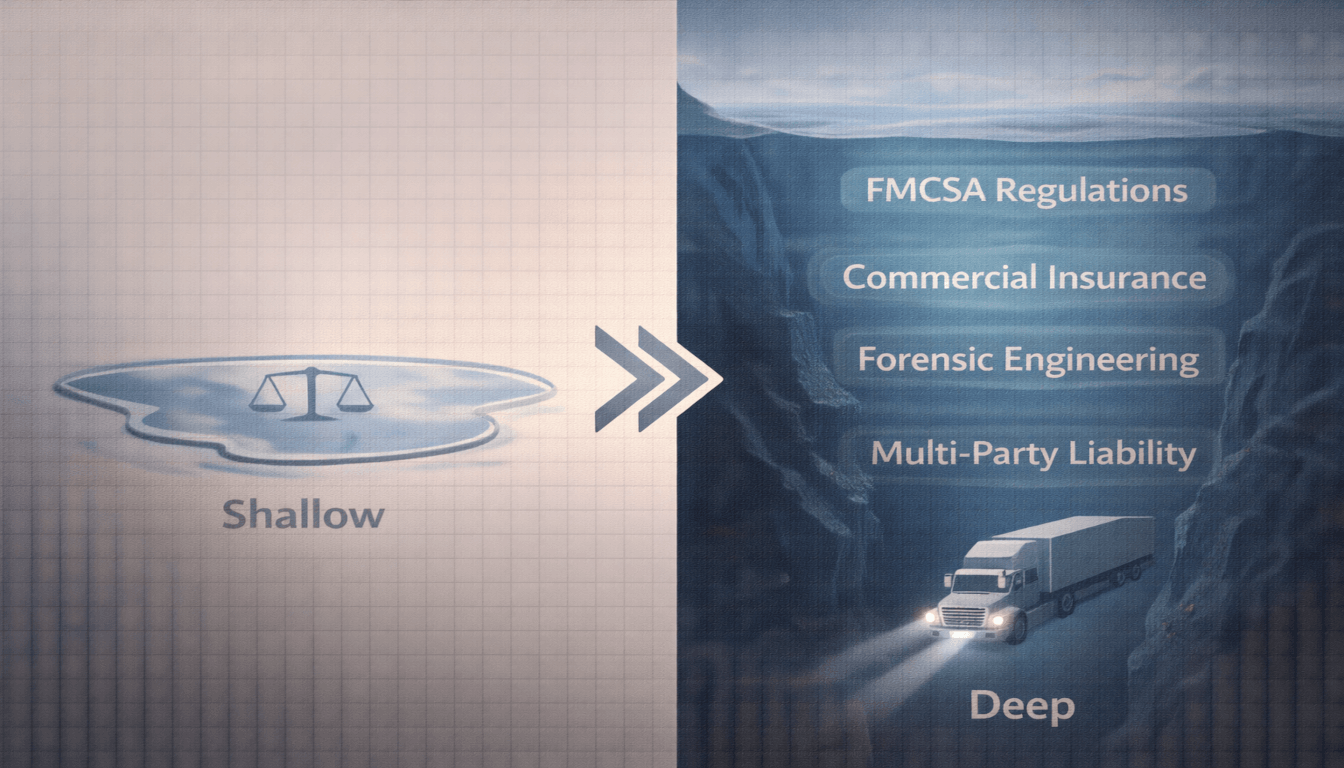
High‑Stakes Commercial Insurance and Aggressive Defense
Trucking companies carry multi-million dollar commercial insurance policies. Because the financial exposure is so high, their insurers deploy aggressive, sophisticated defense teams immediately. You can expect:
-
Early contact and pressure to give a recorded statement.
-
Quick, low-ball settlement offers before you understand the full extent of your injuries.
-
Investigations aimed at shifting blame to you.
A truck accident specialist anticipates these tactics, shields you from harmful communication, and builds a case designed to counter their strategies from day one.
Complex Rules Under the Federal Motor Carrier Safety Administration (FMCSA)
This is the core of what makes these cases unique. The FMCSA sets hundreds of safety rules for the trucking industry. A specialized lawyer uses violations of these rules as powerful evidence of negligence. Key areas include:
-
Hours-of-Service (HOS): Rules limiting driving hours to prevent fatigue.
-
Vehicle Maintenance: Mandated inspection and repair schedules.
-
Driver Qualification: Strict requirements for hiring and training.
-
Electronic Logging Devices (ELDs): Digital records of driver hours that can prove violations.
These rules are not just guidelines; they define the legal duty of care. Violating them can be direct proof of fault. You can review the official FMCSA regulations to understand their scope.
A lawyer unfamiliar with these regulations will miss the opportunity to use them as the foundation of your case.
To fully grasp the unique challenges you face, read our detailed analysis: Why Semi-Truck Accident Cases Are Unique.
Credentials and Licensing That Signal a Semi-Truck Accident Law Focus
When comparing lawyers, don’t just take their word for it. You need to verify their credentials and look for specific proof that they focus on trucking law, not just general personal injury. This due diligence is your first line of defense against hiring an lawyer who isn’t equipped for your complex case.
How to Confirm Genuine Truck Accident Experience
A true specialist’s experience will be evident in the details of their past cases. You should ask for and review documentation that shows:
-
Case Summaries involving black box (ECM) data analysis, ELD log violations, and subpoenas for company maintenance records.
-
A history of filing spoliation letters to preserve digital evidence immediately after a crash.
-
Experience litigating against multiple defendants (trucking companies, loaders, manufacturers), not just individual drivers.
This proof distinguishes a trucking specialist from a generalist who may settle simpler car accident cases quickly.
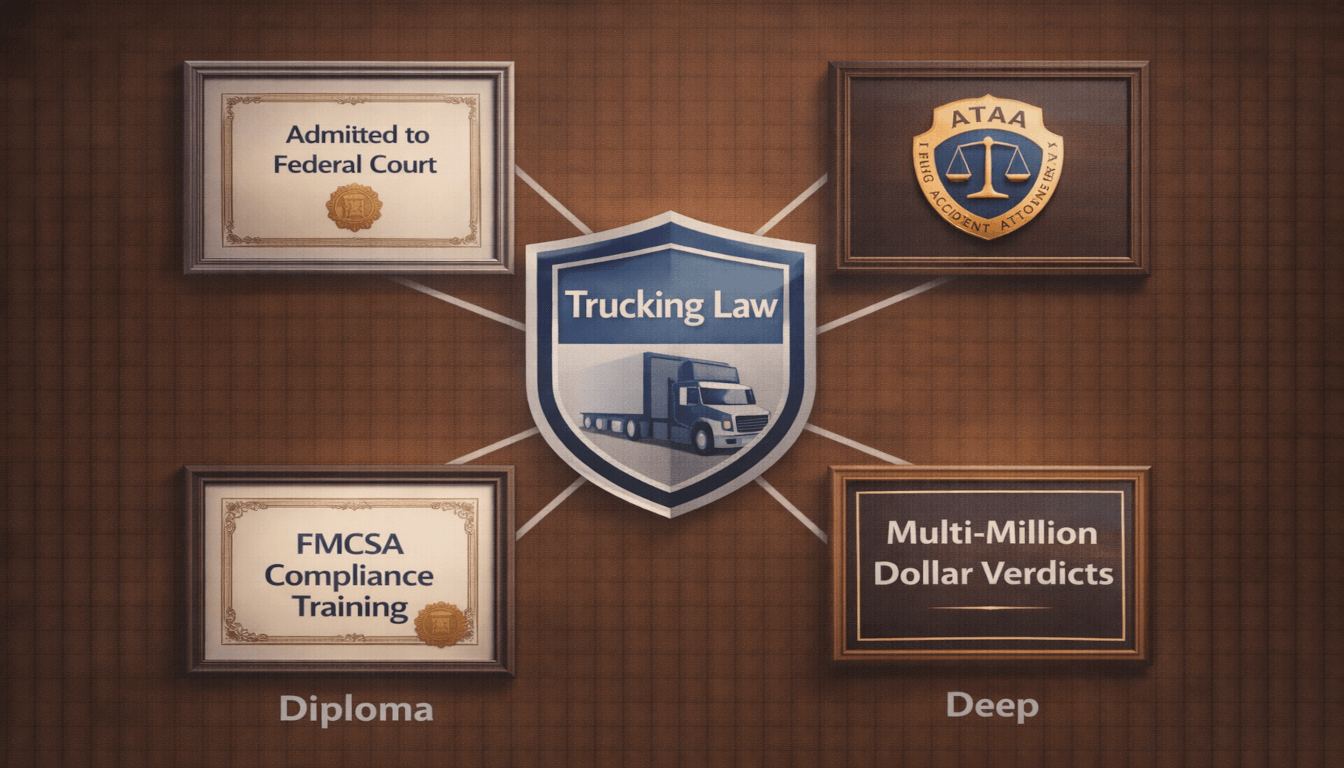
True specialization is demonstrated by credentials. Look for a lawyer with admission to federal courts, membership in trucking law associations, specific FMCSA training, and a history of high-value verdicts in semi-truck cases.
Essential Memberships, Certifications, and Trial Readiness
Affiliations matter because they show a commitment to the field. Look for memberships in:
-
Trial lawyer associations (e.g., the American Association for Justice).
-
Transportation law sections of state or national bar associations.
More importantly, assess their court readiness. Ask:
-
“Can you share an example of a pretrial motion or Daubert challenge you’ve filed in a trucking case?”
-
“How often do you take trucking cases to trial versus settling?”
A lawyer who is truly prepared will have clear answers and examples.
Your Lawyer Credential Checklist
Use this guide to evaluate a lawyer’s qualifications during your consultation:
| Credential to Verify | What It Signals | Why It Matters to You |
|---|---|---|
| Published Trucking Case Results | Hands-on experience with ELD data, black boxes, and corporate discovery. | Proves they have successfully investigated cases like yours. |
| Active Bar License & Clean Record | Professional standing and adherence to ethical rules. | Verify this through your state’s bar association or via the National Association of Attorneys General directory. |
| Trial Association Memberships | Commitment to litigation skills and peer recognition. | Indicates they are part of a network focused on winning in court, not just settling. |
| Expert Network | Collaboration with accident reconstructionists, medical experts, and economists. | Shows they have the resources to build a scientifically proven case for maximum compensation. |
Your Next Step: Verifying credentials is just one part of choosing the right advocate. For a comprehensive walkthrough of the entire selection process, use our detailed guide: How to Choose the Best Lawyer for a Semi‑Truck Accident Case.
Proven Results: Evaluating a Lawyer’s Semi‑Truck Accident Track Record
When your financial future and health are on the line, you need more than promises—you need proof of past success. A lawyer’s track record in trucking cases shows their ability to turn complex evidence into maximum compensation. According to NHTSA research, crashes involving large trucks often result in severe, life-altering injuries, making experienced legal advocacy critical.

Testing Your Lawyer’s Knowledge of FMCSA and State Trucking Rules
A true trucking law specialist doesn’t just know that regulations exist—they know exactly how to use them as evidence to win your case. The Federal Motor Carrier Safety Administration (FMCSA) rules, which are part of the broader U.S. Department of Transportation regulations, form the legal backbone of negligence in trucking cases. Your lawyer must be able to translate these complex regulations into a clear strategy for proving fault.
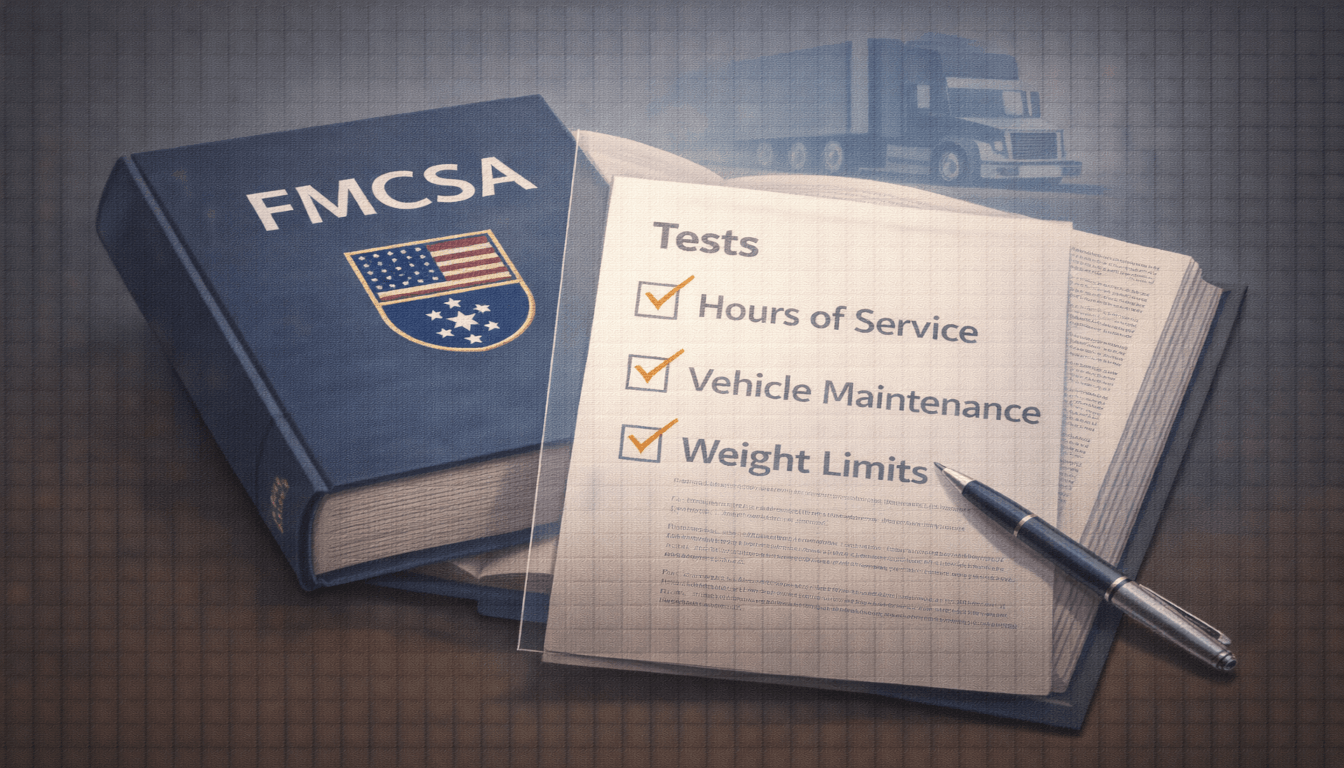
Key FMCSA Areas Your Lawyer Must Master
During a consultation, your lawyer should confidently discuss how they use these specific rules:
-
Hours-of-Service (HOS): They should explain how Electronic Logging Device (ELD) data can prove a driver was fatigued, over-hours, or falsifying records.
-
Vehicle Maintenance (Part 396): They need to know how to subpoena maintenance logs and inspection reports to prove a company skipped required repairs.
-
Driver Qualifications (Part 391): They must understand how to obtain the driver’s qualification file to check for invalid licenses, poor training, or missing medical certificates.
A simple question like, “How would you use FMCSA regulations to prove the trucking company was negligent in my case?” should prompt a detailed, evidence-based answer, not a vague reassurance.
Using Regulatory Violations to Prove Negligence
Violations aren’t just paperwork issues—they are proof of a breached duty of care. A skilled lawyer will:
-
Preserve the Evidence: Immediately send spoliation letters to secure ELD data, GPS history, and maintenance records before they’re destroyed.
-
Correlate the Data: Work with experts to match regulatory violations (e.g., a missed brake inspection) directly to the cause of your crash.
-
Demonstrate a Pattern: Use the trucking company’s own safety audit history and internal compliance reports to show a culture of ignoring safety rules.
This approach transforms technical violations into a compelling story of corporate negligence for a judge or jury.
Your Action Step: Verify their knowledge by asking for a past example where they used an FMCSA violation to secure a settlement or win at trial.
For an in-depth explanation of how these federal rules impact every aspect of a claim, read our guide: How Federal Trucking Regulations Affect Semi‑Truck Accident Cases.
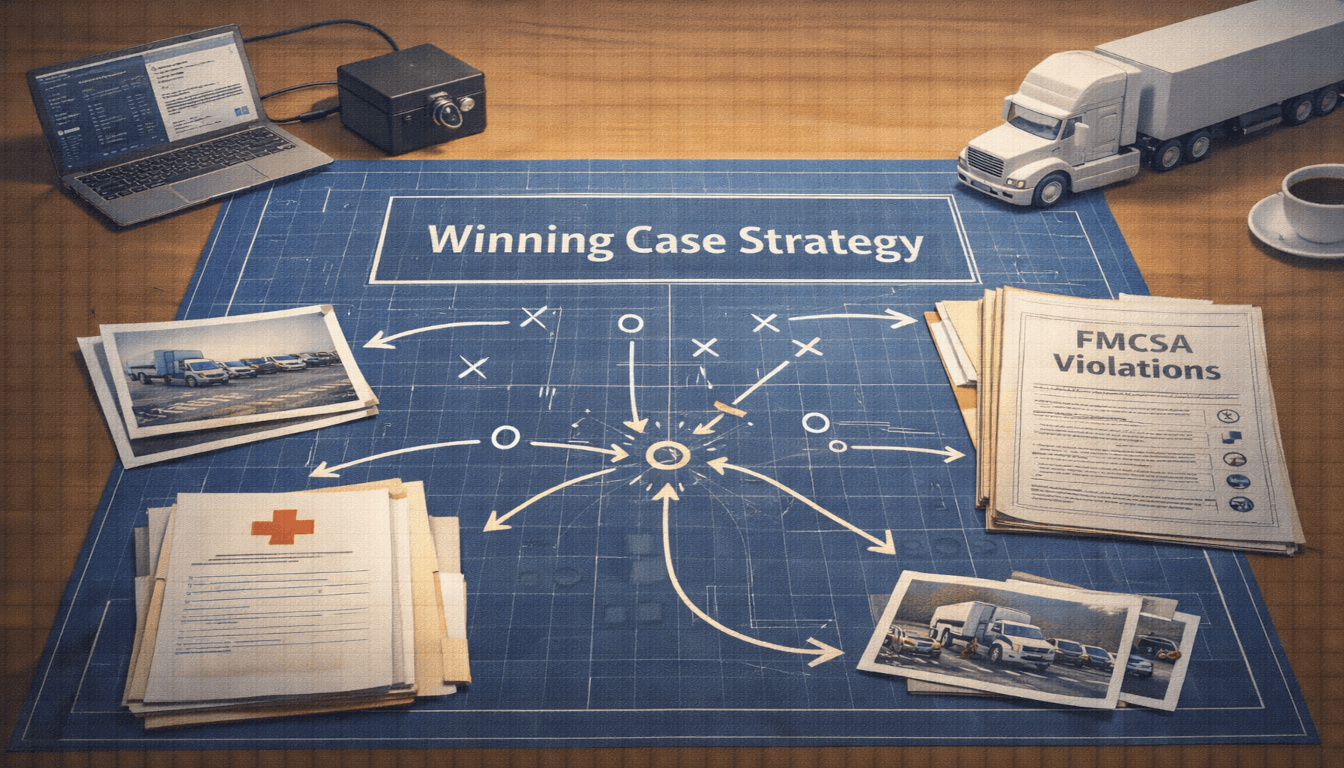
Semi-Truck Accident Evidence Strategy: How Specialists Build a Winning Case
A winning truck accident claim isn’t built on luck—it’s built on a deliberate, rapid evidence strategy executed from day one. According to NHTSA research, critical data can be lost in weeks. A specialized lawyer’s first priority is to act faster than the clock to preserve the proof you need.
Securing the Digital Evidence: Black Boxes, Logs, and GPS
The truck’s electronic systems hold the most powerful evidence, but that data is perishable. A specialist immediately:
-
Identifies and Preserves: The Event Data Recorder (EDR/”Black Box”), Electronic Logging Device (ELD) data, GPS history, and telematics.
-
Analyzes for Violations: Cross-references logs with dispatch records and fuel receipts to prove driver fatigue (HOS violations), speeding, or route deviations.
The Critical First Step: Spoliation Letters
Within the first few days, your lawyer must send spoliation letters—legal demands that require the trucking company, repair shops, and data custodians to preserve all evidence. This stops the routine destruction of data that can occur in as little as 30 days.
Building Your Case with Expert Teams
A specialist doesn’t work alone. They deploy a team of experts to transform data into a compelling story:
-
Accident Reconstructionists: Use black box data and physics to scientifically prove how the crash happened.
-
Medical Experts: Document your injuries and project future medical needs to calculate full damages.
-
Mechanical Experts: Analyze maintenance logs to prove negligent repairs or defective parts caused the crash.
Coordinating the Investigation for a Single Narrative
Your legal team coordinates private investigators to gather surveillance footage, witness statements, and company personnel files. Every piece of evidence—from a skid mark to an email about a missed brake inspection—is woven into a single, undeniable narrative of liability.
The Result: This coordinated strategy turns complex technical data into a clear story that insurance companies and juries understand, maximizing your leverage for a settlement or verdict.
To understand the urgent, step-by-step actions you and your lawyer must take to secure this evidence, follow our dedicated guide: Preserving Evidence in Semi‑Truck Accident Cases.
How Skilled Lawyers Navigate Insurers and Multi‑Party Liability in Semi‑Truck Accident Claims
Dealing with insurance companies after a semi-truck crash is a high-stakes negotiation. As noted in consumer guides from the National Association of Insurance Commissioners (NAIC), multi-carrier claims are inherently complex. A specialized lawyer’s skill here is what separates a full recovery from a low-ball settlement. They manage this by controlling communication and mastering the complexity of multiple liable parties.

Taking Control of Insurance Communications Immediately
Your lawyer’s first move is to shield you. They will:
-
Assume All Contact: Notify all insurance companies that all communication must go through them.
-
Protect Your Words: Prevent you from giving any recorded statements that adjusters can twist to devalue your claim.
-
Set the Tone: Establish from the start that your claim is backed by evidence and legal expertise.
This stops the insurer’s common tactic of early, friendly contact designed to gather information against you.
Managing Multi-Party Liability and Insurance Layers
A serious truck accident often involves more than one responsible company (e.g., the carrier, cargo loader, maintenance shop). A skilled lawyer strategically handles this by:
-
Identifying All Liable Parties to access multiple insurance policies.
-
Presenting a Unified Case to each insurer, using curated evidence like black box data and maintenance logs to prove their client’s negligence.
-
Preventing “Blame-Shifting” between companies, ensuring they can’t point fingers at each other to avoid paying.
This approach maximizes the total insurance coverage available for your claim.
The Strategy: Negotiation Backed by Trial Readiness
Insurance companies respect strength. Your lawyer builds leverage by:
-
Preparing Your Case for Trial From Day One: This shows insurers you are serious and won’t accept an unfair deal.
-
Using Deadlines Strategically: If an insurer delays or denies a fair offer, your lawyer is prepared to immediately file a lawsuit.
-
Valuing Your Claim Fully: They calculate and demand compensation for all your losses—current and future medical care, lost income, pain and suffering—not just immediate bills.
For a clear understanding of the tactics insurers use and how to counter them, read our guide: Semi-Truck Accident Claims.
Remember: A lawyer who navigates this process expertly turns the insurance company’s early pressure into leverage for a settlement that truly reflects the value of your life-altering injuries.
Settlement Strategy and Trial Readiness in Semi‑Truck Accident Claims
A successful outcome in your truck accident case depends on a powerful strategy: negotiating from a position of unquestionable strength. As outlined in the federal court system’s overview of how civil cases work, the leverage to secure a fair settlement often comes from demonstrating serious preparation for trial. A specialized lawyer uses this principle to maximize your recovery.
Maximum recovery in semi-truck accident claims requires a two-pronged approach: pursuing a strong settlement while being fully prepared to go to trial, ensuring insurers take your claim seriously from the start.
Countering Lowball Offers With Full, Expert Valuation
Insurance companies often start with insultingly low offers, hoping you’ll take a quick check. Your lawyer counters this by building an undeniable case for your claim’s true value from day one. This involves:
-
Medical and Life-Care Plans: Expert projections of your future medical needs and costs.
-
Vocational Assessments: Proof of how your injuries impact your ability to work and earn a living.
-
Accident Reconstruction Reports: Scientific analysis proving liability.
Presented with this evidence, an insurer can no longer justify a lowball offer. They must either negotiate seriously or face the risk of a much larger verdict at trial.
The Strategic Power of Filing a Lawsuit
If negotiations stall, filing a lawsuit is a deliberate power move, not a failure. It triggers the formal “discovery” process, which can force the trucking company to hand over evidence they’ve been withholding—like complete ELD data, internal safety audits, and maintenance records.
Filing a complaint signals that you are prepared for a public fight, increasing the financial and reputational risk for the defendant. This alone often brings them back to the table with a much better offer.
Balancing Timelines, Strategy, and Your Best Interests
Your lawyer’s job is to balance aggressive legal strategy with your personal well-being. They will:
-
Manage Complex Timelines involving multiple defendants and insurers to prevent deliberate delays.
-
Use Legal Motions to ensure critical evidence (like black box data) is admitted and to block unfair defense tactics.
-
Advise You Clearly on when a settlement serves your needs and when pursuing a trial could yield a significantly better outcome.
The goal is always to achieve the best possible result for you, whether through a powerful negotiated settlement or a winning verdict at trial.
To understand the full journey of a truck accident lawsuit—from the first filing to a potential trial—read our detailed guide: Semi-Truck Accident Lawsuits Explained.
Key Takeaway: The threat of a well-prepared trial is your lawyer’s greatest tool for forcing a fair settlement. Choose a lawyer who is fully ready and willing to use it.
Understanding Damages and Case Valuation in Semi‑Truck Accident Lawsuits
After a severe truck crash, understanding what your claim is truly worth is critical. An accurate valuation is not a guess—it’s a comprehensive calculation of every past and future loss caused by the accident, supported by evidence and expert analysis. These calculations often reference frameworks used by federal agencies, such as the Social Security Administration’s guidelines on disability and work capacity. This forces insurance companies to confront the real cost of your injuries.
Calculating Your Economic (Financial) Damages
These are the tangible financial losses you can document with bills and records. A specialized lawyer will ensure all of these are included:
-
All Medical Expenses: Emergency care, hospital stays, surgeries, medications, and future medical care (via a life-care plan from a medical expert).
-
Lost Income & Earning Capacity: Wages lost during recovery and, if your injuries are permanent, the future income you will lose over your career (proven by a vocational/economic expert).
-
Property Damage: The full cost to repair or replace your vehicle and other damaged property.
Valuing Your Non-Economic (Personal) Damages
These compensate for the profound personal toll of the accident, which doesn’t come with a bill. They are supported by:
-
Medical Records & Testimony: Documenting your pain, suffering, and emotional distress.
-
Personal Journals: Your own account of how your injuries affect your daily life, relationships, and mental health.
-
Expert Testimony: Doctors and therapists explaining the long-term impact of your injuries.
Insurers often try to minimize these damages, but thorough documentation makes them undeniable.
When Punitive Damages May Apply
In rare cases of extreme corporate misconduct—such as a trucking company knowingly forcing drivers to violate safety laws or systematically falsifying logs—you may be eligible for punitive damages. These are meant to punish the wrongdoer and deter future recklessness. Proving this requires evidence of a willful or reckless disregard for safety.
The Goal: A Unified Valuation That Wins
Your lawyer’s job is to weave all this—medical reports, expert analyses, life-care plans, and documentation of your suffering—into a single, powerful valuation package. This package becomes the foundation of your settlement demand or trial presentation, leaving the insurance company with no room to argue.
For a complete, detailed breakdown of every type of compensation you may be entitled to, read our guide: Economic and Non-Economic Damages in Semi-Truck Accident Claims.
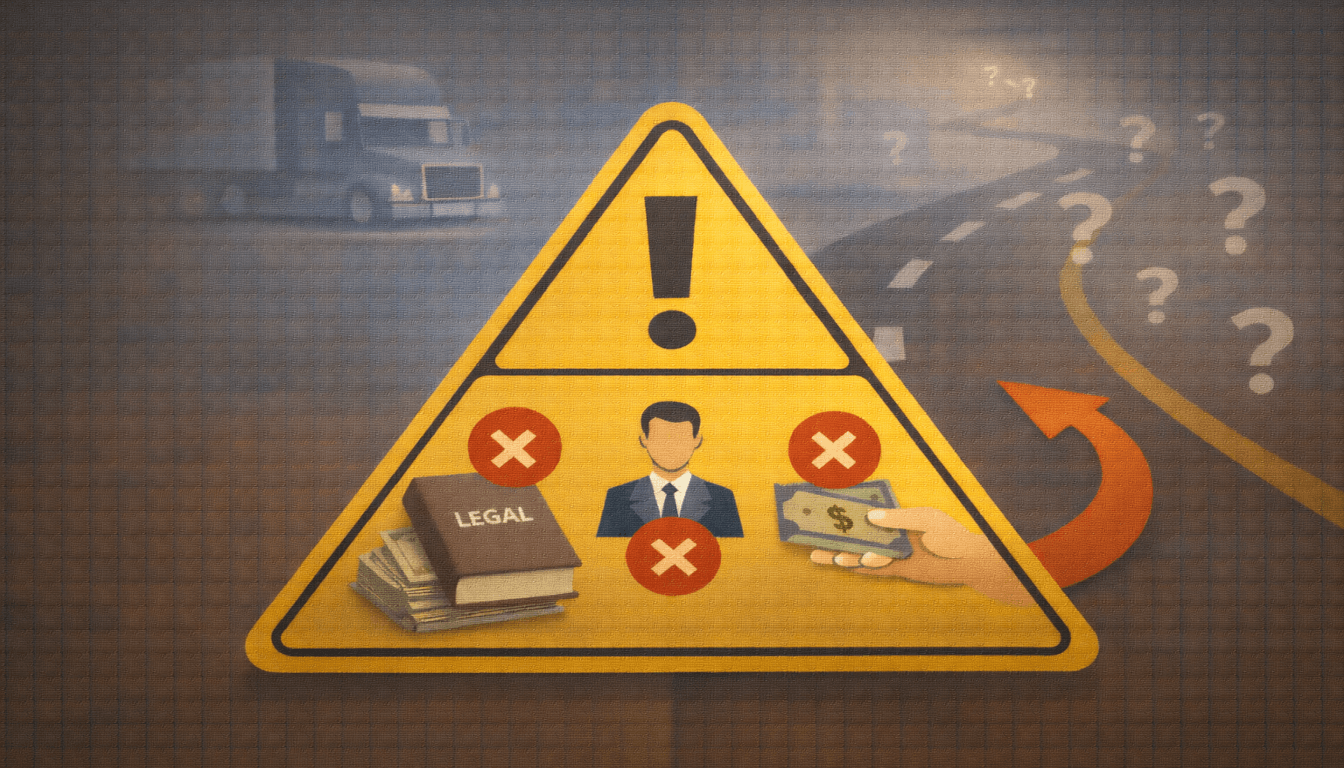
Warning Signs Your Lawyer Isn’t a Semi‑Truck Accident Specialist
Hiring the wrong lawyer can jeopardize your entire claim. A true specialist understands that trucking cases are governed by complex, time-sensitive federal regulations, as outlined in the FMCSA’s Safety and Compliance resources. Be vigilant for these red flags that suggest an lawyer is treating your serious crash like a routine fender-bender.
Taking Action Now: How to Choose the Right Semi‑Truck Accident Lawyer
Taking Confident, Informed Action After a Semi‑Truck Accident
The path forward after a devastating truck crash is daunting, but it is not one you have to walk alone or unprepared. The difference between a low settlement and a recovery that truly covers your lifelong needs comes down to one decision: partnering with a lawyer who possesses specific, proven expertise in trucking law.
This guide has equipped you with the checklist to find that advocate—one who will:
-
Act with urgency to preserve the digital evidence that disappears within weeks.
-
Master the complexities of FMCSA regulations and multi-party liability.
-
Build an undeniable case with a team of specialized experts.
-
Negotiate from a position of uncompromising strength, fully prepared for trial.
You now know the critical questions to ask, the red flags to spot, and the proof of experience to demand. Use this knowledge. Schedule consultations, and choose the lawyer who demonstrates a clear, actionable strategy—not just sympathy.
Your recovery begins with informed action. Take the first step now.
For the immediate actions you must take at the scene to protect your health and your claim, follow our essential guide: What to Do After a Semi‑Truck Accident.
Frequently Asked Questions About Semi‑Truck Accident Lawyers and Claims
Q: What’s the difference between a truck accident lawyer and a regular personal injury lawyer?
A: A truck accident specialist has specific expertise in the complex federal regulations and high-stakes evidence unique to commercial trucking crashes, which a general personal injury lawyer often lacks.
Key differences:
1. FMCSA Knowledge: Specialists use federal trucking regulations to prove negligence.
2. Multi-Party Claims: They pursue the trucking company, cargo loaders, and insurers, not just the driver.
3. Digital Evidence: They act within days to preserve black box and electronic log data before it’s erased.
4. Expert Networks: They work routinely with accident reconstruction and mechanical engineering experts.
Hiring a specialist is critical for winning a full recovery against well-funded trucking corporations.
Q: How can I verify a lawyer’s experience with trucking accident claims?
A: You must ask for specific proof, not just assurances. Use this checklist:
1. Request Case Summaries: Ask for examples of past trucking case results, including settlements and verdicts. Look for details on multi-defendant cases.
2. Check for Specialist Credentials: Look for memberships in trial lawyer associations and transportation law sections of bar associations.
3. Ask About Their Process: A true specialist will immediately discuss securing black box data, driver logs, and sending spoliation letters.
4. Request a Reference: Ask if they can provide a reference from a past truck accident client.
A lawyer with genuine experience will provide clear, confident answers and documentation.
Q: Which federal trucking regulations (FMCSA rules) are most important for my case?
A: The most critical FMCSA rules that can prove negligence are:
1. Hours-of-Service (HOS): Limits driving hours to prevent fatigue.
2. Vehicle Maintenance (Part 396): Requires systematic inspection and repair.
3. Driver Qualifications (Part 391): Mandates proper licensing, training, and medical fitness.
4. Cargo Securement: Rules for properly loading and securing freight.
A violation of any of these rules can be direct evidence that the driver or trucking company breached their duty of care, significantly strengthening your claim for compensation.
Q: What evidence does a truck accident lawyer collect right away?
A: They act immediately to secure time-sensitive evidence before it’s lost. The top priority is digital data from the truck, which can be erased in 30 days or less.
Immediate Evidence Checklist:
1. Black Box (ECM/EDR): Records speed, braking, and steering.
2. Electronic Logging Device (ELD) Data: Proves driver fatigue or hours-of-service violations.
3. Maintenance & Inspection Logs: Shows if the company skipped repairs.
4. GPS & Telematics: Tracks the truck’s route and location.
5. Dashcam/Surveillance Video: Visual proof of the crash.
Your lawyer’s first legal step is sending a spoliation letter to demand all this evidence be preserved.
Q: Why is it so urgent to preserve evidence after a truck accident?
A: Because the most critical evidence disappears fast. The truck’s electronic systems automatically overwrite data, and companies can legally repair or dispose of vehicles, destroying proof.
Critical Timelines:
1. Black Box & Electronic Logs: Can be erased in 30 days or less.
2. Dashcam & Surveillance Video: Often deleted within days or weeks.
2. Vehicle Inspection: Crucial physical evidence is lost once the truck is repaired or scrapped.
A lawyer must send a spoliation letter within days to legally force the trucking company to preserve all evidence. Delay can mean losing the proof you need to win.
Q: How does a truck accident lawyer use expert witnesses?
A: Experts turn complex data into clear proof. A specialized lawyer will hire:
1. Accident Reconstructionist: Uses black box data and physics to prove how the crash happened.
2. Mechanical Engineer: Analyzes maintenance logs to prove brake failures or defective parts.
3. Medical Doctor/Vocational Expert: Documents injuries and calculates future medical costs and lost earning capacity.
These experts create an undeniable, scientific link between the trucking company’s negligence and your injuries, which is essential for winning a full settlement or verdict.
Q: What are warning signs that an insurance company is using aggressive tactics?
A: Watch for these common tactics designed to limit or deny your claim:
1. Early Lowball Settlement Offer: A quick offer before you know the full extent of your injuries.
2. Pressure for a Recorded Statement: Insisting you give your version of events on tape, often to find inconsistencies.
3. Overly Broad Medical Authorization Requests: Asking for unlimited access to your medical history, not just records related to the crash.
4. Delays & Demands for Unnecessary Paperwork: Stalling in hopes you’ll get frustrated and accept less.
A specialized lawyer recognizes these tactics immediately and will shield you from them, ensuring your rights are protected.
Q: How does a lawyer calculate the value of my truck accident claim?
A: They calculate all your losses, both financial and personal, to determine full compensation.
Damages included in a valuation:
1. Economic: All medical bills (past/future), lost wages, and reduced earning capacity.
2. Non-Economic: Pain and suffering, emotional distress, and loss of enjoyment of life.
3. Punitive (in rare cases): Extra damages to punish a company for extreme recklessness, like knowingly violating safety laws.
A specialized lawyer uses medical experts, economists, and life-care planners to build a documented, defensible value for your claim, countering lowball insurance offers.
Q: Will my truck accident case settle or go to trial?
A: Most cases settle after strong evidence forces a fair offer. A trial becomes necessary when:
1. Liability is Disputed: The trucking company refuses to accept fault.
2. Damages are Disputed: The insurer argues your injuries aren’t severe or weren’t caused by the crash.
3. The Offer is Unfair: The settlement offered doesn’t cover your full losses.
Your lawyer will prepare for trial from day one to create maximum leverage. They will advise you to settle only when the offer truly reflects your claim’s proven value.
Q: What are red flags that a lawyer is NOT a true truck accident specialist?
A: Be cautious if a lawyer shows any of these signs:**
1. No FMCSA Knowledge: Doesn’t mention federal regulations like hours-of-service or electronic logs.
2. No Urgent Evidence Plan: Doesn’t prioritize sending spoliation letters to preserve black box data immediately.
3. Vague on Multiple Defendants: Can’t explain how to sue the trucking company, cargo loaders, or maintenance shops.
4. Avoids Experts: Hesitates to hire accident reconstructionists or medical experts.
5. Pushes a Quick Settlement: Encourages you to accept an early offer before all evidence is gathered.
A true specialist will have a clear, urgent plan focused on these complex, time-sensitive issues.
Q: What should I bring to my first meeting with a truck accident lawyer?
A: Bring any documents you have to help the lawyer quickly assess your case. Key items include:
1. Crash Documentation: Police report, your own photos/videos of the scene and vehicle damage.
2. Truck & Driver Info: The truck’s DOT number, license plate, driver’s name, and insurance information.
3. Medical Records: Doctor’s notes, hospital discharge papers, and bills.
4. Communication: Any letters or emails from insurance companies.
5. Proof of Loss: Pay stubs showing lost wages and estimates for vehicle repairs.
This information helps the lawyer identify immediate steps, like sending a spoliation letter to preserve black box data, and start building your claim’s value.
Q: How should I deal with insurance adjusters before I hire a lawyer?
A: Be extremely cautious. Insurance adjusters work for the trucking company, not for you. Follow these rules:
1. Do Not Give a Recorded Statement: Politely decline. Anything you say can be used to reduce your claim.
2. Limit Conversation: Provide only basic facts: date, location, vehicles involved.
3. Do Not Discuss Injuries or Fault: Do not describe your injuries, admit any fault, or speculate on what happened.
4. Do Not Sign Anything: Do not sign any medical releases or settlement offers.
5. Refer Them On: Once you hire a lawyer, provide the adjuster with your lawyer’s contact information and direct all future communication to them.
Your goal is to protect your claim until your legal advocate can take over
⚖️Disclaimer: The information provided in this article is for general informational purposes only and does not constitute legal advice. While we strive to ensure the accuracy and reliability of the content, laws and regulations may vary by state, and individual cases may have unique circumstances. For advice tailored to your specific situation, please consult a lawyer. The inclusion of links to external resources does not imply endorsement or guarantee of the information provided therein.