

A semi-truck accident changes everything in an instant. In the shock and confusion that follows, you need one thing above all: a clear, authoritative checklist of exactly what to do next.
This guide is that checklist. It cuts through the panic and gives you the immediate, actionable steps to protect your health, your legal rights, and your financial future. We start with what you must do in the first minutes at the scene and walk you through the critical first days and weeks, including how to start your claim and what to expect from official investigations.
Follow this plan to ensure evidence is preserved, your injuries are properly documented, and you avoid the common mistakes that can drastically reduce your compensation.
For answers to common concerns, see Semi‑Truck Accident FAQs.
Key Takeaways
- Prioritize safety and prompt medical evaluation at the scene.
- Document the crash thoroughly: photos, witnesses, and the truck’s identifiers.
- Call 911 and wait for law enforcement for an official crash report.
- Preserve records—medical care, repairs, and communications aid claims.
- Consult counsel early to navigate trucking rules and seek fair compensation.
What to Do Immediately After a Semi-Truck Accident: Your First-Hour Checklist
The first hour after a semi-truck accident is critical. Your priorities are safety, official documentation, and evidence. This checklist tells you exactly what to do, step by step.
Step 1: Secure the Scene & Call for Help
Your safety is the absolute priority. If you are able, move your vehicle out of active traffic only if it is safe to do so. Immediately activate your hazard lights. Get yourself and any passengers to a safe area away from the flow of traffic and the wreckage.
- Call 911. Report the accident and request both police and medical services. An official response creates the first legal record of the crash. Follow the dispatcher’s instructions.
Step 2: Interact with Police: Provide Facts, Not Fault
When officers arrive, give a clear, factual statement. Stick to what you saw and experienced. Do not speculate, apologize, or admit any fault. Your goal is to ensure the police report accurately documents the scene.
- Get the report details: Before the officer leaves, confirm how and where you can obtain the official police report and its case number.
Step 3: Exchange Information Systematically
Collect the following from the truck driver and any other involved parties:
- Driver’s Info: Name, commercial driver’s license (CDL) number, and phone number.
- Trucking Company Info: The full legal name of the carrier.
- Insurance Details: The company’s auto liability insurance policy name and number.
- Critical Identifiers: The truck’s license plate number and, most importantly, the U.S. DOT number displayed on the cab door. This number is the key to the company’s federal safety record.
- Witness Info: Get the names and phone numbers of anyone who saw the crash. Their fresh accounts are invaluable.
Step 4: Document Everything Visually
Use your phone’s camera to become your own investigator. Take comprehensive photos and videos of:
- The Overall Scene: Wide shots showing vehicle positions, road conditions, traffic signs, and weather.
- All Vehicle Damage: Close-ups of damage to all vehicles from multiple angles, including the truck’s undercarriage.
- Key Details: Skid marks, debris fields, any visible cargo, and the truck’s company logo and DOT number.
- Potential Evidence Sources: Look for and note any traffic cameras, business surveillance cameras, or the truck’s own dashcam.
Step 5: Protect the Evidence and Your Words
- Preserve Physical Evidence: If it is safe, secure small items like a broken mirror or torn clothing that may be relevant.
- Limit Conversations: Do not discuss the accident details with the truck driver, their company representative, or any insurance adjuster at the scene. Be polite but firm. Anything you say can be recorded and used against you later.
- Know Your Resources: For official safety guidelines on securing a crash scene, you can refer to the National Highway Traffic Safety Administration (NHTSA).
Remember: The actions you take in this first hour directly shape the strength of your future claim. For a detailed guide on the critical pitfalls to avoid in the days that follow, read our article on Mistakes to Avoid After a Semi-Truck Accident.
Medical Care After a Semi‑Truck Accident: Protect Your Health and Document Injuries
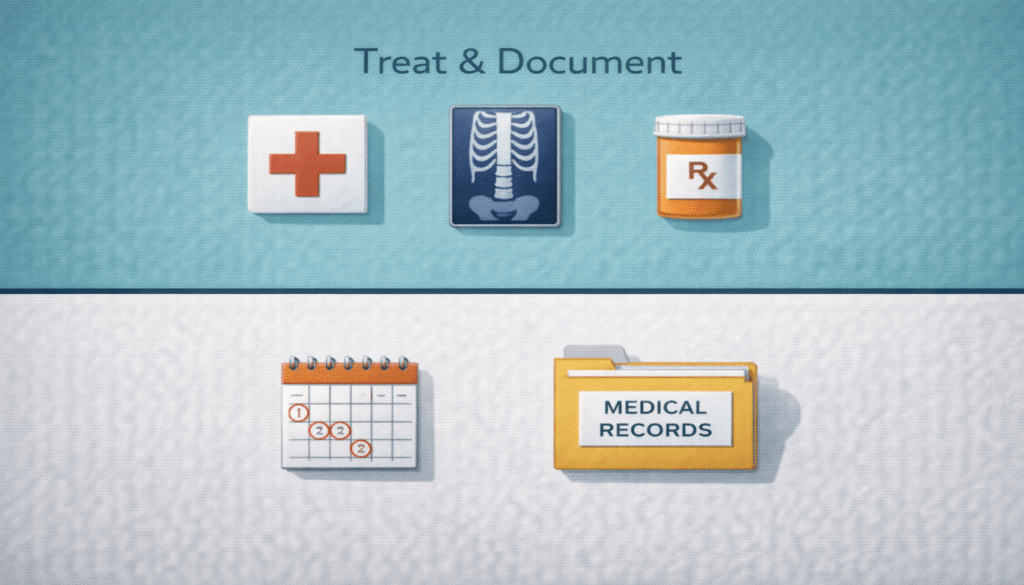
In the chaos after a crash, your health must be your absolute priority. The force of a semi-truck collision can cause severe injuries that aren’t immediately obvious due to shock and adrenaline. Seeking immediate and thorough medical care is not just critical for your recovery—it creates the essential documentation for your injury claim.
Step 1: Seek Immediate Medical Evaluation
Do not assume you are “okay” just because you can walk away. Go to an emergency room or see a doctor within 24 hours. This is non-negotiable.
- Why it’s urgent: Conditions like concussions (TBI), internal bleeding, whiplash, and spinal injuries often have delayed symptoms. A medical professional can identify these hidden problems.
- What to say: Tell the doctor exactly how the accident happened and describe every ache, pain, or unusual sensation, no matter how minor. This directly links your injuries to the crash in your medical records, establishing crucial causation for your claim.
Step 2: Document Every Aspect of Your Treatment
Your medical file is your most powerful evidence. Be meticulous.
- Follow Through: Attend all follow-up appointments, specialist referrals, physical therapy sessions, and recommended imaging (X-rays, MRIs). Gaps in treatment will be used to argue your injuries aren’t serious.
- Keep Everything: Create a dedicated file (digital or physical) for all medical records: ER discharge papers, doctor’s notes, diagnosis reports, test results, prescriptions, and receipts for co-pays or medications.
- Track Related Costs: Log mileage for every medical trip and keep receipts for any out-of-pocket expenses. These are recoverable economic damages.
Step 3: Monitor Delayed Symptoms & Keep a Recovery Journal
Your body’s full response to trauma can take days or weeks to emerge.
- Watch for Warning Signs: Be vigilant for new or worsening symptoms like headaches, dizziness, back pain, numbness, memory fog, or emotional changes. Report them to your doctor immediately.
- Maintain a Symptom Journal: This is a critical tool for documenting “pain and suffering.” Each day or week, briefly note:
- Your pain level (on a scale of 1-10)
- How your injuries limit daily activities (e.g., “couldn’t pick up my child,” “missed work due to headache”)
- Your emotional state (e.g., anxiety, sleep loss, frustration)
- Photograph visible injuries like bruises, scars, or casts as they evolve.
Why This Matters: Prompt medical attention is vital for health outcomes. As the Centers for Disease Control and Prevention (CDC) notes, early evaluation is key for detecting traumatic brain injury and other hidden trauma.
The records and journal you create form the undeniable proof of your damages. For a detailed breakdown of how these documents translate into financial recovery, see our guide: Economic and Non-Economic Damages in Semi-Truck Accident Claims.
Protecting Your Legal Rights After a Semi‑Truck Accident: What to Say, What to Avoid, and When to Report
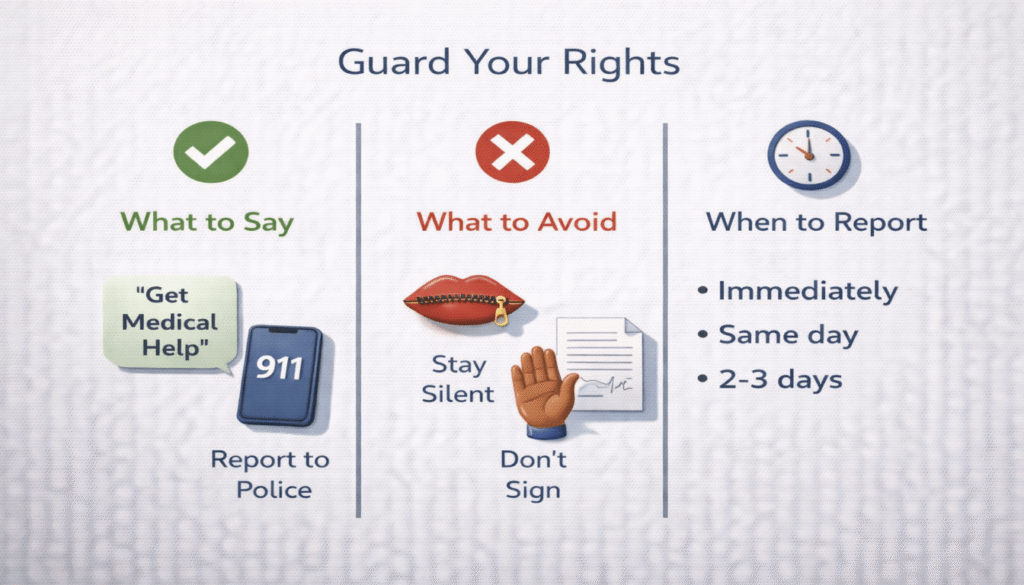
The legal battle over fault and compensation begins the moment the crash happens. Your words and actions in the immediate aftermath are critical. This section outlines how to protect your rights during conversations and official procedures.
Rule 1: Choose Your Words Carefully
What you say can be used to limit or deny your claim.
- To Police: Provide clear, factual answers about what you saw and experienced. Do not speculate, apologize, or admit any fault, even partially. Simply state the facts. Ask for the police report number before the officer leaves.
- To the Truck Driver or Company Representatives: Be polite but limit discussion. Do not engage in debates about how the crash happened. Your only goal is to exchange necessary information.
- To Insurance Adjusters: If contacted by the trucking company’s insurer, politely decline to give a statement. Tell them you are seeking medical care and will have your attorney contact them. Do not answer recorded questions.
Rule 2: Go Silent on Social Media
Assume everything you post online will be found and used against you.
- Do Not Post: Avoid posting any details, photos, check-ins, or updates about the accident, your injuries, your recovery, or your daily activities. Even a positive post like “Feeling better today!” can be twisted to argue your injuries aren’t severe.
- Adjust Privacy Settings: Set all social media profiles to private immediately, and ask family and close friends to avoid posting about your accident as well.
Rule 3: Navigate Official Notifications Correctly
- Your Own Insurance: You are required to notify your insurer of the accident. Provide only the basic facts (date, location, other vehicle). Do not give a recorded statement until you have consulted with an attorney.
- The Police Report: Follow up to confirm the report was filed and obtain your copy. Review it for accuracy. If there are factual errors (e.g., wrong location, missing witness), contact the officer to file a supplemental correction.
Rule 4: Preserve All Evidence and Communications
Start a dedicated file for all case-related materials.
- Document Everything: Save all emails, texts, and letters from insurance companies, the trucking company, or repair shops.
- Log All Contacts: Keep a simple log of every phone call related to the accident, noting the date, the person you spoke with, and a brief summary of what was discussed.
- Act with Urgency: Critical evidence like the truck’s Electronic Logging Device (ELD) data, black box (ECM) recordings, and dashcam footage can be automatically overwritten in as little as 30 days. An attorney can send a spoliation letter to legally compel the trucking company to preserve this data. The Federal Motor Carrier Safety Administration (FMCSA) regulations govern this evidence, but you must act to secure it.
Your Next Step: Protecting your rights is a complex, high-stakes process that requires strategic decisions. The single most effective action you can take is to consult with a specialized attorney who can handle these communications and legal maneuvers on your behalf. For a detailed guide on selecting the right legal advocate, read: Choosing the Best Lawyer for Your Semi-Truck Accident Case.
How to Start Your Semi-Truck Accident Claim: A Step-by-Step Guide
The immediate chaos has passed. Now, you must transition from emergency response to building a strong foundation for your legal and financial recovery. Starting a claim isn’t a single action; it’s a strategic process. Follow these steps in order to protect your rights and position your case for maximum compensation.
Step 1: Lock Down the Evidence (Formalize Your Preservation)
Your initial scene documentation was crucial. Now, you must take legal steps to ensure critical evidence isn’t destroyed.
- Execute a Spoliation Letter: An attorney will immediately send a legal hold letter to the trucking company and its insurer, demanding they preserve all digital evidence—Electronic Logging Device (ELD) data, the “black box” (ECM), GPS records, dashcam footage, and driver communications. This data can be overwritten in as little as 30 days.
- Secure Official Records: Obtain the complete police report and any crash reconstruction data. Begin requesting your full medical file.
- Use a Systematic Tool: Follow every item on our comprehensive Truck Accident Evidence Preservation Checklist to ensure no detail is missed.
Step 2: Establish Your Medical Baseline (The Cornerstone of Damages)
Your health is the priority, and your medical records are the most critical evidence for your claim’s value.
- Follow Through: Attend all follow-up appointments, specialist referrals, and physical therapy sessions. Gaps in treatment will be used by insurers to argue your injuries aren’t severe.
- Document Everything: Keep a detailed journal of your pain levels, mobility limitations, and how the injuries affect your daily life and work. This personal account supports the “pain and suffering” element of your claim.
- Create a File: Save every bill, diagnosis, prescription, and doctor’s note in one place.
Step 3: Consult a Specialized Semi-Truck Accident Lawyer
This is the most consequential decision you will make in your claim. Do not speak to the trucking company’s insurer before doing this.
- Why Specialization Matters: Trucking law involves complex federal regulations, multiple liable parties, and aggressive corporate defense teams. A specialized lawyer understands how to investigate company records (like driver logs and maintenance files) to prove systemic negligence.
- The Initial Consultation: Most attorneys offer free consultations. Bring all the evidence you’ve gathered. A good attorney will evaluate liability, explain the process, and outline a strategy.
- The Contingency Fee Model: Reputable truck accident lawyers work on contingency—they only get paid if you win a settlement or verdict. This aligns their success with yours.
Step 4: Navigate Official Notifications
Your lawyer will manage this, but you should understand the process.
- Your Own Insurance: You are contractually required to notify your insurer of the accident. Provide basic facts (date, location, other driver) but do not give a recorded statement or discuss details until you have legal counsel.
- The Trucking Company’s Insurer: Your attorney will handle all communication. They will receive a call from the adjuster quickly; your attorney ensures you do not make any statements that could harm your case.
- Third Parties: If a mechanical defect or improper loading is suspected, your attorney will identify and notify other potentially liable parties (e.g., maintenance shops, manufacturers, cargo loaders).
Step 5: Understand the Investigation Phase
Once an attorney is retained, the formal discovery process begins. This is where your claim is built.
- The Dual Investigation: While the trucking company’s team works to limit liability, your attorney’s investigators will be gathering evidence to prove it. They will subpoena the driver’s personnel file, the company’s safety policies, and years of maintenance records.
- Expert Analysis: Your legal team will hire experts such as accident reconstructionists, medical specialists, and forensic economists to scientifically prove how the crash happened, the extent of your injuries, and your future financial losses.
- The Timeline: This phase can take several months. Your attorney will keep you updated while building an unassailable file to present to the insurance company or in court.
Key Takeaway: Starting your claim correctly is about shifting from a reactive to a proactive stance. By methodically preserving evidence, documenting your injuries, securing expert legal counsel, and understanding the investigative battle ahead, you move from being a victim of the crash to a prepared claimant building toward recovery.
Building a Strong Semi‑Truck Accident Claim: Key Evidence, Reports, and Records
A successful claim is built on a foundation of organized, comprehensive evidence. The steps you take now to gather and preserve proof are what will ultimately prove liability and secure full compensation for your losses.

Step 1: Secure Critical Identifiers and Digital Data at the Scene
Your first goal is to lock down the information that directly links the truck and driver to their company and insurer.
- Essential Identifiers: Ensure you have the truck’s U.S. DOT number (on the cab door), license plate, the driver’s name and CDL number, and the exact legal name of the trucking company.
- Witness Information: Collect names and phone numbers from anyone who saw the crash.
- Preserve Digital Evidence: This is time-sensitive. The truck’s Electronic Logging Device (ELD) data, GPS history, and “black box” (Event Data Recorder) contain digital proof of speed, braking, and driver hours. This data can be overwritten in weeks. A lawyer can immediately issue a spoliation letter to legally require the trucking company to preserve it. Industry guides, such as this overview on evidence preservation after a truck crash, stress the critical importance of acting fast.
Step 2: Systematically Document All Damages and Communications
Create a dedicated file—digital or physical—for every single document related to the accident.
- Financial Records: Keep every bill, receipt, and invoice. This includes:
- Medical: ER bills, doctor visit co-pays, pharmacy receipts, physical therapy invoices, and mileage for appointments.
- Property & Income: Tow receipts, repair estimates, rental car costs, and letters from your employer documenting lost wages.
- Official Reports: Secure a copy of the complete police report and note its case number.
- Communication Log: Save every email and text. Keep a simple log of all phone calls with insurers, the trucking company, or medical providers, noting the date, person you spoke with, and what was discussed.
Step 3: Do Not Sign Anything Without Legal Review
Insurance adjusters may contact you quickly with settlement offers or forms to sign.
- Do Not Sign: Do not sign any settlement offers, medical releases, or liability waivers before having them reviewed by an attorney. Early offers are often designed to settle your case for far less than it is worth.
- Do Not Give Recorded Statements: Politely decline to give any recorded statement to the other party’s insurance company.
Your Evidence Checklist at a Glance:
| Evidence Category | Key Examples | Why It’s Critical |
|---|---|---|
| Identifiers & Data | U.S. DOT Number, ELD/Black Box Data | Links the truck to the carrier and proves driver violations (fatigue, speeding). |
| Financial Records | Medical Bills, Repair Estimates, Lost Wage Proof | Documents the economic damages you are entitled to recover. |
| Official Documentation | Police Report, Witness Statements | Establishes the factual record of the crash. |
Act Now: The window to secure the most critical evidence is narrow. For a detailed, step-by-step action plan, use our comprehensive guide: Preserving Evidence in Semi-Truck Accident Cases: A Legal Checklist. This checklist will ensure you miss nothing that could determine the outcome of your claim.
What Happens After the Accident: Driver Status, Police & FMCSA Investigations
In the days and weeks following a serious semi-truck accident, you may be left with haunting questions: What happened to the driver? Is anyone holding them accountable? What are the authorities doing? Understanding the official processes that unfold can provide clarity and show you where your civil claim fits into the larger picture.
1. The Immediate Aftermath: Driver Testing & Status
From the moment the police arrive, a strict protocol is triggered for the commercial driver.
- Mandatory Drug & Alcohol Testing: Federal regulations require the trucking company to test the driver after a serious accident. A refusal can lead to the driver’s immediate termination.
- Driver’s Immediate Status: The driver will likely be placed “out of service” (suspended from driving) pending investigation. Depending on the severity, they could be cited or even arrested at the scene. This official action can become key evidence in your case.
2. The Police Investigation: Building Your Official Record
The responding officers are focused on determining how the accident happened.
- The Police Accident Report: This document is a foundational piece of evidence for your claim. Ensure you obtain your copy and review it for accuracy.
- Potential Citations: If the officer issues a ticket to the truck driver (for speeding, etc.), that citation is strong evidence of a breach of duty that you can use to support your civil case.
3. The Trucking Company’s Internal Review (Protecting Their Interests)
You should assume the trucking company has launched its own investigation immediately. Their goal is to limit liability.
- They Are Building a Defense File: They will secure the truck, download its electronic data, and interview their driver. This is why you must act quickly to preserve evidence through a spoliation letter.
- Internal Driver Discipline: The company may suspend or fire the driver. This is an internal decision and does not mean they admit fault to you.
4. The Federal Investigation: FMCSA’s Role
For serious accidents, the Federal Motor Carrier Safety Administration (FMCSA) may investigate.
- Focus on Safety Violations: The FMCSA investigates whether the trucking company or driver broke federal safety rules (like Hours of Service). They are not determining who pays your damages.
- Outcomes That Help Your Case: If the FMCSA finds violations and issues fines, those findings can be powerful evidence in your lawsuit, showing a history of non-compliance.
Potential Outcomes for the Driver: How They Affect You
- Administrative: The driver could lose their commercial license.
- Civil: This is your lawsuit. The driver and company can be held financially liable for your medical bills, lost wages, and pain and suffering.
- Criminal: In extreme cases, the driver could face criminal charges. This is separate from your claim but can influence settlement negotiations.
Your Key Takeaway: A multi-layered investigation begins instantly. While the police and FMCSA focus on rules, your civil claim is the process dedicated solely to securing compensation for your losses. Understanding this helps you see the importance of having your own legal advocate, focused entirely on your recovery.
Who May Be Liable in a Semi-Truck Accident Case
In a semi-truck accident, the driver is often just one piece of the puzzle. Liability frequently extends to the company that employs them and other third parties whose negligence contributed to the crash. The Federal Motor Carrier Safety Administration (FMCSA) outlines how multiple parties can share responsibility, and your attorney’s job is to identify all of them to maximize your potential recovery.

Primary Target 1: The Truck Driver
The driver’s direct actions are the most common source of liability. Evidence can prove:
- Distracted, Fatigued, or Impaired Driving: Logs and witness statements can show violations of safety rules.
- Speeding or Aggressive Driving: Data from the truck’s “black box” (ECM) is key evidence.
- Traffic Violations: Citations issued at the scene are strong indicators of fault.
Primary Target 2: The Trucking Company
Under the legal principle of vicarious liability, a company is often responsible for its employee’s actions. Furthermore, the company itself can be directly liable for its own negligence in:
- Negligent Hiring, Training, or Supervision: Failing to properly vet or train drivers.
- Unrealistic Scheduling: Pressuring drivers to violate Hours-of-Service regulations, leading to fatigue.
- Poor Safety Culture: Ignoring known safety issues to cut costs.
Secondary Targets: Maintenance Providers & Cargo Loaders
Other businesses in the transportation chain can share blame:
- Maintenance Shops & Parts Suppliers: If a mechanical failure (e.g., bad brakes, tire blowout) caused the crash due to improper repair or a defective part, the shop or manufacturer can be held liable.
- Cargo Loaders & Shippers: Improperly secured or overweight cargo can make a truck unstable and cause a rollover or loss of control. The company that loaded the freight may be responsible.
Other Possible Liable Parties: Government & Manufacturers
In some cases, liability extends beyond the trucking industry:
- Government Entities: Dangerous road design, missing signage, or poor road maintenance can contribute to an accident. A municipality or state department of transportation may share fault.
- Vehicle Manufacturers: If a defect in the truck or trailer (not due to maintenance) caused the crash, a product liability claim against the manufacturer may be possible.
Understanding Liability at a Glance:
| Potentially Liable Party | Key Evidence to Find | How It Establishes Fault |
|---|---|---|
| Truck Driver | ELD Logs, Black Box Data, Traffic Citation | Proves immediate, unsafe actions. |
| Trucking Company | Driver Hiring/Training Files, Dispatch Records | Proves systemic negligence or vicarious liability. |
| Maintenance Provider | Repair Invoices, Parts Receipts, Mechanic Testimony | Links a mechanical failure to negligent work. |
| Cargo Loader | Loading Logs, Weight Tickets, Cargo Securement Photos | Shows improper loading caused instability. |
Your Next Step: Identifying all potentially liable parties is a complex investigation that requires legal expertise. It is crucial to securing full compensation, as it determines whose insurance policies will contribute to your recovery. For a complete breakdown of how liability is determined and proven, see our detailed guide: Legal Liability in Semi-Truck Accidents.
Working With a Semi‑Truck Accident Lawyer to Maximize Compensation
After a devastating crash, partnering with a specialized semi-truck accident lawyer is the single most important step you can take to protect your rights and maximize your financial recovery. The complexity of trucking cases—with multiple liable parties, federal regulations, and aggressive insurance defense—requires an expert advocate. As the American Bar Association notes, choosing the right attorney is critical in complex litigation where evidence is perishable and liability is heavily contested.

How Your Lawyer Builds an Unbeatable Case: The Investigation
Your attorney immediately launches a forensic investigation you cannot do on your own.
- Secures Critical Evidence: They send spoliation letters to lock down the truck’s electronic data (ELD logs, black box, GPS) before it’s overwritten. They obtain maintenance records, driver files, and company safety manuals.
- Identifies All Liable Parties: They look beyond the driver to the trucking company, maintenance contractors, cargo loaders, and manufacturers to ensure every source of compensation is pursued.
- Hires Key Experts: They engage accident reconstructionists, medical specialists, and economists to scientifically prove how the crash happened, the extent of your injuries, and your future losses.
How Your Lawyer Fights for You: Negotiation & Litigation
With a powerful evidence file, your attorney then fights on your behalf.
- Shields You from Insurers: They handle all communication with the trucking company’s insurance adjusters, preventing you from making any statements that could hurt your case.
- Negotiates from a Position of Strength: They use the assembled evidence and expert analysis to demand a full and fair settlement that reflects the true value of your claim.
- Is Ready to File a Lawsuit: If the insurance company refuses to offer a fair settlement, your attorney will file a lawsuit, conduct formal discovery (depositions, document requests), and prepare your case for trial with compelling testimony.
Why Time is Your Most Valuable Asset: Statutes & Deadlines
Acting quickly is not just about evidence—it’s the law.
- Statutes of Limitations: Every state has a strict deadline (often 2-3 years from the accident date) to file a lawsuit. Missing this deadline forfeits your right to compensation forever.
- Evidence Preservation: As outlined above, critical digital evidence on the truck can be lost in weeks.
- Witness Memories Fade: Securing statements while recollections are fresh is vital.
Your Key Takeaway: A specialized truck accident attorney does more than just “handle your case.” They become your strategist, investigator, and shield, deploying legal tools and resources to build maximum leverage from day one.
To ensure you choose an attorney with the specific experience needed to win, use our guide: How to Know If Your Lawyer Specializes in Semi-Truck Accident Cases.
Moving From Shock to Recovery After a Semi‑Truck Accident
The path from the initial shock of a semi-truck accident to full recovery is a journey. It requires you to be your own first advocate, transforming from a victim into a prepared claimant. This guide has provided your step-by-step action plan to navigate that transition with confidence.
You’ve learned your priorities:
- Immediate Safety & Evidence: Call 911, secure the scene, and document everything with photos and notes.
- Unwavering Health Focus: Seek medical care immediately, follow all treatment plans, and meticulously document your injuries and recovery.
- Proactive Legal Protection: Guard your words, avoid social media, and understand the importance of acting quickly to preserve evidence and consult with a specialized attorney.
By following this structured approach, you do more than just react—you build the foundation of a strong claim. You ensure that the liable parties are held accountable and that the full value of your medical bills, lost income, pain, and suffering is recognized.
Remember, you are not navigating this alone. The process involves official investigations, complex insurance negotiations, and potentially, litigation. Having a skilled legal advocate allows you to focus on your physical and emotional healing while they handle the legal battle.
Your journey continues here. For clear answers to the most common and pressing questions about your rights, case timelines, and what to expect next, explore our comprehensive resource: FAQs for Semi-Truck Accident Victims.
Frequently Asked Questions About Semi‑Truck Accidents: Rights, Recovery, and Compensation
Q: What should I do first at the scene of a semi‑truck accident?
A: Your absolute first priority is safety. If you can, move your vehicle out of active traffic lanes. Immediately turn on your hazard lights. Then, call 911 to report the crash and request both police and emergency medical services. Do this even if you don’t feel seriously hurt—adrenaline can mask injuries. This call creates the first official record of the accident and starts the process of getting you medical attention, which is critical for both your health and any future claim.
Q: Do I have to stay at the scene after a collision with a semi‑truck?
A: Yes, you are legally required to remain at the scene. Leaving the scene of an accident, especially one involving a commercial vehicle, can result in serious criminal charges (like a “hit-and-run”) and will severely damage—or completely destroy—your insurance claim and any potential lawsuit. You must stay until the police have arrived, you have exchanged information with the other driver, and you have been told you are free to leave by the responding officer.
Q: What information should I get from the semi‑truck driver and their company?
A: Collect these key pieces of information:
1. Driver’s name and Commercial Driver’s License (CDL) number.
2. Truck’s license plate and U.S. DOT number (on the cab door).
3. Trucking company’s full legal name and insurance details.
4. Witness contact information.
Q: How important are photos and witness details after a semi‑truck accident?
A: Critically important. They are the most time-sensitive evidence you can collect.
Photo create an unchangeable record of the scene, damage, and road conditions.
Witness details provide independent accounts that support your case.
Gather them immediately, as this evidence can disappear within hours.
Q: When should I seek medical evaluation after a semi‑truck accident?
A: Immediately. Go to an emergency room or urgent care center right away, even if you feel “okay.” Symptoms of serious injuries like concussions, internal bleeding, or spinal damage can be delayed by shock and adrenaline. A prompt medical exam does two critical things:
1. Protects your health by diagnosing hidden injuries.
2. Creates an official record that directly links your injuries to the accident, which is essential for your claim.
Do not wait.
Q: What if my symptoms start days after the semi‑truck accident?
A: Yes, it is absolutely necessary. Delayed symptoms (like headaches, back pain, or dizziness) are common after the adrenaline wears off. You must:
1. Report them to your doctor immediately to get the right treatment and update your medical record.
2. Document them in a journal, noting the date each symptom started and how it affects your daily life.
This documentation is crucial. It proves to the insurance company that these are legitimate, accident-related injuries and not a new, unrelated issue. Failing to report delayed symptoms can seriously weaken your claim.
Q: What should I avoid saying at the scene or to an insurance adjuster?
A: You must avoid three things: apologies, admissions of fault, and speculation.
1. Never say “I’m sorry,” “It was my fault,” or “I didn’t see you.”
2. Do not guess at causes like, “I must have been speeding,” or “The sun was in my eyes.”
3. To insurers, stick to basic facts (date, location, vehicles involved). Do not give a recorded statement without your attorney.
Q: Should I post about my accident or recovery on social media?
A: No. You should avoid all social media activity related to the accident. Do not post photos, details, updates about your recovery, or even general activity. Assume insurance investigators are watching.
Set all profiles to private immediately and ask friends and family not to post about you or tag you. Even a positive post like “Feeling better today!” can be used to argue your injuries are not serious. The safest rule is to go silent until your case is fully resolved.
Q: When and how do I notify my own insurance company about the accident?
A: Notify them within 24-48 hours to comply with your policy, but be very careful about what you say. Only provide the basic facts: the date, location, and that a semi-truck was involved.
Crucially, do not:
Give a detailed recorded statement.
Speculate about who was at fault.
Discuss the extent of your injuries.
Politely state you are seeking medical care and will have your attorney follow up. Your attorney can then handle all further communication to protect your rights.
Q: What specific evidence do I need for a claim against a trucking company?
A: You need a combination of scene evidence, personal records, and the trucking company’s own data.
Your Documentation: Police report, scene photos/video, all medical records/bills, proof of lost wages, and repair estimates.
The Trucking Company’s Data: This is the most critical. Your attorney must immediately request the truck’s Electronic Logging Device (ELD) data, maintenance records, and the driver’s personnel file to prove violations and negligence.
Preserve everything. The company’s internal records are often the key to winning your case.
Q: Who can I sue after a semi‑truck accident?
A: Liability often extends beyond just the driver. You may have claims against:
1. The truck driver for negligent operation.
2. The trucking company for negligent hiring, training, or pressuring drivers.
3. Maintenance companies or parts manufacturers if a mechanical failure caused the crash.
4. Cargo loaders for improperly secured or overweight freight.
5. Government entities for dangerous road conditions.
A thorough investigation is needed to identify all potentially liable parties, which is why specialized legal help is essential.
Q: Can a city or state be liable for a truck accident caused by a bad road?
A: Yes, government entities can share liability for accidents caused by dangerous road conditions like potholes, missing guardrails, poor design, or faded signage.
However, these claims have very strict, short deadlines (often just months) to file a formal notice of claim against the government. Missing this deadline forfeits your right to sue them. If road conditions played a role, you must consult an attorney immediately to preserve this potential claim.
Q: Why do I need a lawyer who specializes in semi-truck accidents?
A: Because trucking cases are a specialized legal battlefield. A specialized lawyer understands the federal regulations, electronic data, and complex insurance layers specific to the trucking industry. They know how to secure the truck’s “black box” data before it’s erased, subpoena company safety records, hire the right accident reconstruction experts, and negotiate with powerful trucking insurers to recover the full compensation you need for medical bills, lost income, and your suffering. A general personal injury lawyer may not have this specific expertise.
Q: How soon do I need to act after a semi‑truck accident?
A: Immediately. You face two critical deadlines:
1. Evidence Deadline: The truck’s electronic data (like black box and driver logs) can be automatically erased in 30 days or less. A lawyer must act fast to preserve it.
2. Legal Deadline (Statute of Limitations): You have a limited time—often just 2 to 3 years from the accident date—to file a lawsuit. Missing this deadline forfeits your right to any compensation.
The sooner a lawyer investigates, the stronger your claim will be. Do not wait.
Q: What kind of compensation can I recover after a semi‑truck accident?
A: You can seek compensation for all your losses, which typically fall into two categories:
1. Economic (Financial) Damages:
All medical bills (emergency care, surgery, therapy)
Lost wages and future lost earning capacity
Vehicle repair or replacement costs
Other out-of-pocket expenses
2. Non-Economic (Personal) Damages:
Pain and suffering
Emotional distress
Loss of enjoyment of life
In cases of severe negligence, punitive damages may also be available to punish the wrongdoer.
A specialized lawyer will calculate the full value of both your current and future losses to ensure you are fully compensated.
Q: How do insurance companies calculate my lost income and future earnings?
A: They calculate it in two parts:
1. Past Lost Wages: Based on your pay stubs, tax returns, and a letter from your employer proving time missed.
2. Future Lost Earning Capacity: If your injuries affect your ability to work long-term, an economic expert will analyze your career path, age, and disability to project the total income and benefits you will lose over your lifetime.
A specialized lawyer ensures all future losses—including reduced promotion potential or needed career changes—are included in the calculation.
Q: Should I accept the first settlement offer from the insurance company?
A: It is highly risky to accept any offer without consulting a lawyer. The first offer is almost always a low-ball settlement designed to close your case quickly and cheaply. It will not account for your future medical bills, ongoing pain, or lost earning potential.
A lawyer will calculate the true, long-term value of your claim and negotiate to get you full compensation. Accepting an early offer often means you cannot ask for more money later, even if your condition worsens.
Q: How important is the police report for my truck accident claim?
A: It is a foundational piece of evidence. The police report provides an official, third-party record of the crash scene, including the officer’s initial observations, any citations issued, and a diagram. While not the final word on fault, it is crucial for:
Guiding the initial investigation.
Supporting requests for other evidence (like traffic camera footage).
Establishing a timeline and factual baseline for your claim.
You must obtain a copy and review it for accuracy. If there are factual errors, contact the officer to file a supplemental correction.
Q: How does the truck’s “black box” and electronic logs prove fault?
A: This digital evidence is often the most powerful proof of negligence. The truck’s devices record:
Black Box (ECM/EDR): Exact speed, braking force, steering input, and engine RPM seconds before the crash.
Electronic Logging Device (ELD): The driver’s hours and duty status, proving if they were fatigued or violating federal driving limits.
This objective data doesn’t lie. It can prove speeding, distraction, or driver fatigue, making it essential for your lawyer to secure this data immediately before it’s erased.
Q: What should my family do after a fatal semi-truck accident?
A: The immediate steps are critical and overwhelming. Your family should focus on:
1. Secure Official Documents: Obtain the official death certificate and the police accident report.
2. Preserve Evidence: Gather all related records (medical, employment, communications). Do not sign anything from the trucking company’s insurer.
3. Contact a Specialized Wrongful Death Lawyer Immediately: These cases are exceptionally complex. A lawyer with specific experience in trucking wrongful death is essential to investigate fully, identify all liable parties (driver, company, manufacturers), and protect your family’s right to compensation for funeral costs, lost financial support, and loss of companionship.
Time is critical due to strict legal deadlines and the risk of evidence being destroyed.
Q: When can I get punitive damages in a truck accident case?
A: Punitive damages are not for every case. They may be awarded to punish the defendant when their conduct was especially reckless or intentional—like a company knowingly forcing a driver to violate safety laws or a driver being extremely impaired.
Your lawyer must prove “gross negligence” or “willful misconduct.” These damages are subject to strict state laws and caps, so an experienced attorney must evaluate if your case qualifies.
Q: How much does it cost to hire a truck accident lawyer?
A: Most specialized truck accident lawyers work on a contingency fee basis. This means:
You pay $0 upfront.
The lawyer only gets paid if they win money for you.
Their fee is a percentage of your final settlement or award.
You are typically responsible for case expenses (like filing fees, expert witnesses), but these are often advanced by the firm and reimbursed from your recovery. A clear fee agreement will outline all costs before you hire them.
Q: What if I’m found partially at fault for the accident?
A: Most states use comparative fault rules. This means your compensation will be reduced by your percentage of fault.
Example: If you are found 20% at fault and your total damages are $100,000, you would recover $80,000.
Crucial Limit: In many states, if you are found 50% or 51% or more at fault, you recover nothing.
A skilled lawyer fights to minimize the fault assigned to you by presenting strong evidence against the truck driver and company, protecting your right to full recovery.
Q: Where can I find more help and information after the accident?
A: For official information and support, you can consult:
The Federal Motor Carrier Safety Administration (FMCSA): For carrier safety records and regulations.
Your State’s Department of Transportation: For local crash report procedures.
Your medical providers: For complete treatment records.
A specialized semi-truck accident lawyer: This is your most critical resource for navigating the legal process, accessing all evidence, and securing full compensation.
They can guide you to all other necessary resources.
⚖️ Disclaimer: The information provided in this article is for general informational purposes only and does not constitute legal advice. While we strive to ensure the accuracy and reliability of the content, laws and regulations may vary by state, and individual cases may have unique circumstances. For advice tailored to your specific situation, please consult a lawyer. The inclusion of links to external resources does not imply endorsement or guarantee of the information provided therein.