
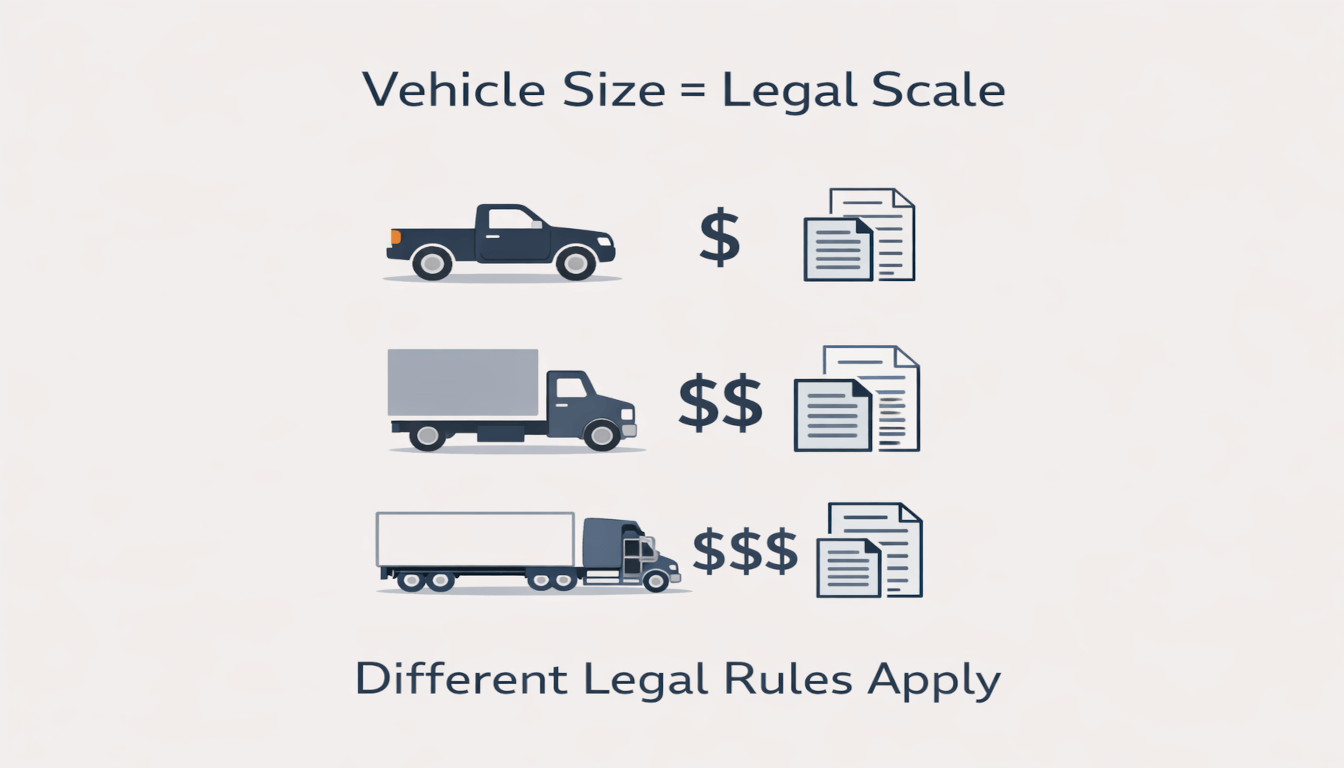
In 2024, thousands of commercial motor vehicle crashes across the United States resulted in catastrophic injuries and fatalities. These figures underscore how vehicle classification can dramatically change the stakes in a semi‑truck accident case. The way courts and insurers label a truck, tractor‑trailer, or delivery van affects the rules applied, the type of proof required, and the compensation available to victims.
Federal weight and axle standards often trigger stricter safety rules and higher minimum insurance limits, shaping an attorney’s litigation strategy. Readers will learn how GVWR categories, CDL requirements, and endorsements influence negligence claims and employer responsibility in semi‑truck accident litigation.
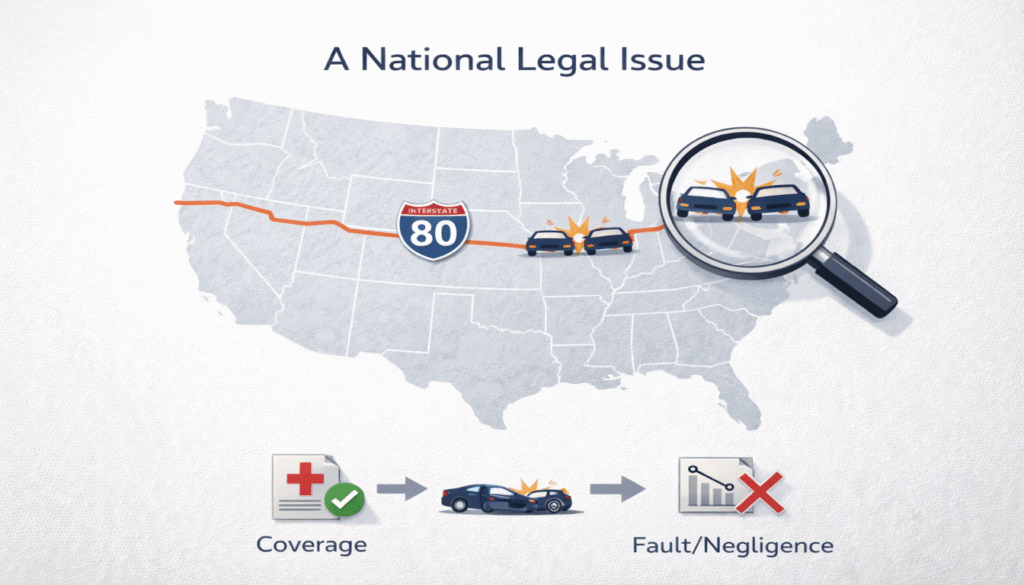
Crash clusters on major freight corridors—including interstates such as I‑40, I‑70, I‑80, and I‑95—illustrate where heavy rigs and delivery vans concentrate risk. These patterns appear nationwide, revealing how classification intersects with liability and compensation in semi‑truck accident claims.
Early investigation is critical. Insurer response teams often act within 24 hours, so preserving driver logs, black box data, and maintenance records quickly can protect the value of a claim and strengthen recovery efforts.
For more on how federal trucking laws shape liability and compensation, see Federal Trucking Laws That Impact Semi‑Truck Accident Claims.
Key Takeaways
- Classification affects applicable federal rules and insurance exposure.
- Higher weight classes often mean larger policies and greater compensation potential.
- CDL status and endorsements can elevate employer liability.
- Crash clusters on major routes show where evidence is often needed fast.
- Early attorney involvement preserves critical data for strong claims.
Commercial Vehicle Classes in Semi‑Truck Accident Cases: The Ultimate Guide to Definitions, Liability, and Compensation
Definitions and licensing determine who bears responsibility after a serious roadway event. According to the FMCSA Commercial Driver’s License (CDL) Standards, weight thresholds, CDL rules, and endorsements directly affect liability, evidence, and damages in semi‑truck accident cases.
Federal rules often treat any truck over 10,001 pounds used in interstate commerce differently than state law. While federal standards establish uniform safety and insurance requirements nationwide, individual states may set higher thresholds or unique licensing rules. For example, some jurisdictions apply stricter CDL requirements at 26,001+ GVWR, while others focus on passenger capacity or hazardous cargo.
Across the country, highways and freight corridors carry a mix of delivery trucks, regional carriers, and 18‑wheelers—conditions that complicate liability, timelines, and the proof required in semi‑truck accident cases.
CDL Classes and Endorsements:
- Class A, B, and C hinge on GVWR and passenger or hazmat duties.
- Endorsements such as H, N, P, S, T, and X raise safety obligations.
- A mismatch between the driver’s license and the rig they operate strengthens a claim against both driver and employer.
Key Evidence and Insurance Factors:
- FMCSA records, maintenance logs, and ELD data are time‑sensitive.
- Insurance minimums, umbrella layers, and policy disputes affect recovery time.
- Prompt legal consultation preserves critical proof and sets case strategy.
For more on how federal trucking regulations shape liability and compensation, see How Federal Trucking Regulations Affect Semi‑Truck Accident Cases.
Understanding Commercial Motor Vehicle Definitions and Weight‑Based Classifications in Semi‑Truck Accident Claims
Legal exposure often turns on how a truck’s weight, purpose, and axle layout map to federal safety rules. The FMCSA explains who must hold a CDL and how classes and endorsements apply to different commercial motor vehicles on its Drivers: Commercial Driver’s License (CDL) overview. Establishing the correct category early shapes which standards apply and which records are discoverable in semi‑truck accident cases.
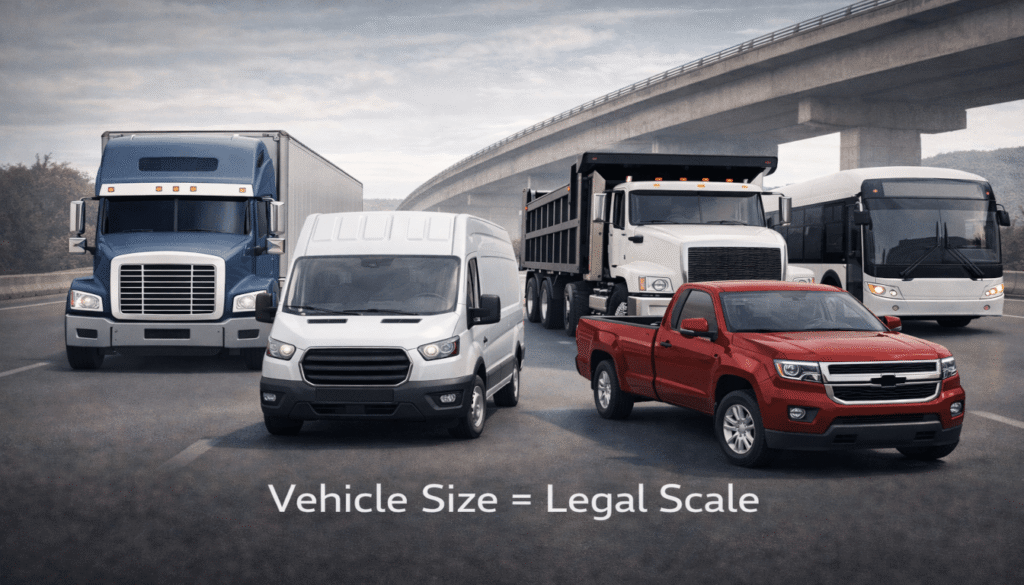
Federal CMV Definition and FMCSA Scope in Semi‑Truck Accident Cases
A commercial motor vehicle (CMV) is any self‑propelled or towed unit used on public highways to move goods or passengers that meets one of these federal triggers:
- Weight: 10,001 pounds or more.
- Passengers: Designed to carry more than eight paid passengers or more than 15 unpaid passengers.
- Hazardous materials: Hauls hazmat subject to placarding.
This CMV status activates FMCSA oversight and carrier safety rules that matter to liability and proof in semi‑truck accident litigation.
FHWA Vehicle and Truck Classifications in Semi‑Truck Accident Investigations
The Federal Highway Administration (FHWA) sorts motor traffic into 13 classes based on axle count, tires, and unit configuration. These axle and unit counts help reconstruct braking, load transfer, and impact forces in semi‑truck accident investigations.
GVWR Thresholds and Weight‑Based Truck Classes in Semi‑Truck Accident Claims
GVWR (Gross Vehicle Weight Rating) is the manufacturer‑assigned maximum safe operating weight of a truck, including the vehicle, cargo, fuel, and driver.
| Class | GVWR (pounds) | Relevance |
|---|---|---|
| Class 3 | 10,001–14,000 | Light rig; federal triggers begin |
| Class 6 | 19,501–26,000 | Heavier loads affect stopping distance |
| Class 8 | 33,001–80,000 | Highest crash energy; larger damages |
Documenting true operating weight, cargo placement, and axle loads is critical. Counsel should tie the measured pounds and configuration to applicable federal motor carrier standards to strengthen liability arguments.For a deeper look at how classifications make semi‑truck accident claims different from car accident claims, see Semi‑Truck Accident vs Car Accidents.
“Classifying the unit precisely unlocks the records and rules that prove liability.”
CDL License Classes, Endorsements, and Their Impact on Semi‑Truck Accident Liability
A driver’s credential set often determines which safety rules and training requirements apply when a wreck occurs. The Electronic Code of Federal Regulations, Part 383 details CDL standards, requirements, and penalties, providing the legal foundation for liability when semi‑truck accidents involve credential mismatches.
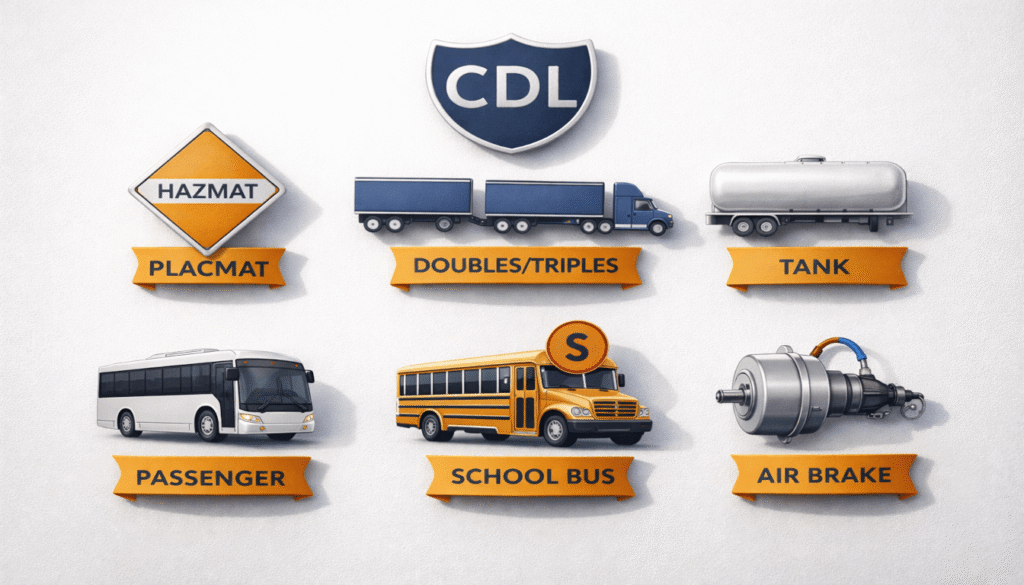
Class A, B, and C CDL Requirements in Semi‑Truck Accident Cases
- Class A covers combinations with GVWR 26,001+ pounds where the trailer exceeds 10,000 pounds. Typical examples include tractor‑trailers and flatbeds.
- Class B applies to single units 26,001+ GVWR or towing under 10,000 pounds, such as box trucks and large buses.
- Class C is for vehicles carrying 16+ passengers or hazardous material without the heavier weight triggers.
Hazmat, Tanker, Passenger, School Bus, and Trailer Endorsements in Semi‑Truck Accident Liability
Endorsements H, N, P, S, T, and X demand extra testing and training. They raise the standard of care for drivers who haul cargo that risks public safety.
How CDL Mismatches Increase Negligence in Semi‑Truck Accident Cases
A truck driver operating outside the proper class or without required endorsements can show negligence and negligent entrustment by companies. Credential gaps also prompt insurer disputes about coverage applicability and can strengthen a claimant’s case.
CDL Types and Why They Matter in Semi‑Truck Accident Claims
| CDL Type | Typical Units | Why It Matters |
|---|---|---|
| Class A | Tractor‑trailers, tank combos | Requires towing endorsement and higher training |
| Class B | Box trucks, straight trucks, buses | Focus on single‑unit control and load securement |
| Class C | Hazmat loads, passenger vans | Centers on passenger safety and hazmat handling |
Counsel should demand the driver qualification file, road test results, endorsement records, and recent training. A review of federal motor carrier audits and citations can show systemic motor carrier safety failures. For more on how credential issues and complex liability theories shape claims, see Why Semi‑Truck Accident Cases Are Unique.
How Vehicle Type, Size, and Cargo Determine Fault in a Semi-Truck Accident Claim
Size and cargo often determine which negligence theories and insurance defenses become central to a semi‑truck accident claim. The FMCSA Insurance Requirements establish federal minimums for commercial motor carriers, shaping how liability and coverage disputes unfold after a crash.
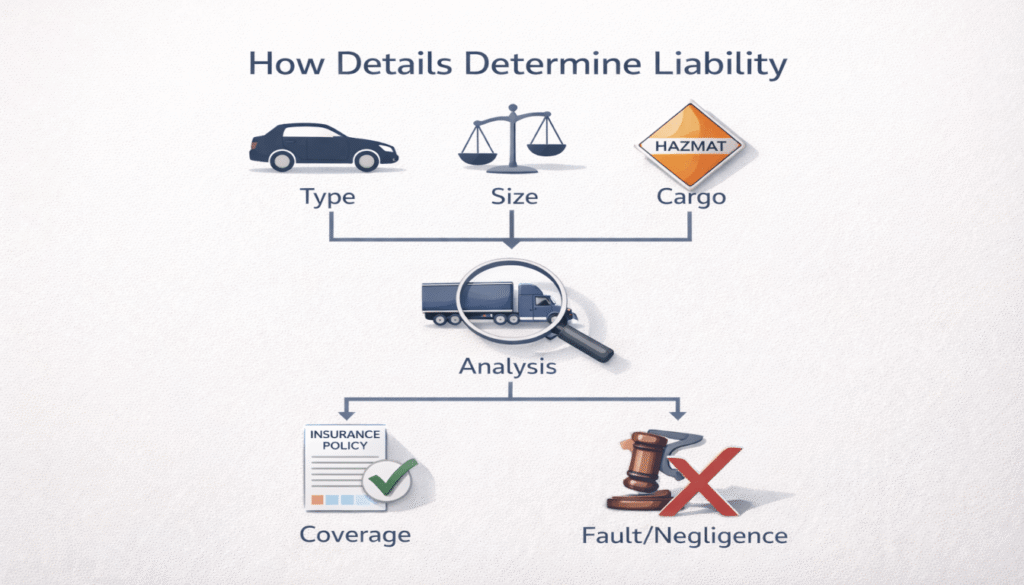
Common Liability Theories in Semi‑Truck Accident Cases: Driver Error, Regulatory Violations, and Employer Responsibility
Speed, fatigue, improper loading, and missed maintenance are common drivers of liability. A licensing mismatch or missing hazmat endorsement can create direct claims for negligent hiring and supervision. Violations of FMCSA rules—such as hours‑of‑service breaches or poor maintenance—often become strong evidence of negligence in semi‑truck accident litigation.
Insurance Minimums, Motor Carrier Coverage, and Policy Disputes in Semi‑Truck Accident Claims
- Federal minimums for units over 10,000 pounds start at $750,000.
- Many motor carrier policies carry $1,000,000 primary limits plus umbrella coverage.
- Insurers deploy quick response teams within 24 hours to shape the early narrative.
Regulatory breaches may support negligence per se and increase settlement leverage. Policy exclusions and endorsement gaps often spark coverage fights. Vehicle size and cargo raise stopping distances and expected damages, making classification central to liability and compensation.
For more on how evidence strengthens liability arguments in trucking cases, see Evidence in Semi‑Truck Accident Cases.
| Factor | How It Affects Fault | Common Insurance Outcome |
|---|---|---|
| Hours‑of‑Service Violation | Shows fatigue and foreseeability | Strengthens plaintiff’s claim; insurer exposure rises |
| Improper Loading | Creates control and brake issues | Higher damages; cargo owner may be implicated |
| CDL Mismatch | Triggers negligent hiring/supervision claims | Coverage disputes; possible denial by insurer |
“Early preservation of ELD, maintenance logs, and scene evidence is vital to protect compensation.”
Nationwide Semi‑Truck Accidents: Highways, Crash Patterns, Investigations, and Damages Across the U.S.
Semi‑truck accidents remain a major safety concern across the United States. According to the National Highway Traffic Safety Administration (NHTSA), thousands of large truck crashes occur annually, with fatalities and serious injuries concentrated along major freight corridors. These numbers highlight where risk concentrates and why quick action matters after a collision.
Where and Why Semi-Truck Accidents Happen: Interstates, Freight Corridors, Delivery Vans, and Semi-Trucks
Semi‑truck accidents occur most often along the nation’s busiest freight corridors, where long‑haul traffic intersects with daily commuter flow. High‑volume interstates such as I‑40, I‑70, I‑80, and I‑95 carry heavy concentrations of tractor‑trailers, regional delivery trucks, and passenger vehicles. This mix of freight and local traffic raises collision frequency and complicates liability assessments.
Congested metro areas, distribution hubs, and shipping lanes near major ports also see elevated crash risks. Delivery vans weaving through urban streets and 18‑wheelers navigating crowded interchanges create scenarios where driver error, cargo shifts, and regulatory violations can quickly escalate into serious accidents.
Primary Causes of Semi-Truck Accidents: Hours of Service, Fatigue, Speeding, Weather, and Equipment Failures
Common causes include:
- Hours‑of‑Service (HOS) violations and driver fatigue.
- Speeding and aggressive driving.
- Adverse weather conditions like snow, rain, or fog.
- Mechanical failures tied to poor maintenance.
Many of these causes are preventable and directly link to injury severity and damages in semi‑truck accident claims.
Semi-Truck Accident Reconstruction: Black Box Data, Driver Logs, Carrier Safety, and Quick Response Teams
Highway patrol and reconstruction experts use mapping and surveying to recreate crashes. Insurers’ quick response teams often arrive within 24 hours to shape the narrative. Electronic Logging Device (ELD) data, driver logs, and maintenance records become central to proving fault and showing how vehicle weight and cargo loads affect crash energy.
Injuries and Damages in Semi‑Truck Accident Cases: Medical Care, Lost Earning Capacity, Property Damage, and Exemplary Damages
Typical injuries range from fractures to long‑term impairment. Damages often include:
- Medical care and rehabilitation costs
- Lost earning capacity
- Property damage
- Mental anguish and pain and suffering
Exemplary damages may be possible but are capped by statute in many jurisdictions. Early documentation of road and weather conditions preserves key causation evidence.
Key Factors in Semi‑Truck Accident Liability and Compensation
| Factor | Why It Matters | Common Outcome |
|---|---|---|
| HOS Violation | Shows fatigue and foreseeability | Increased insurer exposure |
| Black Box/ELD | Records speed, braking, hours | Strong proof of fault |
| Weight/Load (pounds) | Affects crash energy and injury severity | Higher damages; multiple liable parties |
For more on how federal safety rules shape liability outcomes, see Hours‑of‑Service Violations in Semi‑Truck Accidents.
“Preserve ELDs, maintenance logs, and scene photos—the first 24 hours shape claims.”
Building a Strong Semi-Truck Accident Case: Evidence, Timelines, and Legal Representation
A swift, organized evidence plan often makes the difference between a resolved case and a stalled lawsuit. Counsel must move quickly to preserve fragile proof and to counter insurers’ early scene control. The Federal Motor Carrier Safety Administration (FMCSA) sets national safety and compliance standards, making its records and audits critical in semi‑truck accident litigation.
Early Evidence Strategy in Semi‑Truck Accident Cases: Preserving ELD Data, Maintenance Records, and FMCSA Compliance Proof
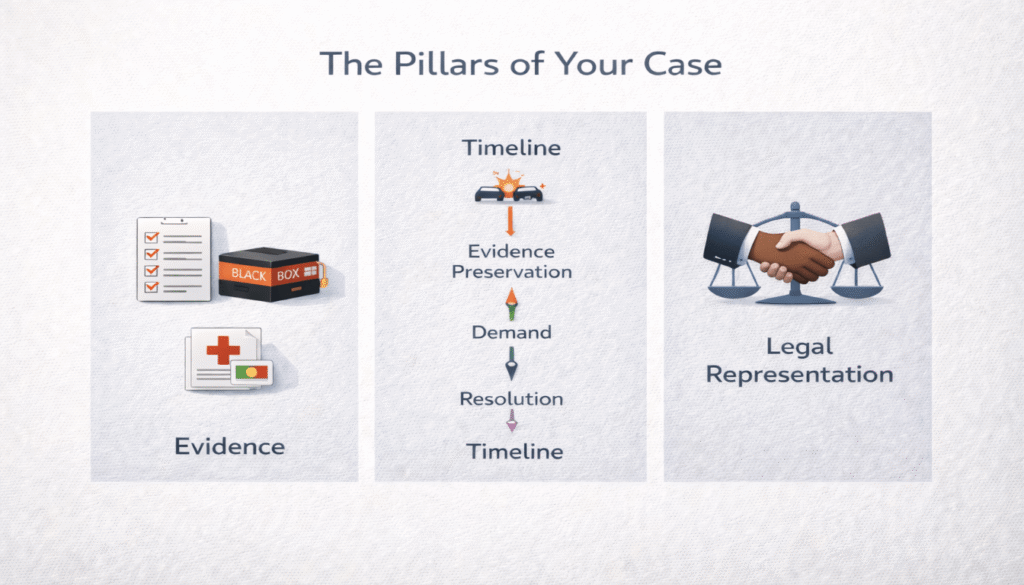
The immediate priority is to secure Electronic Logging Device (ELD) and Engine Control Module (ECM) data, driver logs, inspection reports, and maintenance files before over‑the‑air updates or repairs alter them. Litigation holds and prompt subpoenas can lock down FMCSA compliance records, carrier audits, and training files that reveal systemic violations. Accident reconstruction reports from highway patrols nationwide often tie these records directly to cause and fault.
Identifying All Parties in Semi‑Truck Accident Cases: Drivers, Motor Carriers, Brokers, Shippers, and Equipment Companies
Liability can extend beyond the driver to include the motor carrier, broker, shipper, trailer owner, and maintenance companies. Each party may add insurance layers or indemnity paths for recovery, making early identification essential.
Evidence Checklist
| Action | Why It Matters | Who to Target |
|---|---|---|
| Preserve ELD/Black Box | Shows speed, braking, hours | Driver; carrier |
| Collect Maintenance Files | Proves faults or missed repairs | Repair shops; fleet managers |
| Document Scene | Skid marks, photos, witness statements | Investigators; police |
A skilled attorney coordinates medical records, expert analysis, and insurer communication. Many firms offer free consultations and contingency representation to act quickly. Time is critical—filing deadlines and competing claims can exhaust insurance limits fast.
For a step‑by‑step guide on preserving records and building liability, see Preserving Evidence in Semi‑Truck Accident Cases.
“Preserve electronic logs and scene photos within the first 24–72 hours to protect the claim.”
Commercial Vehicle Classification and Its Impact on Liability and Compensation in Semi‑Truck Accident Cases
Precise classification of a truck’s weight, type, and licensing often decides who pays and how much. The Federal Highway Administration (FHWA) outlines national vehicle classes by weight and axle configuration, standards that directly shape liability, insurance coverage, and damages in semi‑truck accident cases.
State and federal tests, GVWR thresholds, and FHWA categories determine which safety rules apply. Proper CDL status and endorsements for a truck driver are core safety duties that directly affect negligence claims and insurer exposure.
Act quickly:
- Document injuries and medical care.
- Preserve ELD and maintenance records.
- Identify all vehicles and responsible entities.
- Secure legal representation before insurers steer the narrative.
Many carriers hold $750,000 minimum coverage or $1,000,000 primary limits plus umbrella policies. Early legal advocacy helps manage coverage disputes and protect recoverable damages. For a deeper look at how federal safety laws shape liability, see Federal Trucking Laws That Impact Semi‑Truck Accident Claims.
Frequently Asked Questions (FAQ) About Semi‑Truck Accident Cases and Commercial Vehicle Classifications
What is a commercial motor vehicle under federal law and why does that matter after a semi‑truck accident?
The Federal Motor Carrier Safety Administration (FMCSA) defines a commercial motor vehicle by weight, passenger count, or transport of hazardous materials. That federal definition determines which safety rules apply, which records must be preserved, and which agencies investigate. Identifying this status early helps victims secure evidence, establish regulatory violations, and pursue higher insurance limits and carrier liability in semi‑truck accident claims.
How do state definitions affect a semi‑truck accident claim?
States set registration, licensing, and sometimes different weight thresholds that affect enforcement and civil liability. While many states follow federal standards, local rules on registrations, highway enforcement, and court procedures can vary. Lawyers evaluate both federal and state classifications to pinpoint responsible parties and applicable legal duties in semi‑truck accident cases.
How do axle count, units, and tire configurations factor into truck classification?
Agencies such as the Federal Highway Administration classify trucks by axle groups, trailer units, and tire arrangement. These technical details influence GVWR calculations, determine which inspections applied, and can reveal improper configurations or overloading—facts that support negligence and damages claims in semi‑truck accidents.
What GVWR thresholds are most important for injury claims?
Gross vehicle weight rating (GVWR) thresholds set obligations for drivers, carriers, and insurers. Vehicles above certain GVWRs face stricter maintenance, logbook, and insurance requirements. Establishing a truck’s GVWR helps lawyers demand regulatory records and higher policy limits when pursuing compensation for medical costs and lost wages after a semi‑truck accident.
How do CDL classes and endorsements affect liability after a collision?
Commercial driver license (CDL) classes A, B, and C and endorsements (hazmat, tanker, passenger, school bus) dictate the driver’s legal qualifications for specific rigs and cargo. A mismatch between the CDL held and the vehicle operated can show negligence by the driver and employer, strengthening a claimant’s case for fault and punitive damages in semi‑truck accident litigation.
When does a CDL mismatch increase employer liability?
If an employer knowingly allowed an improperly licensed driver to operate a rig, that decision can amount to negligent hiring, supervision, or retention. Motor carriers must verify endorsements and maintain training records; failure to do so opens the company to vicarious and direct liability for semi‑truck accidents and resulting injuries.
Which types of cargo increase the carrier’s safety obligations?
Hazardous materials, bulk liquids, and passengers raise the legal duty of care. Hazmat and tanker loads require special endorsements, placarding, and route restrictions. When carriers fail to follow those rules, plaintiffs can pursue heightened negligence claims and statutory penalties tied to unsafe transport in semi‑truck accident cases.
What are the main liability theories in semi‑truck accident cases?
Common theories include driver error, regulatory violations (hours‑of‑service, maintenance, weight limits), negligent hiring or supervision by the carrier, defective equipment from manufacturers, and broker or shipper negligence for improper loading or routing. Attorneys build claims around multiple avenues to maximize recovery.
How do insurance minimums and motor carrier coverage disputes affect recovery?
Federal and state rules set minimum insurance for commercial operations, but those limits may be insufficient for serious injuries. Disputes often arise over whether a policy covers a particular loss, whether a broker or shipper qualifies as a motor carrier, and whether umbrella or excess policies apply. Early counsel is essential to preserve claims against all available insurers in semi‑truck accident cases.
What evidence should be preserved immediately after a semi‑truck accident?
Priority evidence includes electronic logging device (ELD) data, driver inspection reports, maintenance logs, black box data, CCTV or dashcam footage, cargo documents, and contact information for witnesses. Preserving FMCSA records and carrier safety scores also helps show regulatory violations and patterns of negligence.
Who can be named as defendants beyond the truck driver?
Potential defendants include motor carriers, leasing companies, freight brokers, shippers, cargo loaders, maintenance shops, and equipment manufacturers. Identifying all parties quickly allows for timely notice and evidence preservation, and prevents insurers or companies from evading responsibility in semi‑truck accident claims.
How do crash locations influence investigation and damages?
Major highways and freight corridors across the U.S. see heavy commercial traffic and unique crash patterns. Investigators consider roadway design, traffic density, and local dispatch practices. Fatalities and catastrophic injuries on interstate corridors often produce higher economic and non‑economic damages, triggering specialized reconstruction and expert analysis.
What role does accident reconstruction play in proving fault?
Reconstruction combines black box data, skid marks, damage patterns, and scene photos to recreate events. It can show speed, braking, steering inputs, and sequence of impacts. Strong reconstruction supports claims of negligence and counters defenses that shift blame to the injured party in semi‑truck accident cases.
Which injuries and damages are common and compensable in semi‑truck accidents?
Severe outcomes include spinal cord injuries, traumatic brain injury, amputations, and multiple fractures. Compensable damages encompass medical expenses, future care, lost earning capacity, pain and suffering, and property damage. In cases of egregious conduct, exemplary damages or statutory penalties may apply.
How soon should a victim seek legal representation after a semi‑truck accident?
Time is critical. Evidence can disappear, logs can be altered, and witnesses may become unavailable. A lawyer experienced in semi‑truck accident litigation can immediately issue preservation letters, obtain ELD data, and identify responsible parties to protect the client’s right to full compensation.
Are free consultations available for those injured in semi‑truck accidents?
Many law firms offer free, no‑obligation consultations to review the crash, explain legal options, and outline potential claims. Prospective clients should look for lawyers with semi‑truck accident experience and a track record of handling complex federal and state regulatory issues.
⚖️ Disclaimer: The content of this article is for informational purposes only and does not constitute legal advice. The information provided is based on general research and is not intended to be a substitute for professional legal advice or consultation with a qualified attorney. Always consult with a lawyer regarding your specific legal situation.