

Drivers who exceed federal limits are far more likely to cause crashes due to fatigue — a pattern that often determines legal fault in semi‑truck accident cases.
The Federal Motor Carrier Safety Administration (FMCSA) caps driving at 11 hours within a 14‑hour duty window, requires a 30‑minute break after 8 hours, and mandates 10 consecutive hours off duty. Weekly limits and a 34‑hour reset are designed to curb tired driving and reduce catastrophic collisions.
Since December 2019, Electronic Logging Devices (ELDs) automatically record driver hours. However, those logs can be overwritten after about 30 days if not preserved, making prompt evidence collection critical for anyone injured in a semi‑truck accident.
This introduction explains how breaches of hours‑of‑service rules link fatigue to negligence and why trucking companies face scrutiny when drivers falsify logs. It previews how preserved ELD data, receipts, and duty records shape claims and expand potential compensation. For more context on how federal rules shape liability, see Federal Trucking Laws That Impact Semi‑Truck Accident Claims.
Key Takeaways
- Federal hours‑of‑service rules set clear standards used to assess fault after a semi‑truck accident.
- Driver fatigue from exceeded hours often supports negligence arguments in litigation.
- ELD data is time‑sensitive and must be preserved quickly to serve as admissible evidence.
- Trucking companies can share liability when policies encourage or tolerate hours‑of‑service breaches.
- Early action protects claims and helps victims pursue full compensation in complex semi‑truck accident cases.
Hours‑of‑Service Violations in Semi‑Truck Accidents: Impact on Crash Cases
According to FMCSA’s Hours of Service Regulations, drivers are capped at 11 hours of driving within a 14‑hour duty window, must take a 30‑minute break after eight hours, and are required to have 10 consecutive hours off duty. Weekly limits and a 34‑hour reset further aim to curb fatigue‑related collisions.
When drivers exceed these limits, what began as a routine crash often becomes a regulatory case. Breaches such as driving past the 11‑hour cap, skipping breaks, or falsifying duty logs directly strengthen negligence claims. Proof of over‑hours driving or falsified records can shift a claim from basic negligence to one focused on compliance failures.
When logs and Electronic Logging Device (ELD) outputs reveal noncompliance, discovery narrows to timelines, company scheduling, and dispatcher demands. That evidence can support negligence per se and increase potential damages.
For deeper context on how federal rules shape liability in trucking cases, see How Federal Trucking Regulations Affect Semi‑Truck Accident Cases.
Why it matters: Violations simplify causal proof and highlight company responsibility when policies incentivize excess hours.
Action: Preserve ELDs, records, and receipts quickly to link hours to the moment of the accident.
FMCSA Safety Rules Governing Driver Hours in Semi‑Truck Operations
Federal rules set clear limits on how long a driver may operate a commercial vehicle to reduce fatigue risk. These regulations come from the Federal Motor Carrier Safety Administration (FMCSA) and define what carriers and drivers must follow. They apply to property‑carrying trucks and are designed to protect other motorists and vehicles. For broader context, see FMCSA’s Driver Regulations Overview.
The 11‑Hour Driving Limit and 14‑Hour Duty Window
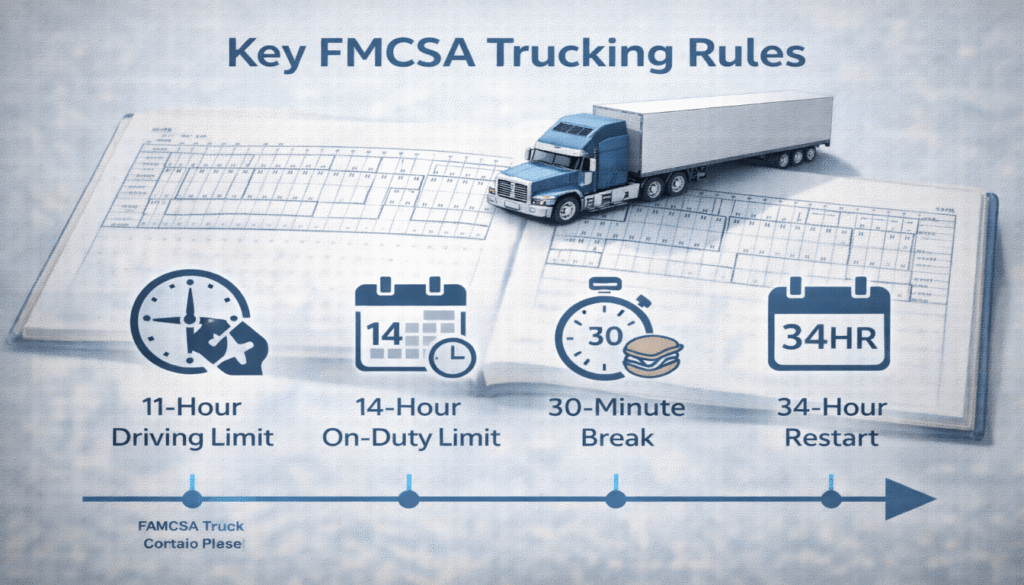
The most used rule caps driving at 11 hours inside a 14‑hour on‑duty window. Once the window ends, the driver cannot resume driving until they log the required rest. Exceeding the 11‑hour driving cap or the 14‑hour duty window constitutes a breach of the rules and may support legal claims against both the driver and the carrier.
Mandatory 30‑Minute Breaks, 10 Consecutive Off‑Duty Hours, and Weekly 60/70 Caps
Drivers must take a 30‑minute break after eight hours of driving. They also need 10 consecutive hours off before a new shift starts. Weekly limits are 60 hours over seven days or 70 hours over eight days, with a 34‑hour reset available to restore duty eligibility.
Electronic Logging Devices and Record of Duty Status Compliance
Since December 2019, Electronic Logging Devices (ELDs) have automated Records of Duty Status and tied logs to engine activity and vehicle movement. This change reduced common paper‑log manipulation.
Noncompliant devices, tampering, or missing records can trigger inspections, out‑of‑service orders, and fines from the FMCSA. A company must monitor compliance, keep accurate records, and schedule operations to avoid breaches.
For deeper insight into how violations connect to liability, see Legal Liability in Semi‑Truck Accidents.
Quick takeaway: Preserve RODS and ELD extracts promptly; they are central to proving hours and identifying company oversight failures.
Driver Fatigue and Crash Risk: Why Hours‑of‑Service Regulations Matter
According to the National Highway Traffic Safety Administration (NHTSA), drowsy driving contributes to about 91,000 crashes each year. Driver fatigue reduces cognitive function and can match the impairment of low‑level alcohol intoxication after long wake periods. Being awake for 18 hours impairs a driver similarly to a 0.05% BAC, a key data point that underpins federal hours‑of‑service rules.

How Fatigue Impairs Judgment, Vigilance, and Reaction Time
Fatigue degrades vigilance and slows decision‑making. It increases microsleeps and delays braking at highway speeds. These changes raise the chance of a severe crash, especially for semi‑truck operators where stopping distances are long and the margin for error is small.
When and How Fatigue‑Related Semi‑Truck Accidents Commonly Occur
Many fatigue‑related crashes happen during circadian low points or after extended duty without sufficient rest. Hours‑of‑service regulations exist to prevent these predictable failures. Both drivers and carriers must manage schedules and rest to reduce foreseeable risks.
“Lane departures, delayed braking, and loss of situational awareness are common markers of fatigue-related incidents.”
| Impairment | Typical Signs | Road Risk |
|---|---|---|
| 18 Hours Awake (~0.05% BAC) | Slower reaction, poor judgment | Late braking, collisions |
| Microsleeps | Lane drift, missed exits | Run-off-road events |
| Circadian Low | Reduced alertness at night | High-speed impacts |
| Extended Duty Periods | Cumulative attention loss | Severe outcomes for others |
Purpose: The regulations exist to prevent these predictable failures. Both drivers and carriers must manage schedules and rest to reduce predictable risk.
For more on how fatigue and regulatory breaches shape liability, see Why Semi‑Truck Accident Cases Are Unique.
Key Evidence That Proves Hours‑of‑Service Violations and Driver Fatigue
According to the Federal Motor Carrier Safety Administration (FMCSA), Electronic Logging Devices (ELDs) are required to track driver hours and duty status. Securing telematics and log exports quickly can make or break a case about fatigue. Rapid preservation protects critical evidence that proves driver hours and on‑duty patterns.
ELD Data, RODS, and Engine‑Linked Movement Records
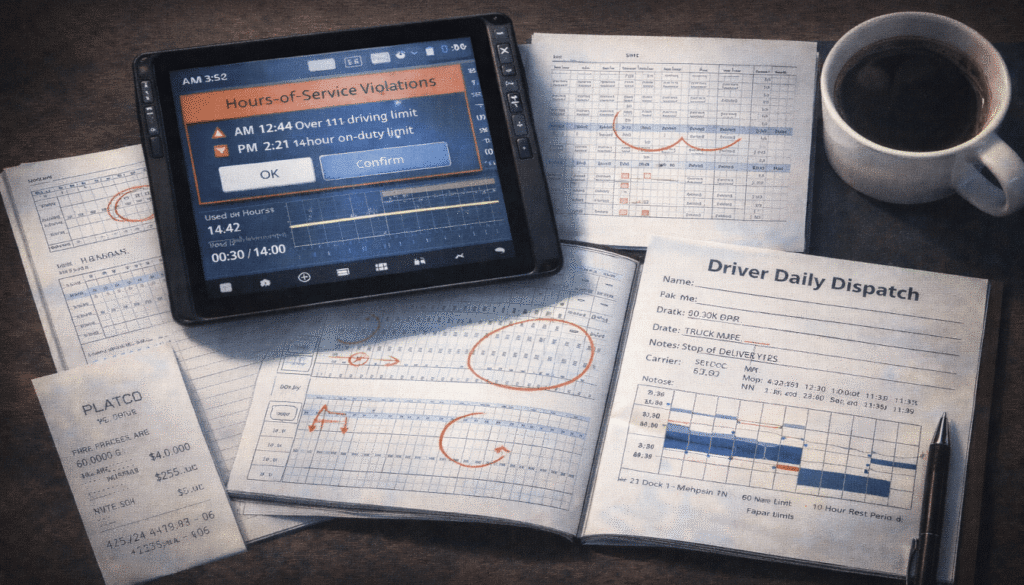
ELD extracts capture engine status, movement, miles, and driver identity. Those records form the core evidence to show actual hours and service patterns. Paper RODS often conflict with engine‑linked data, and comparing both files can reveal falsified entries or omissions.
Corroborating Proof: GPS, Fuel and Toll Receipts, Cell Records, and Dispatch Logs
GPS pings, fuel timestamps, toll crossings, and cell tower logs reconstruct a timeline. Dispatch notes and load documents show whether routing forced overtime, strengthening claims of negligence or regulatory breaches.
Preservation Letters, Deletion Windows, and Spoliation Risks
Data can be overwritten after about 30 days. Sending preservation letters and working with an attorney to issue subpoenas quickly is essential. Missing or “malfunctioning” exports can support spoliation claims if backups are absent.
| Source | What It Shows | Use In Case |
|---|---|---|
| ELD Export | Engine run, miles, driver ID | Primary proof of hours |
| RODS / Paper Logs | Claimed duty periods | Compare vs engine data for inconsistencies |
| GPS / Telematics | Route and stops | Corroborate movement timestamps |
| Fuel/Toll/Cell Records | Time-stamped actions | Fill gaps and validate rest times |
For a step‑by‑step guide on safeguarding this type of evidence, see Preserving Evidence in Semi‑Truck Accident Cases.
Action: Synchronize all sources into a timeline to link hours to the moments before a crash.
Legal Liability in Semi‑Truck Accidents: From Driver Negligence to Carrier Responsibility
When a crash follows long duty periods, courts examine both the driver’s conduct and the carrier’s policies. The Federal Motor Carrier Safety Administration (FMCSA) outlines its Compliance, Safety, Accountability (CSA) program to monitor carriers through audits, inspections, and enforcement actions. This framework ties regulatory breaches directly to civil claims and frames who must answer for harm.
Driver Duties, Motor Carrier Oversight, and FMCSA Enforcement
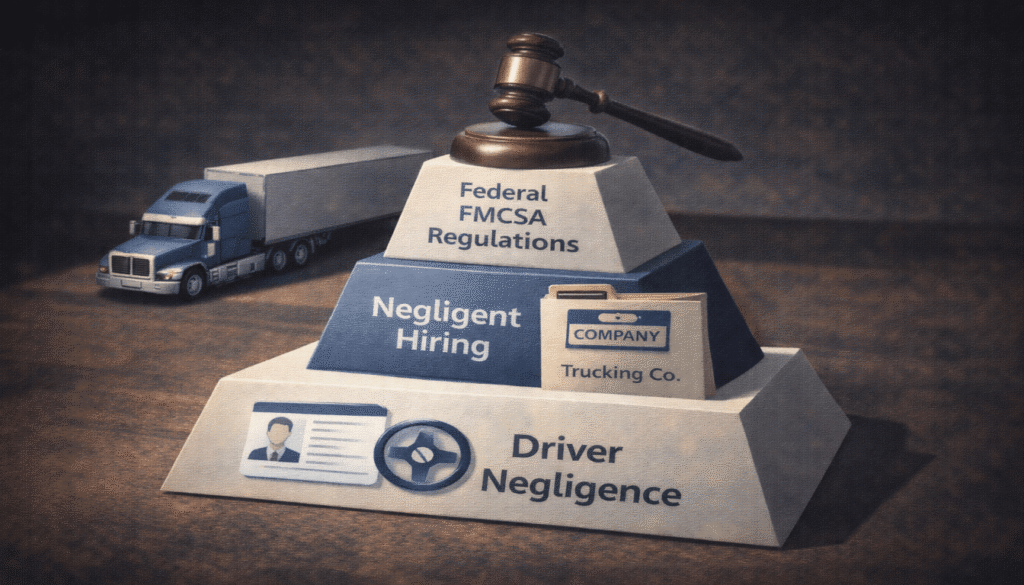
A truck driver owes a duty to follow federal regulations and operate vehicles safely. At the same time, a motor carrier must train, schedule, and audit drivers to ensure compliance. FMCSA audits, inspections, and investigations establish safety expectations for carriers, and sustained noncompliance can lead to fines, out‑of‑service orders, and loss of operating authority.
Negligence Per Se, Gross Negligence, and Punitive Damages Potential
Violating a safety rule designed to prevent the harm suffered can support negligence per se in a personal injury claim, streamlining proof of breach and causation against both drivers and companies. Systemic failures—such as falsified logs or pressure to exceed limits—may rise to gross negligence, opening the door to punitive damages intended to deter unsafe corporate practices.
Vicarious Liability and Direct Corporate Fault
Vicarious liability holds companies answerable for employee conduct within the scope of employment. Direct theories include negligent hiring, retention, and safety policy failures. Regulatory history and enforcement records often bolster civil claims by showing patterns of noncompliance.
An attorney aligns ELD exports, dispatch logs, and training files with legal theories to seek full compensation for victims of a semi‑truck accident. For more on how courts weigh company versus driver responsibility, see Employer vs Driver Liability in Semi‑Truck Accidents.
From Collision to Compensation: How Semi‑Truck Accident Cases Progress Through Litigation
Prompt steps taken in the first 72 hours often determine whether critical data survives for court. The National Highway Traffic Safety Administration (NHTSA) emphasizes the importance of collecting and preserving crash evidence to protect victims’ rights. Victims should prioritize medical care, obtain the police report, and contact counsel immediately.

Immediate Steps: Medical Care, Police Report, and Evidence Preservation
Seek medical attention within 0–72 hours to document injuries for a personal injury claim.
Have an attorney request the police report and send preservation letters for ELD, GPS, dash cam, and maintenance files within days.
Early Investigation: Subpoenas, ELD/RODS Review, and Safety Policies
Week 1–2 usually focuses on spoliation prevention and targeted subpoenas.
Month 1–3 experts extract ELD/RODS and match fuel, toll, and cell records to verify hours and routes.
Discovery, Settlement Negotiations, and Trial Preparation
Month 3–6 centers on company policies, prior violations, and incentive schemes that shaped conduct.
Month 6–12 brings settlement talks tied to documented liability and expected compensation.
Month 12–24 readies depositions, reconstruction, and trial strategy.
| Phase | Typical Timeframe | Key Actions |
|---|---|---|
| Immediate | 0–72 hours | Medical care, police report, preservation letters |
| Early Investigation | Week 1–Month 3 | Subpoenas, ELD/RODS download, correlate fuel/cell data |
| Discovery & Negotiation | Month 3–12 | Policy review, depositions, settlement talks |
| Trial Prep | Month 12–24 | Reconstruction, expert testimony, motions on spoliation |
Note: Statutes set filing deadlines, but electronic evidence often auto‑deletes within about 30 days. Act swiftly to protect proof that links hours and vehicle data to the accident and to maximize compensation. For a deeper look at how lawsuits unfold, see Semi‑Truck Accident Lawsuits Explained.
Patterns of Hours‑of‑Service Violations and Data Tampering in Semi-Truck Accident Cases
Corporate scheduling and pay formulas often pressure drivers to stretch legal limits to meet delivery targets. The Federal Motor Carrier Safety Administration (FMCSA) outlines civil penalties and enforcement actions for carriers that engage in systemic misconduct, underscoring how violations move beyond isolated driver error. When multiple records show the same shortcuts, the conduct looks systemic and points to company‑wide practices.
Common Service Violations and Economic Pressures
Unrealistic deadlines, pay‑by‑load incentives, and threats of firing push many truck drivers to skip breaks, compress rest, or exceed hours. Dispatchers and managers at some trucking companies set routes that are not feasible without bending rules.
Falsified Logs, Ghost Drivers, and Noncompliant ELDs
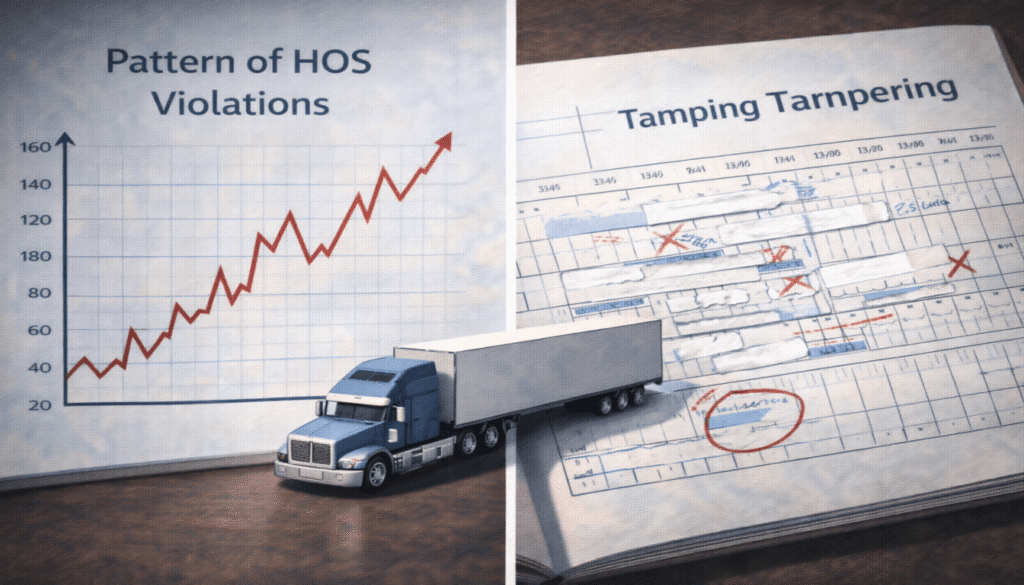
Tampering tactics are concrete: duplicate paper logs, post‑hoc edits to electronic logs, swapping IDs on team runs, and using noncompliant devices to mask true hours. Stolen credentials and fake licenses can obscure who actually drove.
FMCSA Penalties, Out‑of‑Service Orders, and Business Consequences
Fines, out‑of‑service orders, and loss of authority follow systemic misconduct. The FMCSA can levy thousands of dollars in penalties per violation, suspend CDLs, and revoke operating authority. Companies also face higher insurance rates, damaged safety ratings, and loss of customers.
Patterns of tampering strengthen claims and support punitive damages when misconduct is willful. Quick preservation of ELD exports and dispatch logs turns opaque records into clear evidence for liability and compensation. For more on how courts weigh misconduct and damages, see Punitive Damages in Semi‑Truck Accident Cases.
Why Timely Action Secures Justice in Semi‑Truck Accident Cases
Regulatory data and enforcement history provide a roadmap for holding negligent motor carriers accountable. When records show repeated noncompliance, liability in related cases often becomes clearer and easier to prove.
Victims must act fast. Preserve ELD exports, GPS logs, dispatch notes, and communications immediately — these files may be overwritten in roughly 30 days, leaving critical gaps in the evidence trail.
Systematic breaches can support claims of gross negligence and even punitive damages. FMCSA penalties and prior enforcement history strengthen civil arguments and highlight safety failures by carriers that place profit over compliance.
Engaging an experienced attorney early ensures that subpoenas are issued, expert analysis of vehicle data is aligned with legal theories, and every avenue for compensation is pursued. Timely action maximizes the chance for fair recovery, accountability, and long‑term safety improvements across the trucking industry. For a deeper look at how federal rules shape liability, see Federal Trucking Laws That Impact Semi‑Truck Accident Claims.
Frequently Asked Questions (FAQ): Hours‑of‑Service Violations, Evidence, and Legal Liability in Semi‑Truck Accident Cases
What federal rules set limits on semi‑truck driver hours and duty time?
The Federal Motor Carrier Safety Administration (FMCSA) issues regulations that limit daily driving to 11 hours within a 14‑hour duty window, require 10 consecutive off‑duty hours, mandate 30‑minute breaks after 8 driving hours, and cap weekly on‑duty time at 60/70 hours depending on the restart.
How does violating these rules affect liability after a semi‑truck accident?
Violations create powerful evidence of negligence. If a semi‑truck driver exceeded permitted hours or skipped required rests, plaintiffs can argue the driver and the carrier breached statutory duties. That can support negligence per se, bolster claims of gross negligence, and increase the likelihood of punitive damages and carrier liability for poor oversight in a semi‑truck accident case.
What types of evidence prove semi‑truck drivers exceeded allowable hours or falsified logs?
ELD downloads and RODS are primary sources. Investigators also use GPS traces, engine and transmission movement records, fuel and toll receipts, dispatch and load documents, and cell phone location records. Discrepancies among these records often reveal tampering or inaccuracies in semi‑truck accident investigations.
What should survivors or injured parties do immediately to protect evidence in a semi‑truck accident case?
Seek medical care and notify law enforcement so a police report exists. Preserve all physical and digital evidence: request ELD data, photographs, and witness statements; issue preservation letters to the carrier and vendor; and avoid discussing the case publicly. Early preservation avoids spoliation and strengthens semi‑truck accident claims.
How do carriers try to hide semi‑truck hours violations, and how are those schemes detected?
Common tactics include falsified paper logs, “ghost drivers” who swap identities, tampering with ELDs, and altering dispatch records. Detection relies on cross‑checking ELD data against GPS, engine hours, weigh station scans, and third‑party receipts. Forensic analysis of device logs can reveal deletion windows and manipulation in semi‑truck accident cases.
Can a trucking company be held responsible if its semi‑truck driver violated hours rules?
Yes. Motor carriers owe a nondelegable duty to ensure safe operations. Liability can arise from negligent hiring, retention, training, or supervision, and from policies that incentivize excessive hours. FMCSA enforcement actions and out‑of‑service orders against carriers also support civil claims in semi‑truck accident litigation.
What role do ELDs play in semi‑truck accident litigation and regulatory enforcement?
ELDs provide time‑stamped driving records that are central to semi‑truck accident investigations. Regulators use ELDs to assess compliance and order corrective actions. In court, ELD downloads can confirm duty status, contradict driver testimony, and expose discrepancies that prove fault or pattern behavior.
How do fatigue and extended semi‑truck driving increase crash risk?
Fatigue impairs attention, slows reaction times, and degrades decision‑making—effects similar to alcohol impairment. Extended hours without proper rest raise the probability of lane departures, delayed braking, and microsleeps. These physiological facts underpin why hours rules exist and why violations matter in semi‑truck accident liability assessments.
What legal theories relate to statutory hour limits and recoverable damages in semi‑truck accident cases?
Plaintiffs commonly assert negligence per se when a violation breaches FMCSA mandates. Cases may escalate to gross negligence when carriers knowingly disregard rules, potentially triggering punitive damages. Regulatory violations also support claims for compensatory damages for medical costs, lost wages, and pain and suffering in semi‑truck accident claims.
How long should parties retain ELD and carrier records after a semi‑truck accident?
ELD vendors and carriers often have automatic deletion windows. Best practice is immediate issuance of a preservation letter to the carrier, motor carrier safety vendor, and ELD provider to prevent loss. Attorneys typically seek records dating back weeks or months to establish patterns and economic pressure leading to semi‑truck accident violations.
What investigative steps follow a serious semi‑truck collision involving suspected duty breaches?
Early steps include obtaining police and medical reports, securing the vehicle and ELD data, interviewing witnesses, and issuing subpoenas for dispatch logs, payroll records, driver files, and maintenance histories. Forensic review of electronic records and hiring a transportation safety expert are common next moves in semi‑truck accident cases.
How do economic pressures in the trucking industry contribute to semi‑truck noncompliance?
Competitive freight markets, tight delivery schedules, pay structures based on miles or stops, and unrealistic dispatch demands create incentives to extend driving time. These systemic pressures can lead carriers to tolerate or encourage log falsification, making carrier policies and payroll practices relevant in semi‑truck accident litigation.
What penalties can the FMCSA impose for deliberate record tampering or repeated semi‑truck noncompliance?
The FMCSA may levy fines, place drivers or carriers out of service, revoke operating authority, and require corrective action plans. Severe or repeated violations can prompt civil penalties and regulatory scrutiny that also inform damage claims in semi‑truck accident cases.
When should an injured person consult a lawyer experienced with semi‑truck accident cases?
Early consultation is crucial—ideally within days of the crash. A specialized attorney can preserve volatile electronic evidence, coordinate with accident reconstruction and ELD experts, and pursue records and regulatory files that establish liability and support maximum recovery.
⚖️ Disclaimer: The content of this article is for informational purposes only and does not constitute legal advice. The information provided is based on general research and is not intended to be a substitute for professional legal advice or consultation with a qualified attorney. Always consult with a lawyer regarding your specific legal situation.