

Federal trucking laws are evolving rapidly, reshaping how liability is measured after a semi‑truck accident. By 2027–2028, new mandates will require Automatic Emergency Braking systems on commercial vehicles, and the Safety Measurement System (SMS) will operate with a 12‑month lookback that changes how risk is tracked. The Federal Motor Carrier Safety Administration (FMCSA) also tightened English proficiency checks in 2025 and allowed temporary paper medical certificates until January 10, 2026.
These updates affect what evidence victims must preserve after a crash. When a semi‑truck collides with a passenger vehicle, inspection logs, electronic driver records, and carrier files often determine whether federal policies were followed. Compliance not only influences insurance coverage decisions but also shapes how courts evaluate negligence.
Understanding these rules helps victims act quickly to preserve inspection reports, ECM data, and driver qualification files that tie actions on the road to legal duties. For a deeper look at how regulations shape liability, see How Federal Trucking Regulations Affect Semi‑Truck Accident Cases.
Key Takeaways
- New safety technology mandates and SMS updates change how risk is evaluated.
- Records from drivers and carriers are central to proving fault in semi‑truck accident claims.
- Compliance impacts insurance coverage and settlement leverage.
- Transition lapses can become discoverable evidence after a crash.
Federal Trucking Laws and Why They Matter After a Semi‑Truck Accident
Civil claims after a severe semi‑truck accident depend heavily on statutory duties and documentary trails. Investigators and attorneys rely on federal rulebooks, inspection logs, and carrier files to connect conduct on the road to resulting harm. For context on how these rules are enforced nationally, see the FMCSA’s Regulations and Enforcement Overview.
How Federal Rules Shape Liability and Compensation
National regulations establish the standard of care for drivers and carriers. When those rules are broken, plaintiffs can demonstrate breach and proximate cause, strengthening liability arguments in court. Hours‑of‑service limits, drug and alcohol testing, driver vehicle inspection reports (DVIRs), cargo securement requirements, and driver qualification standards all generate records. Those records frequently reveal fatigue, poor maintenance, or inadequate vetting — factors that directly influence damages and compensation in semi‑truck accident claims.
Key Agencies and Terminology Victims Will Encounter
The Federal Motor Carrier Safety Administration (FMCSA) leads the process of issuing rules, compiling them in the Code of Federal Regulations (CFR), and coordinating with state partners on enforcement. Victims and their attorneys will encounter terms like CSA percentiles, SMS categories, HOS, ELDs, and DVIRs in discovery and expert reports. Identifying whether a vehicle was engaged in interstate commerce is also critical, as it opens access to broader motor carrier files and service records that can strengthen a claim.
For a deeper look at how classification impacts liability, see Commercial Vehicle Classes in Semi‑Truck Accident Cases.
FMCSA Oversight and the Federal Motor Carrier Safety Framework
The Federal Motor Carrier Safety Administration (FMCSA) sets the baseline standards that shape how commercial vehicle safety is measured and enforced. Its mission is to reduce crashes, injuries, and fatalities involving commercial motor vehicles. For context on its role, see the FMCSA’s About Us overview.
What the Federal Motor Carrier Safety Administration Regulates
The FMCSA issues regulations that affect equipment, driver qualification, and company operations. It covers Hours of Service and Electronic Logging Devices, pre‑employment checks, drug and alcohol testing, and Driver Vehicle Inspection Reports (DVIRs). The agency also governs hazardous materials handling, cargo securement, driver fitness, and inspection/maintenance requirements — all of which directly impact liability in semi‑truck accident claims.
How Rules Are Made, Published, and Enforced
Rulemaking relies on crash and exposure data along with stakeholder outreach. Final rules appear in the Federal Register and are codified in the Code of Federal Regulations (CFR). Enforcement occurs through coordinated audits, roadside inspections, and state partner investigations. Outcomes range from out‑of‑service orders to civil penalties and mandated compliance plans.
| Area | What Is Regulated | Why It Matters After A Crash |
|---|---|---|
| Driver Qualification | Medical certification, background checks | Shows whether hiring met federal requirements |
| Hours Of Service / ELD | Log limits, electronic records | Reveals fatigue and logbook discrepancies |
| Vehicle Maintenance | Inspections, repairs, DVIRs | Links defects to collision causation |
| Cargo & Hazardous Materials | Securement, placarding, handling | Identifies cargo-related breaches and risks |
For a deeper look at how fatigue rules influence liability, see Hours‑of‑Service Violations in Semi‑Truck Accidents.
Compliance, Safety, and Accountability: CSA/SMS Scores in Semi‑Truck Accident Claims
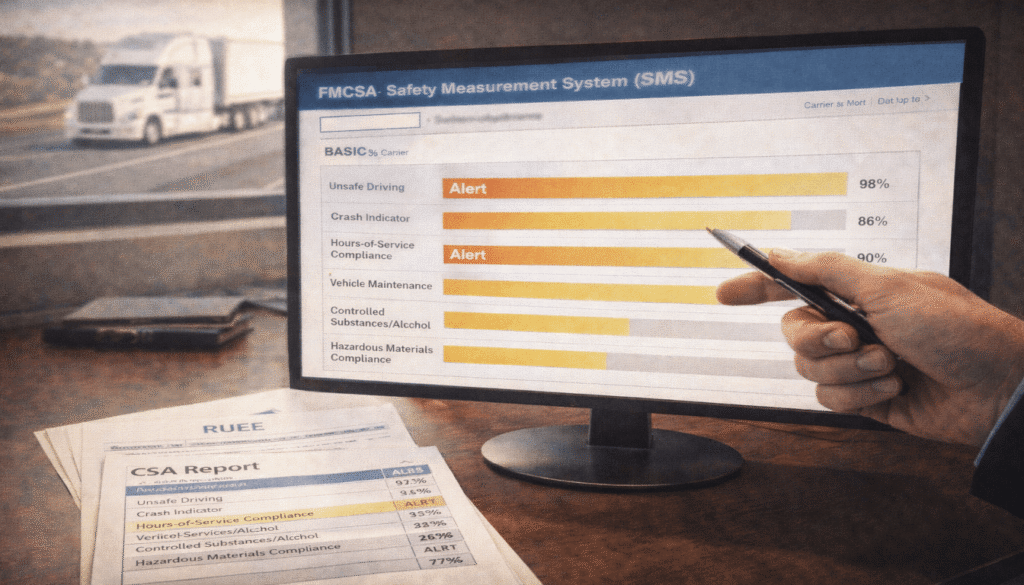
Updated CSA/SMS scoring compresses historical noise and highlights recent safety signals that matter in semi‑truck accident litigation. By grouping violations into roughly 100 categories and standardizing severity weights to 1–2, the system narrows focus to the most relevant conduct within a 12‑month lookback. The utilization factor now rises to 250,000 vehicle miles traveled (VMT), changing benchmarking for large fleets. For background on how CSA works, see FMCSA’s Compliance, Safety, Accountability Program.
From BASICs to Updated Safety Measurement System Categories
The shift from seven BASICs to consolidated SMS categories makes comparisons easier for experts. Monthly updates arrive about ten days after capture, giving near‑current snapshots of carrier performance.
Intervention Thresholds and What They Reveal About a Carrier
Historical percentiles remain useful. A percentile above 65% in Unsafe Driving, Crash Indicator, or Hours‑of‑Service once signaled intervention risk under prior thresholds. These benchmarks continue to help attorneys and experts evaluate whether a carrier’s safety record reflects negligence.
Using CSA/SMS Data as Evidence of Safety Performance
Plaintiffs can compare drivers’ violations to carrier trends to frame negligence in semi‑truck accident claims. They should also check whether a crash was ruled non‑preventable via the Crash Preventability Determination Program.
“SMS updates and intervention records often supply the clearest proof that a carrier failed to correct known hazards.”
| Feature | What Changed | Litigation Use | Practical Tip |
|---|---|---|---|
| Grouping | ~100 consolidated categories | Clearer expert comparison | Match discovery to categories |
| Severity | Standardized weights 1–2 | Simpler risk ranking | Ask experts about weight effects |
| Lookback | 12 months | Focus on recent performance | Time discovery to 12‑month window |
| Updates | Monthly (~10 days after capture) | Near‑current evidence of corrective action | Monitor SMS during litigation |
For more on how evidence strengthens liability arguments, see Evidence in Semi‑Truck Accident Cases.
Hours‑of‑Service and ELD Rules: Fatigue Evidence in Semi‑Truck Accident Litigation
Fatigue is one of the leading causes of semi‑truck accidents, and Hours‑of‑Service (HOS) rules create a measurable timeline to test that claim. These limits cap consecutive driving time and require rest breaks, forming the backbone of safety enforcement. For background on HOS requirements, see FMCSA’s Hours of Service Regulations.
Core HOS Limits and Common Violations
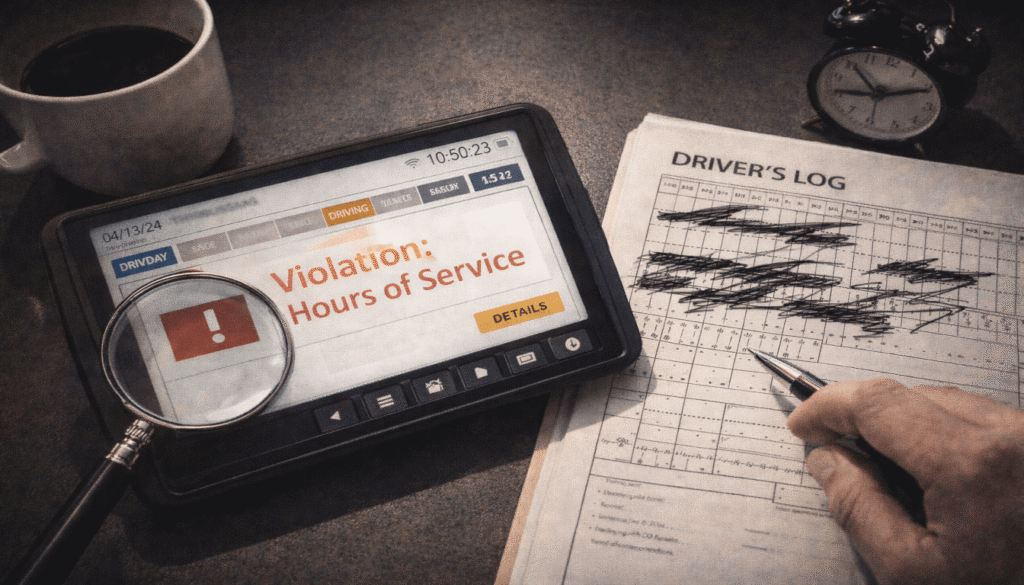
Plaintiffs compare HOS limits to duty logs to show over‑hours driving. Common violations include exceeding daily or weekly maximums, misusing personal conveyance, and skipping required breaks. When inspectors cite HOS failures, those findings can support assertions about a driver’s fitness for the road in semi‑truck accident claims.
Electronic Logging Devices and Logbook Discrepancies
Electronic Logging Devices (ELDs) record duty status tied to the vehicle engine, producing tamper‑resistant records. Inconsistencies between paper backups and ELD files often signal falsification or poor training. Records of edits, unassigned driving, or unidentified engine hours help show whether the driver and carrier ignored service limits. Plaintiffs should seek dispatch logs, telematics, and edit histories during discovery.
Adverse Conditions, Exemptions, and Their Limits
Adverse condition and emergency exemptions are narrow and brief. Weather reports, road closure logs, and dispatch messages can expose improper exemption claims. Out‑of‑service orders for egregious HOS breaches and on‑road inspection reports can strengthen arguments about systemic noncompliance and carrier pressure to meet tight delivery windows.
| Issue | What It Shows | Litigation Use |
|---|---|---|
| Exceeded Driving Time | Hours beyond permitted limits | Demonstrates fatigue and breach of duty |
| ELD Discrepancy | Edits, unassigned miles, missing engine sync | Suggests falsification or inadequate oversight |
| Exemption Misuse | Claims of adverse conditions without support | Refutes carrier defenses and timelines |
For more on how legal time limits affect semi‑truck accident claims, see Statute of Limitations for Semi‑Truck Accidents.
Drug and Alcohol Testing Requirements That Affect Fault in Semi‑Truck Accident Cases
Timely toxicology results and documented policies can turn an ambiguous semi‑truck accident into clear evidence of fault. The FMCSA requires drug and alcohol testing at hire, randomly, for reasonable suspicion, after accidents, and for return‑to‑duty follow‑up. These steps create a traceable chain that helps determine impairment and carrier compliance. For background on federal testing rules, see FMCSA’s Drug and Alcohol Testing Program.

Pre‑Employment, Random, Post‑Accident, and Return‑to‑Duty
Post‑accident drug and alcohol testing is critical evidence. Failure to test promptly may violate regulations and allow adverse inferences against a carrier. Employers must run pre‑employment queries and annual checks. Missing queries or ignored results can support negligent hiring claims in semi‑truck accident litigation.
Drug and Alcohol Clearinghouse and CDL Downgrades
The Clearinghouse centralizes violation records. Plaintiffs should verify whether a driver was listed as “prohibited” at the time of the crash and whether a carrier knowingly allowed operation. States now downgrade CDL privileges for prohibited drivers, increasing liability for unauthorized dispatch. Chain‑of‑custody forms, lab reports, and notification logs are discoverable and often dispositive. Communications showing dispatch pressure over testing link compliance choices directly to the collision.
| Requirement | What To Seek In Discovery | Why It Matters |
|---|---|---|
| Post‑Accident Testing | Time stamps, specimen chain, results | Shows impairment or procedural failure |
| Pre‑Employment Queries | Clearinghouse checks, hiring files | Supports negligent hiring/retention claims |
| Return‑To‑Duty | Evaluation records, follow‑up tests | Proves remediation or ongoing risk |
For more on how negligent hiring and training amplify liability, see Negligent Hiring and Training in Semi‑Truck Accidents.
Driver Qualification and English Proficiency Standards in Semi‑Truck Accident Liability
A careful review of a driver’s qualification package can expose compliance failures that change the outcome of a semi‑truck accident claim. Every commercial driver must hold a valid commercial driver license and current medical certification. Employers are required to maintain a qualification file that documents prior employment checks, motor vehicle records, medical certificates, and training history. For background on recent enforcement changes, see CVSA’s English Proficiency Out‑of‑Service Criteria Notice.

Commercial Driver License, Medical Certification, and Files
Omissions in qualification files often support negligent qualification claims. Plaintiffs should probe endorsements, restrictions, and whether the carrier verified qualifications both at hire and annually. Missing or outdated documentation can strengthen arguments that a carrier failed to meet federal standards.
Renewed English Proficiency Enforcement and Out‑of‑Service Risks
Since June 25, 2025, enforcement of English proficiency has increased. Drivers who cannot converse with officials, read signs, or complete paperwork face citations and possible out‑of‑service orders. If an out‑of‑service order for language issues existed before a crash, it can undermine carrier defenses and highlight systemic compliance failures.
| File Element | What To Seek | Litigation Use |
|---|---|---|
| Licenses & Endorsements | CDL status, restrictions | Shows baseline competency for load/route |
| Medical Certificates | Current, dates, temporary paper proof | Links fitness to operate during waiver period |
| Training Records | Remedial instruction, interstate experience | Shows whether carrier maintained standards |
| Hiring Checks | Prior employers, MVRs, background | Supports negligent hiring/retention claims |
For more on how legal complexities shape liability in these cases, see Why Semi‑Truck Accident Cases Are Unique.
Vehicle Maintenance and DVIRs: Mechanical Defects as Negligence in Semi‑Truck Accident Claims
A missing or vague inspection report can speak louder than testimony when a vehicle’s condition is at issue. Clear documentation connects on‑road failures to prior alerts and missed repairs. For context on national inspection trends, see CVSA’s 2024 International Roadcheck Results.

Pre‑Trip, Post‑Trip, and Annual Inspection Requirements
Drivers must complete pre‑trip and post‑trip checks and file DVIRs when defects appear. These reports create an early record that can show whether vehicle maintenance standards were followed. During the 2024 CVSA International Roadcheck, 23% of vehicles and 4.8% of drivers were placed out of service. Brakes, lights, tires, steering, and emergency gear are common failure points inspectors cite.
Repair Documentation, Out‑of‑Service Orders, and Recalls
Carriers must ensure annual inspections and fix critical defects before returning a vehicle to service. An out‑of‑service order for a safety‑critical item shows the vehicle should not have been on the road. Plaintiffs should seek work orders, parts receipts, recall notices, and technician certifications to prove whether repairs were completed and adequate.
DVIRs that list defects without corrective action tend to undermine a carrier’s defense. Fleet patterns of brake, lighting, or tire violations signal systemic disregard for safety. Inspection histories aligned with telematics can pinpoint when a defect first appeared. Photographs, alignment reports, and brake measurements translate technical faults for juries.
For more on how classification affects liability when mechanical defects are involved, see Commercial Vehicle Classes in Semi‑Truck Accident Cases.
“Gaps in maintenance records often reveal the true timeline between reported defects and the crash itself.”
Compliance, Safety, and Accountability: CSA/SMS Scores in Semi‑Truck Accident Claims
Updated CSA/SMS scoring compresses historical noise and highlights recent safety signals that matter in semi‑truck accident litigation. By grouping violations into roughly 100 categories and standardizing severity weights to 1–2, the system narrows focus to the most relevant conduct within a 12‑month lookback. The utilization factor now rises to 250,000 vehicle miles traveled (VMT), changing benchmarking for large fleets.

From BASICs to Updated Safety Measurement System Categories
The shift from seven BASICs to consolidated SMS categories makes comparisons easier for experts. Monthly updates arrive about ten days after capture, giving near‑current snapshots of carrier performance. Cargo securement violations, for example, are one of the categories tracked in CSA scoring. For details on those requirements, see FMCSA’s Cargo Securement Rules.
Intervention Thresholds and What They Reveal About a Carrier
Historical percentiles remain useful. A percentile above 65% in Unsafe Driving, Crash Indicator, or Hours‑of‑Service once signaled intervention risk under prior thresholds. These benchmarks continue to help attorneys and experts evaluate whether a carrier’s safety record reflects negligence.
Using CSA/SMS Data as Evidence of Safety Performance
Plaintiffs can compare drivers’ violations to carrier trends to frame negligence in semi‑truck accident claims. They should also check whether a crash was ruled non‑preventable via the Crash Preventability Determination Program.
| Issue | Effect | Evidence |
|---|---|---|
| Overweight Loads | Longer stopping distance | Scale tickets, load plans |
| Improper Tie‑Down | Load shift/rollover | Strap ratings, photos |
| Hazmat Mislabeling | Increased risk & liability | Shipping papers, placards |
For more on how CSA scores connect to fault, see Liability in Semi‑Truck Accidents.
Recordkeeping and Evidence Preservation After a Semi‑Truck Accident
After a collision, the clock starts on preserving digital and physical proof. Quick steps protect facts that prove negligence and show whether companies followed regulations. For context on records commonly requested and obtained from the agency, see FMCSA’s FOIA page: Frequently Requested Records.
What records carriers must maintain and for how long
Required documents include proof of insurance, driver rosters and qualification files, drug testing records, Hours‑of‑Service logs, inspection and maintenance reports, incident reports, and IFTA filings. Electronic records such as ELDs, DVIRs, and CSA data are common sources of evidence. Note: paper payments to FMCSA ended September 30, 2025, which affects where records are kept.
Preservation letters, spoliation risks, and data sources
Immediate preservation letters should name ELD raw data, ECM downloads, dash cam footage, DVIRs, maintenance files, and dispatch communications to prevent spoliation.
- Insurance coverage: request policies, MCS‑90 endorsements, and broker bonds early.
- Operational pressure: gather service assignments, route planning, and delivery deadline records.
- Mechanical causation: pull inspection histories, repair invoices, and annual reports.
- Compliance gaps: obtain drug/alcohol logs, Clearinghouse queries, and supervisor training materials.
- HOS/ELD issues: analyze logs and edit histories for unassigned driving or suspicious edits.
- Third‑party corroboration: toll data, weigh station records, and telematics vendor exports.
“Early motions to preserve evidence reduce spoliation risk and protect admissibility.”
For step‑by‑step preservation tactics and checklists, see Preserving Evidence in Semi‑Truck Accident Cases.
Federal Trucking Laws: 2024–2028 Updates That Can Influence Semi‑Truck Accident Claims
Industry shifts in measurement, identifiers, and equipment rules affect discovery strategies and expert analysis. For background on recent rulemaking activity, see FMCSA’s Federal Register Notices and Rulemaking Documents. These changes not only reshape compliance obligations but also redefine the types of records and expert testimony that become critical in semi‑truck accident litigation. Attorneys should anticipate how shortened lookback periods, new technology mandates, and identifier transitions will alter both the scope of discovery and the arguments available in court.
SMS Overhaul, Standardized Severity Weights, and 12‑Month Lookback
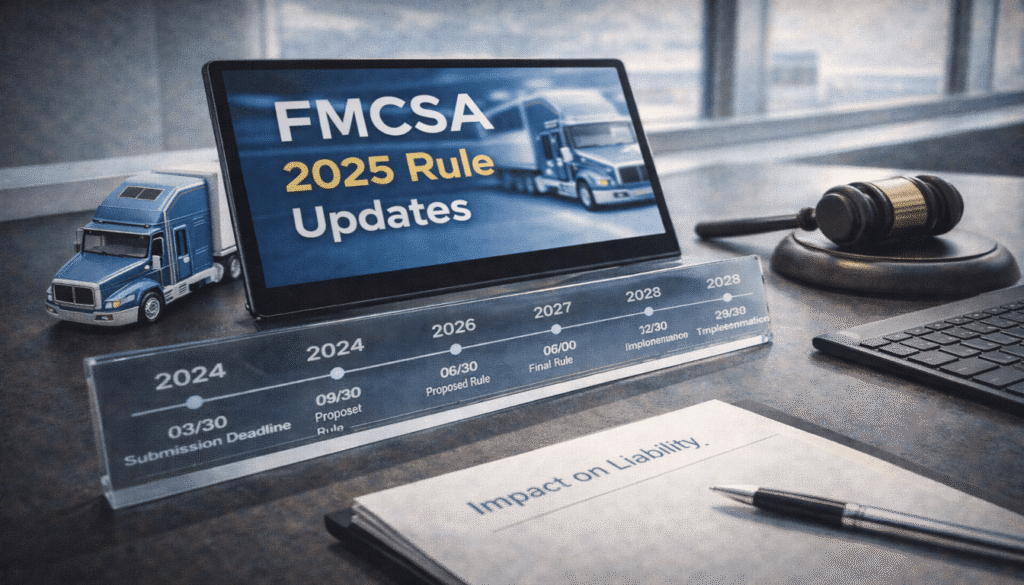
The SMS redesign groups violations into about 100 categories and standardizes severity weights at 1–2. This change shortens the lookback to 12 months and raises the utilization factor to 250,000 VMT. Experts should match preservation requests to the new structure to capture the most relevant carrier performance snapshots.
Technology Mandates: AEB and ESC Timelines
The AEB final rule (Jan 2025) phases in requirements for Class 7–8 by 2027 and Class 3–6 by 2028. ESC is now required for heavy‑duty vehicles as well. Absent or disabled systems in applicable model years can become disputed evidence. The withdrawn speed limiter rule (July 24, 2025) shifts focus back to carrier policies and driver coaching over hardware governance.
Temporary Waivers, Payment Changes, and USDOT Number Transition
Administrative moves complicate record trails. Paper medical certificates were allowed Oct 13, 2025–Jan 10, 2026 under a temporary waiver. FMCSA stopped accepting paper payments on Sept 30, 2025, and the MC→USDOT transition required number updates by Oct 1, 2025. Mismatches between identifiers on trucks and documents can be a discovery red flag.
Agency notices and webinars from the safety administration often establish when carriers knew of a change and when they should have acted.
| Update | Effective Dates | Claim Relevance |
|---|---|---|
| SMS Redesign | 2024–2025 | Affects how carrier safety regulations are scored and compared |
| AEB & ESC Mandates | AEB Jan 2025; phased 2027–2028 | Absence on applicable vehicles can show noncompliance |
| Paper Medical Waiver | Oct 13, 2025–Jan 10, 2026 | May create alternate documentation paths for medical fitness |
| MC to USDOT | Transition by Oct 1, 2025 | Identifier mismatches affect carrier records and service timelines |
Practical tip: Check inspection histories for out‑of‑service orders tied to English proficiency and reconcile ELD, dispatch, and repair timestamps. Look for post‑crash gaps in drug and alcohol testing or delayed post‑accident service records that could support adverse inferences.
For more on how federal laws shape liability and compensation, see Federal Trucking Laws That Impact Semi‑Truck Accident Claims.
Insurance, Surety, and the Role of Motor Carriers and Brokers in Semi‑Truck Accident Recovery
Claims frequently pivot on which policy responds and whether extra endorsements open additional recovery paths. Victims and counsel must map available coverages early. That assessment identifies potential defendants and funding sources for damages. For federal filing and financial responsibility requirements (including endorsements and broker/forwarder rules), see FMCSA’s Insurance Filing Requirements.
Liability Coverage, MCS‑90, and Broker Bond Requirements
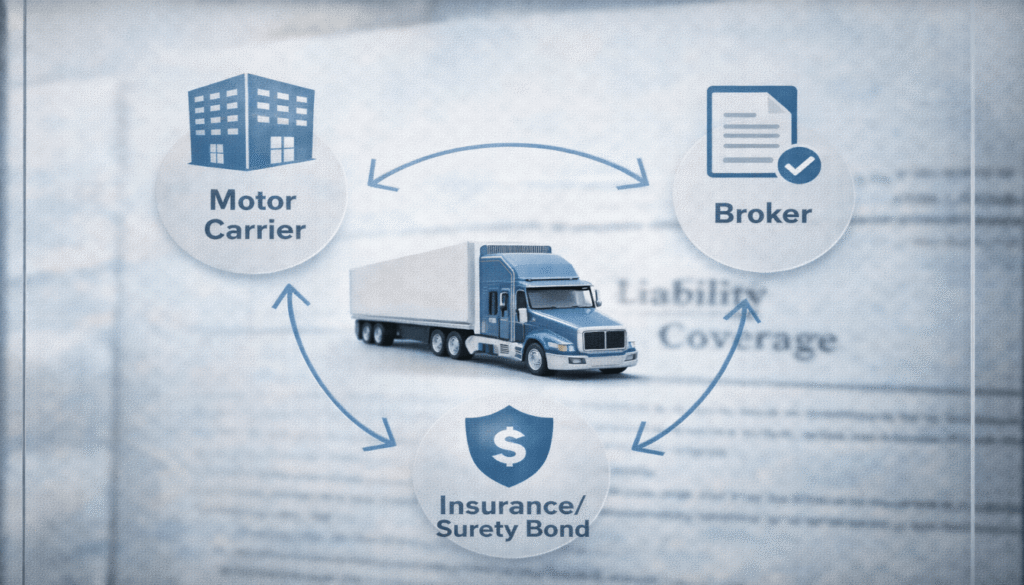
Insurance programs mix auto liability, excess layers, cargo coverage, and the MCS‑90 endorsement. The MCS‑90 can obligate an insurer to satisfy certain judgments that otherwise might be excluded. The FMCSA requires brokers to hold a $75,000 surety bond or trust. That bond provides an added recovery avenue when negligent selection or arrangement is alleged. Attorneys should scrutinize whether the bond or endorsement was active at the time of the crash, since lapses or cancellations can complicate recovery.
How Insurance Interacts With Federal Safety Compliance
Underwriters review compliance and safety records when pricing and renewing policies. Documented lapses in HOS, DVIRs, or Clearinghouse checks may increase settlement leverage. Motor carriers and brokers often dispute tender and control, but clear dispatch and safety records usually resolve who is the proper insured for a claim. Insurance disputes often overlap with regulatory violations, meaning plaintiffs can use compliance failures to pressure insurers into settlement.
For more on how insurance disputes shape recovery, see Bad Faith Insurance Tactics in Semi‑Truck Accident Claims.
| Item | What To Request | Claim Use |
|---|---|---|
| Primary Liability | Certificates, declarations | Shows limits and named insureds |
| MCS-90 Endorsement | Endorsement copy | May extend insurer payment obligations |
| Broker Bond | Bond/trust documentation | Alternate source when broker fault exists |
| Excess/Cargo | Policy language, exclusions | Determines gap coverage and coordination |
“Electronic-only administrative payments and records require early digital preservation requests.”
Turning Federal Trucking Regulations Into Evidence That Wins Semi‑Truck Accident Cases
Connecting agency standards to on‑scene conduct turns records into decisive evidence. Successful claims tie motor carrier safety and carrier safety regulations to what drivers did at the time of a crash.
Plaintiffs and counsel should act quickly to preserve ELD, DVIR, vehicle maintenance, and qualification files. They must also seek Clearinghouse and drug and alcohol testing records when impairment is suspected. Beyond immediate preservation, attorneys should anticipate how evolving federal rules — from SMS redesigns to technology mandates like AEB and ESC — reshape the discovery landscape and influence expert testimony.
Showing patterns — SMS trends, training gaps, missing AEB or ESC on applicable trucks, weight and cargo documentation — strengthens the case. Experts translate technical standards into a clear narrative so juries see how compliance failures caused harm. For a deeper look at how federal regulations shape liability arguments, see How Federal Trucking Regulations Affect Semi‑Truck Accident Cases.
Frequently Asked Questions About Federal Rules and Evidence in Semi‑Truck Accident Claims
What key federal rules affect semi‑truck accident claims?
Several federal regulations shape liability and recovery after a semi‑truck accident. These include hours‑of‑service limits, electronic logging device (ELD) mandates, driver qualification and medical certification rules, drug and alcohol testing requirements, vehicle inspection and maintenance standards, cargo securement rules, and recordkeeping obligations. Violations of these rules often serve as direct evidence of negligence.
Which agencies and terms will victims encounter during a semi‑truck accident claim?
Victims typically interact with the Federal Motor Carrier Safety Administration (FMCSA), the Department of Transportation (DOT), and state motor carrier enforcement units. Common terms include CSA (Compliance, Safety, Accountability), SMS (Safety Measurement System), BASICs (Behavior Analysis and Safety Improvement Categories), MCS‑90 endorsement, ELD, CDL, and driver qualification file (DQ file).
How do CSA and SMS scores influence a semi‑truck accident lawsuit?
CSA and SMS data demonstrate a carrier’s safety performance and violation patterns. High BASIC scores or intervention thresholds can support claims that a carrier acted negligently or exposed the public to undue risk. Plaintiffs use this data to prove foreseeability and systemic noncompliance when establishing liability in semi‑truck accident cases.
What hours‑of‑service rules matter most for proving fatigue in a semi‑truck accident?
Core HOS limits—daily driving maximums, on‑duty limits, required rest breaks, and weekly caps—are central. Violations such as exceeding driving hours, skipping rest periods, or falsified logs can show driver fatigue. ELD records and paper log inconsistencies are common sources of evidence in semi‑truck accident claims.
How do ELDs and logbooks factor into semi‑truck accident evidence collection?
ELDs create near‑real‑time electronic records of driving time, making falsification harder. Investigators compare ELD data to dispatch records, fuel receipts, GPS, and driver statements. Discrepancies between ELDs and paper logs or missing ELD data can be powerful evidence of misconduct in semi‑truck accident litigation.
What drug and alcohol rules affect fault after a semi‑truck accident?
Carriers must follow pre‑employment, random, reasonable suspicion, post‑accident, and return‑to‑duty testing procedures for safety‑sensitive drivers. Positive tests, refusals, or failures to follow protocols can impact liability, CDL status, and insurance coverage. The FMCSA Clearinghouse documents violations and employer queries, often used as evidence in semi‑truck accident claims.
What must appear in a driver qualification file (DQ file)?
A compliant DQ file should include the CDL copy, medical examiner’s certificate, inquiries to previous employers about safety performance, road test or equivalent, and records of training and violations. Missing or incomplete DQ files can indicate regulatory breach and strengthen a plaintiff’s semi‑truck accident case.
How do vehicle inspections and DVIRs help prove negligence in semi‑truck accidents?
Pre‑trip, post‑trip, and periodic inspection records—including Driver Vehicle Inspection Reports (DVIRs)—show whether a carrier or driver identified and repaired defects. Omitted inspections, ignored defect reports, or absent repair documentation suggest negligent maintenance and can link mechanical failures to a semi‑truck accident.
What evidence supports claims about cargo securement or weight violations in semi‑truck accidents?
Securement logs, load manifests, tie‑down inspections, weigh station records, and witness photos can show improper fastening or overload. Overweight or insecure loads increase rollover and shifting risks; documentation of violated tie‑down rules, load distribution, or weight limits bolsters negligence claims in semi‑truck accident cases.
Which records must carriers preserve after a semi‑truck accident and for how long?
Carriers must retain driver logs, ELD data, drug and alcohol test records, DQ files, maintenance and repair records, DVIRs, cargo paperwork, dispatch and GPS data, and insurance documents. Retention periods vary, but many safety‑related records must be kept for one to five years. Preservation letters help prevent spoliation in semi‑truck accident claims.
How do recent 2024–2025 regulatory updates affect semi‑truck accident claims?
Recent changes include SMS adjustments, revised severity weights, and shorter lookback windows that alter safety scoring. Technology mandates—like automatic emergency braking (AEB) and electronic stability control (ESC)—and administrative shifts (such as DOT number transitions) influence causation and industry standards used in semi‑truck accident litigation.
What role do insurance and broker obligations play in semi‑truck accident recovery?
Insurance coverage limits, MCS‑90 endorsements, and broker surety bonds determine available compensation. Plaintiffs must evaluate carrier policies, broker responsibility, and excess coverage. Noncompliance with safety rules can weaken a carrier’s defense and affect insurers’ willingness to settle semi‑truck accident claims.
How can claimants use FMCSA data and inspection reports in semi‑truck accident cases?
FMCSA inspection reports, roadside inspection results, and public SMS data provide contemporaneous records of violations. Attorneys use these documents to establish unsafe practices, corroborate eyewitness testimony, and rebut carrier defenses that a semi‑truck accident was unavoidable.
When should a preservation letter be sent after a semi‑truck accident?
A preservation letter should be sent immediately after notice of a semi‑truck accident—often within days—to demand retention of ELD data, driver logs, maintenance records, video footage, dispatch communications, and testing results. It prevents routine deletion and supports later discovery requests.
What are common carrier defenses in semi‑truck accident cases and how do plaintiffs counter them?
Carriers often argue third‑party fault, unforeseeable mechanical failure, or sole driver negligence. Plaintiffs counter with maintenance histories, DVIRs, ELD discrepancies, drug and alcohol results, witness statements, and FMCSA safety records to show systemic issues or carrier responsibility.
How do hazardous materials rules change liability in a semi‑truck accident?
Hazmat regulations add responsibilities for training, labeling, placarding, and routing. Violations can increase civil exposure, elevate damages for environmental cleanup or specialized injuries, and trigger fines against carriers and shippers in semi‑truck accident cases.
Can safety score changes or interventions after a semi‑truck accident be used as evidence?
Yes. Interventions, out‑of‑service orders, and post‑crash increases in safety scores show regulatory recognition of safety problems. Courts may consider these official actions as corroboration of unsafe practices that contributed to a semi‑truck accident.
What steps should victims take right after a semi‑truck accident to protect a claim?
Seek medical care and document injuries, photograph the scene and vehicles, get witness information, report the crash to police, and notify insurers. Preserve evidence by requesting retention of ELD data, maintenance records, and driver files through a preservation letter or counsel.
How does a carrier’s maintenance program affect liability in a semi‑truck accident?
A robust, documented maintenance program reduces liability. Gaps—missed inspections, late repairs, absent parts histories, or ignored recalls—demonstrate negligence. Plaintiffs use repair logs, service invoices, and recall notices to link mechanical failure to semi‑truck accident causation.
What impact does the Drug and Alcohol Clearinghouse have on semi‑truck accident claims?
The Clearinghouse records verified drug and alcohol violations tied to a driver’s CDL. A listed violation can show the driver posed a known risk and that the carrier failed to prevent unsafe operation. Employers must query the Clearinghouse during hiring, and failures to do so can indicate negligent hiring in semi‑truck accident cases.
⚖️ Disclaimer: The content of this article is for informational purposes only and does not constitute legal advice. The information provided is based on general research and is not intended to be a substitute for professional legal advice or consultation with a qualified attorney. Always consult with a lawyer regarding your specific legal situation.