

Economic and non‑economic damages in semi‑truck accident claims set the stage for what victims may pursue after a serious crash. Whether on busy corridors like I‑295 or highways across the country, collisions with large rigs often lead to catastrophic medical costs and long recovery timelines.
Too often, victims accept quick settlement offers that fail to account for future medical needs, lost earnings, or long‑term quality‑of‑life impacts. Understanding how damages are categorized — both measurable financial losses and less tangible non‑economic harms — is essential to building a claim that reflects the true scope of injury.
This article explains why documentation, medical projections, and expert reports matter early, especially when trucking companies and insurers move fast to limit liability. Readers will learn practical steps to strengthen their case: track bills, record functional changes, and quantify lifetime costs so compensation reflects both financial and personal impact.
For a deeper look at recovery options, see Compensation in Semi‑Truck Accident Cases.
Key Takeaways
- Victims must document medical care and financial loss to support recovery requests.
- Damage categories capture both measurable bills and daily life impacts.
- Early low offers often miss future needs; medical and economic projections are critical.
- Trucking companies and insurers act quickly; preparation is essential.
- Expert assessments help align medical proof with legal standards.
Overview: What Victims Can Recover in Semi‑Truck Accident Claims
The Insurance Information Institute (III) emphasizes documenting medical care, property damage, and lost income immediately after a crash to protect compensation rights. Recovering from a semi‑truck accident means mapping losses now and forecasting care needs later.
This guide separates measurable losses—medical bills, vehicle repair, lost wages, and diminished earning capacity—from less tangible harms such as pain, emotional distress, loss of enjoyment of life, and loss of consortium. Prompt documentation of treatment and care, including bills, prescriptions, and work absences, helps prevent trucking companies and insurers from undervaluing a claim.
Quick settlements can miss delayed injuries and future care costs. Identifying all potentially liable parties—driver, carrier, maintenance crews, loaders, or manufacturers—can raise total recovery. Readers get a procedural roadmap: timelines, evidence gathering, and how insurers evaluate cases.
For insurer tactics and how to respond, see Semi‑Truck Accident Claims.
Economic and Non‑Economic Damages in Semi‑Truck Accident Claims Explained
The National Safety Council (NSC) notes that motor vehicle crashes impose staggering costs nationwide, with large truck collisions often leading to higher medical expenses and longer recovery timelines. Victims face both clear financial hits and less visible harms that shape long‑term recovery.
How These Two Damage Categories Work Together
The measurable side covers hospital bills, lost pay, and projected care costs. The less tangible side captures pain, emotional suffering, and loss of enjoyment of life. Together, these streams create a full picture of harm. An attorney ties medical records to daily function to show how physical limits cause wage loss and life changes.
Avoiding Quick, Inadequate Settlements
Insurers and companies often open talks with formulaic offers, such as multipliers or daily‑rate models, that miss unique facts. Careful documentation — timelines, treatment notes, and statements about pain — helps resist early pressure and supports fair compensation.
For strategies to counter insurer tactics, see Top Reasons Semi‑Truck Accident Claims Are Denied.
Semi-Truck Accident Economic Damages: Calculating Medical Costs, Lost Wages, and Future Earnings
The Centers for Disease Control and Prevention (CDC) notes that motor vehicle crashes create enormous medical and financial burdens nationwide, with large truck collisions often leading to higher costs and longer recovery timelines. Putting dollar values on injury‑related losses requires medical proof, pay records, and expert forecasts.
Medical Expenses: Present Bills and Future Medical Care
Medical expenses begin with emergency care, surgeries, and prescriptions supported by bills and records. Specialist opinions help project future medical needs when long‑term therapy or surgeries are likely.

Lost Wages and Diminished Earning Capacity
Document missed work with employer letters, pay stubs, and tax returns to show lost wages. For long‑term limits, vocational experts model reduced earning capacity and lifetime income loss.
Rehabilitation, Assistive Devices, and Home Modifications
Recoverables include rehab sessions, prosthetics, mobility aids, and home changes such as ramps or bathroom alterations. Each item needs receipts and medical justification.
Property Damage and Related Out‑of‑Pocket Costs
Vehicle repair estimates, total loss calculations, towing, and rental expenses round out financial losses. Keep a ledger that links each cost to the crash and to medical necessity.
| Category | Typical Proof | Who Assesses |
|---|---|---|
| Medical Care | Hospital bills, physician reports, therapy invoices | Treating doctors, medical experts |
| Lost Income | Pay stubs, employer letters, tax returns | Forensic accountant, vocational expert |
| Rehab & Home Needs | Receipts, PT notes, contractor quotes | Therapists, contractors |
| Property Loss | Repair estimates, rental bills, title papers | Appraisers, mechanics |
For more on how evidence strengthens these claims, see Evidence in Semi‑Truck Accident Cases.
Semi-Truck Accident Non‑Economic Damages: Valuing Pain, Suffering, and Loss of Enjoyment
The American Bar Association (ABA) explains that non‑economic damages are designed to compensate for the intangible toll of injuries, including pain, emotional distress, and loss of enjoyment of life. Courts and juries seek to place value on the unseen consequences a serious wreck leaves behind. These awards cover pain, emotional harm, diminished enjoyment, and relationship strain. There is no broad statutory cap for most personal injury suits in New Jersey, so careful proof matters.
Common Methods: Multiplier and Per Diem Approaches
Insurers often begin with a multiplier or per diem model as a starting point. A multiplier ties pain and suffering to medical costs, while per diem assigns a daily rate for every day affected. Neither method is fixed. Strong, individualized evidence can justify higher valuation in a fair settlement or verdict.

Documenting Emotional Distress and Loss of Enjoyment of Life
Keep therapy notes, psychiatry reports, and a daily journal showing routines lost after the accident. Photo logs, calendars, and witness letters help prove before‑and‑after limits on hobbies, travel, or work.
Impact on Relationships: Loss of Consortium Considerations
Relationship harms are supported by testimony from partners, family, and treating clinicians. Show how care needs and new functional limits changed household roles and intimacy to strengthen the case for fair compensation.
Practical Steps to Document Non‑Economic Damages
- Organize medical and mental‑health records to show consistent treatment and professional validation of emotional harm.
- Keep detailed journals and third‑party statements that capture daily pain levels, lost routines, and lifestyle changes.
- Align personal accounts with objective findings so insurers cannot minimize the impact of pain, suffering, or loss of enjoyment of life.
For more on how damages categories interact, see What Victims Can Recover in Semi‑Truck Accident Claims.
Punitive Damages: When Gross Negligence in Semi‑Truck Accidents Triggers Extra Compensation
The Legal Information Institute (Cornell Law School) explains that punitive damages are designed not to compensate victims directly but to punish defendants for egregious misconduct and deter future wrongdoing. When proof shows a trucking company knowingly risked harm, judges can allow punishment beyond basic compensation.
Punitive damages are distinct from compensatory awards. They punish outrageous conduct and seek to deter future negligence by carriers and drivers.

Semi-Truck Accident Punitive Damages: Proving Misconduct with DUI, Log Violations, and Bad Equipment
Concrete examples include a driver operating under the influence, falsified logbooks, willful hours‑of‑service breaches, or sending a truck with known mechanical defects. Under New Jersey law, punitive awards are capped at the greater of five times compensatory damages or $350,000. This limit frames how courts weigh punishment against the harm suffered.
“Punitive awards focus on conduct that shows reckless indifference to safety, not on honest mistakes.”
| Misconduct | Proof Often Used | Effect |
|---|---|---|
| DUI Operation | Toxicology reports, witness statements | Supports punitive damages claim |
| Falsified Logs / HOS Violations | ELD data, company schedules | Shows willful policy failure by companies |
| Unsafe Equipment | Maintenance logs, inspection failures | Demonstrates conscious disregard for safety |
Finding the Proof: Key Documents and Electronic Data for Punitive Claims
Electronic logging device (ELD) records, maintenance files, inspection reports, and prior safety citations can reveal systemic policy choices by carriers that support a punitive claim. Targeted discovery is often key to proving gross negligence.
How Proof of Misconduct Strengthens Your Settlement and Trial Position
Alleging punitive damages may increase negotiation leverage and raise total compensation when clear, convincing proof ties misconduct to serious injuries. For help evaluating whether a punitive theory fits a particular accident, a qualified truck accident lawyer can guide discovery and case strategy.
For a deeper look at how these awards are pursued, see Punitive Damages in Semi‑Truck Accident Cases.
Liability and Comparative Negligence in Semi‑Truck Accident Claims
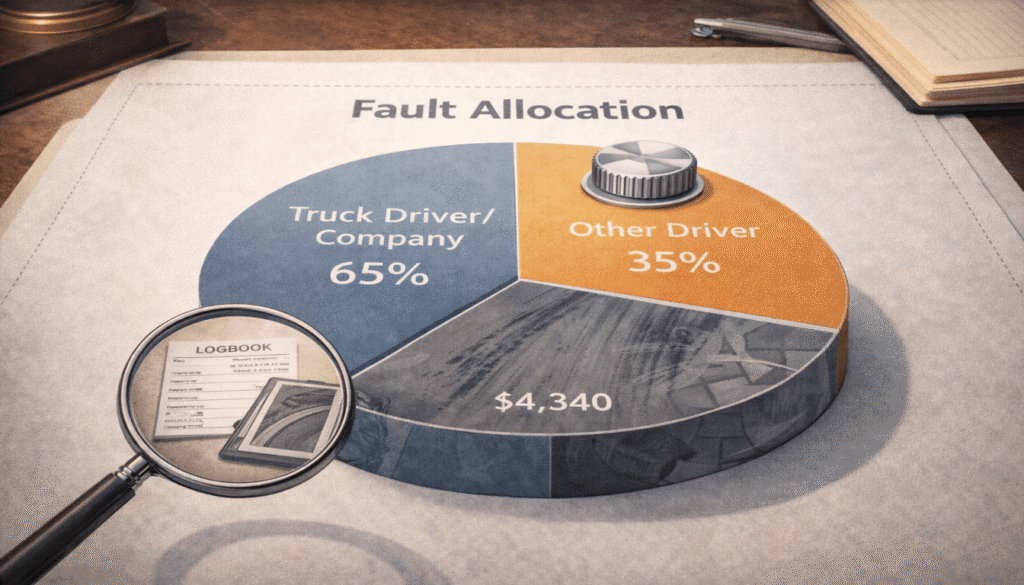
The National Conference of State Legislatures (NCSL) explains that states apply different comparative negligence rules, which directly affect how much a victim can recover after an accident. Under New Jersey’s modified comparative fault system, a plaintiff’s award is reduced by their percentage of fault. If fault reaches 51% or more, recovery is barred.
Modified Comparative Fault and the 51 Percent Bar
Modified comparative fault means jury allocations matter. A plaintiff found 20% at fault sees a 20% cut to compensation. If a victim is 51% at fault, the law bars recovery entirely. This rule makes early fault contests central to many accident cases.
Multiple Liable Parties in Commercial Trucking Cases
Truck crashes often involve several defendants: the driver, carrier, maintenance shops, loaders, and parts makers. Insurers for companies will try to shift blame to lower payouts. Preserving ELD data, dashcam footage, and maintenance logs quickly is critical. Expert reconstruction can rebut fault allegations and protect a personal injury claim.
For more on how shared blame impacts settlements, see Comparative Fault in Semi‑Truck Accidents.
Building Your Case: Key Evidence to Collect and Preserve After a Semi-Truck Accident
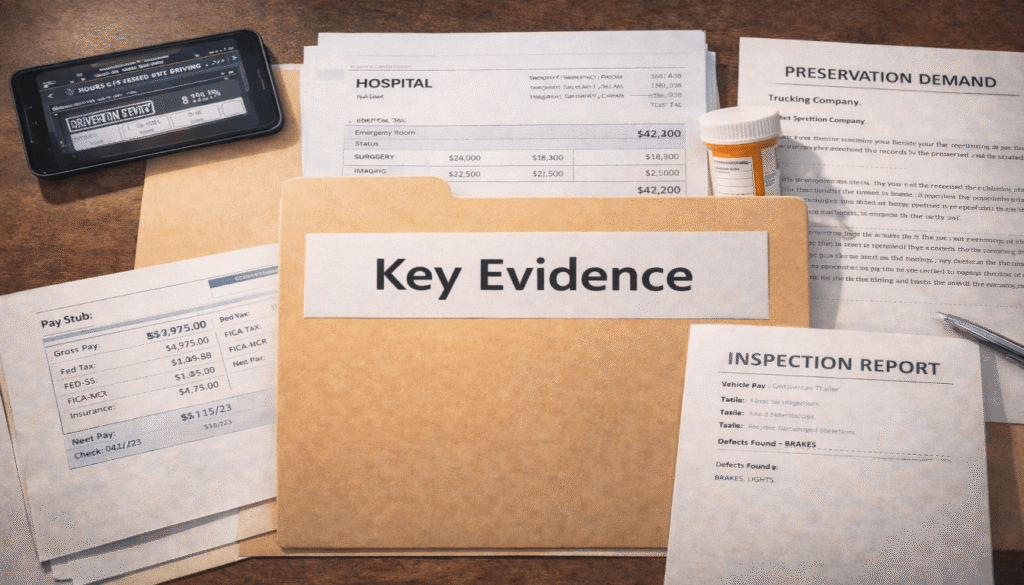
The Federal Motor Carrier Safety Administration (FMCSA) outlines electronic logging device (ELD) requirements that make driver hours and duty status records central evidence in commercial trucking cases. Clear, well‑preserved evidence often decides whether a victim recovers fairly after a major truck wreck. Early organization turns scattered records into a persuasive case file.
Key proof: Medical records, bills, pay stubs, and expert opinions
- Medical records and itemized bills: Backbone of monetary claims, linking diagnosis and treatment to costs.
- Pay stubs and employer statements: Prove lost income and connect treatment to time away from work.
- Expert reports: Translate current care into projected costs for future therapy and reduced earning capacity.
Crash investigation: ELD data, dashcam footage, and witness statements
- Time‑sensitive data: ELD files, dashcam/surveillance video, and telematics must be preserved promptly to avoid overwrites.
- Corroboration: Vehicle inspections, scene photos, and witness accounts establish fault, conditions, and damage patterns.
- Chain of custody: Document handling to protect technical evidence for court.
Practical steps to preserve evidence
- Track all expenses: Medical bills, repairs, and related costs with receipts.
- Document injuries: Journals, therapy notes, and photographs.
- Engage a lawyer early: Issue preservation demands and manage technical data.
For a deeper dive into preservation strategy, see Preserving Evidence in Semi‑Truck Accident Cases.
| Evidence Type | Why It Matters | Typical Source |
|---|---|---|
| Medical Records & Bills | Proves treatment, links costs to injuries | Hospitals, clinics, billing statements |
| Employment Records | Shows lost wages and benefits impact | Pay stubs, employer letters |
| Telematics & Video | Establishes timeline and driver behavior | ELD downloads, dashcam, CCTV |
| Scene Documentation | Supports fault and damage analysis | Photos, inspections, witness statements |
“A well-preserved evidence file strengthens negotiation posture and trial readiness.”
How a Semi‑Truck Accident Lawyer Maximizes Recovery for Victims
The American Bar Association (ABA) notes that effective representation in personal injury cases requires blending prompt investigation with economic modeling to protect long‑term needs. A skilled truck accident lawyer preserves evidence, identifies all responsible parties, and builds a factual record used to demand fair compensation. To learn more, read How Do I Find a Lawyer.
Comprehensive Case Strategy and Negotiation with Insurers
An accident lawyer creates a file that ties medical treatment to lost wages, medical expenses, and projected costs. This organized package counters low software valuations and forces insurers to address real facts.
Key actions include:
- Immediate evidence preservation and witness interviews.
- Retention of specialists for vehicle reconstruction and income analysis.
- Clear communication with clients about strategy and timing.
Projecting Lifetime Costs to Protect Future Needs
The attorney works with vocational and economic experts to model earning capacity and lifetime income loss. They factor in future medical, home care, and adaptive needs so settlement demands reflect real life costs.
For more on how damages reflect both present and future needs, see Economic and Non‑Economic Damages in Semi‑Truck Accident Claims.
Protecting Recovery and Securing Justice
Concluding a truck case requires melding clear proof with a plan that protects long‑term recovery. Victims should document medical records, bills, and personal journals to show both financial losses and daily life change.
Fair compensation depends on tying present expenses to projected costs, including ongoing care, lost wages, and reduced earning capacity. Where reckless conduct exists, punitive damages may increase recovery.
Understanding New Jersey’s comparative fault rules shapes strategy and possible outcomes. A skilled lawyer turns evidence into a persuasive claim and helps guard future needs. Beyond the courtroom, these cases are about restoring stability, ensuring families are supported, and holding negligent trucking companies accountable.
For more on what victims can recover, see Compensation in Semi‑Truck Accident Cases.
Frequently Asked Questions About Damages in Semi‑Truck Accident Claims
What compensation can I get after a semi-truck rear-end collision?
You can recover compensation for both financial losses and personal impact. This includes:
1. Medical Bills: ER care, surgery, physical therapy.
2. Lost Wages & Vehicle Repair: Income lost during recovery and costs to fix or replace your vehicle.
3. Pain & Suffering: Compensation for physical pain, emotional distress, and reduced quality of life from injuries like whiplash or spinal trauma.
The final value depends on injury severity and evidence. For a complete breakdown of damage types and calculations, see Economic and Non-Economic Damages in Semi-Truck Accident Claims.
What types of losses can victims recover after a semi‑truck accident?
Victims may recover past and future medical bills, lost income and reduced earning capacity, vehicle repair or replacement costs, rehabilitation and home care expenses, and compensation for pain, suffering, emotional distress, and loss of enjoyment of life. In egregious semi‑truck crash cases, courts may award punitive damages against a trucking company or driver for willful misconduct.
How do monetary losses for treatment and care get calculated after a semi‑truck accident?
Attorneys compile medical records, invoices, and expert opinions to total emergency care, surgeries, outpatient visits, prescriptions, physical therapy, and projected future treatment. Economists or life‑care planners estimate lifetime medical needs and costs so semi‑truck accident settlements or verdicts reflect ongoing care and rehabilitation.
What proof is needed to recover lost wages and diminished earning capacity in a semi‑truck accident claim?
Pay stubs, tax returns, employer statements, and vocational expert reports establish lost earnings to date. To prove reduced future income, a vocational specialist, medical expert, and economist document how injuries limit work ability and calculate lifetime earning losses specific to semi‑truck crash injuries.
How is pain, suffering, and reduced quality of life valued in a semi‑truck accident case?
Lawyers use methods like multipliers of economic losses or per diem formulas, supported by medical testimony and personal impact statements, to assign a dollar value to pain and diminished life quality. Thorough documentation of symptoms, mental health care, and daily limitations strengthens these semi‑truck claims.
Can punitive awards apply in semi‑truck accident lawsuits?
Yes. Punitive damages target conduct such as driving under the influence, falsifying logbooks, violating hours‑of‑service rules, or failing to maintain safety equipment. Courts reserve punitive measures for reckless or intentional behavior in semi‑truck accidents, and insurers and juries weigh evidence of gross negligence.
What happens if the injured person shares fault for a semi‑truck accident?
Under New Jersey’s modified comparative fault rule, a claimant can recover damages if they bear 50% or less of the fault; recovery is reduced by their percentage of responsibility. If they are 51% or more at fault, they cannot recover. Multiple parties—including trucking companies, contractors, and drivers—can share liability in semi‑truck accidents.
Which records are essential to build a strong semi‑truck accident case?
Key evidence includes ambulance and hospital records, treatment bills, medication receipts, pay records, vehicle repair estimates, witness statements, police reports, electronic logging device data, dashcam footage, and expert analyses such as accident reconstruction and life‑care plans.
How do investigators use ELD data and dashcam footage in semi‑truck accident claims?
ELD logs show hours of service, driving times, and potential fatigue violations. Dashcam and on‑board camera footage can reveal speed, lane changes, braking, and driver behavior. Combined with maintenance records and inspection reports, this data helps prove negligence and regulatory breaches in semi‑truck crash cases.
Why should victims hire a lawyer experienced with semi‑truck accidents?
Semi‑truck accident cases involve complex federal regulations, corporate liability theories, multiple insurance policies, and specialized evidence. Experienced attorneys assemble medical and vocational experts, negotiate with insurers, preserve critical evidence, and project long‑term costs to pursue fair compensation.
How do attorneys estimate lifetime costs for permanent injuries from a semi‑truck accident?
Counsel works with life‑care planners, medical specialists, and financial analysts to forecast ongoing medical care, assistive devices, home modifications, lost earning capacity, and long‑term personal care needs. These projections inform demands and trial valuations to protect future needs in semi‑truck accident claims.
What immediate steps should an injured person take after a semi‑truck accident?
Seek prompt medical attention, preserve medical records and billing statements, document the scene with photos, get witness contact information, report the crash to police and insurers, and consult a qualified semi‑truck accident attorney quickly to preserve perishable evidence like ELD data and camera recordings.
Can property damage costs be included in a semi‑truck accident claim?
Yes. Repair estimates or total loss payouts for vehicles, towing fees, and related out‑of‑pocket expenses are part of a full recovery package. Counsel ensures property losses are documented alongside medical and income evidence to capture the complete financial impact of a semi‑truck crash.
How do emotional distress and loss of consortium get proven in semi‑truck accident cases?
Mental health treatment records, therapist or psychiatrist reports, testimony from family members, and daily activity limitations help quantify emotional harm. Loss of consortium claims rely on spousal testimony and evidence showing the injury’s effect on intimacy, companionship, and household roles following a semi‑truck accident.
What role do expert witnesses play in semi‑truck accident lawsuits?
Experts—such as accident reconstructionists, medical specialists, vocational evaluators, life‑care planners, and economists—translate technical facts into persuasive testimony. Their analyses establish causation, quantify future needs, and rebut defense arguments to maximize recovery in semi‑truck accident claims.
⚖️ Disclaimer: The content of this article is for informational purposes only and does not constitute legal advice. The information provided is based on general research and is not intended to be a substitute for professional legal advice or consultation with a qualified attorney. Always consult with a lawyer regarding your specific legal situation.