

“The time is always right to do what is right,” said Martin Luther King Jr.—a call that frames the pursuit of truth after a serious semi‑truck accident.
Expert witnesses in semi‑truck accident claims serve as the linchpin that transforms complex technical data into clear proof of fault and damages. Attorneys rely on forensic analysis of ECM/EDR downloads, ELD logs, maintenance files, and cargo records to build causation narratives that courts and juries can understand.
Specialized testimony explains what happened, why it happened, and which parties breached safety duties. Early engagement of experts preserves scene markings and digital evidence that can vanish quickly, strengthening liability arguments and clarifying long‑term damages. For a broader overview of how lawsuits progress from filing to settlement, see Semi‑Truck Accident Lawsuits Explained.
Key Takeaways
- Expert witnesses translate technical data into courtroom‑ready testimony.
- Objective analysis of black box and maintenance logs often determines liability.
- Early preservation of evidence helps maintain claim value.
- Comprehensive expert input can accelerate fair compensation.
- Counsel must vet experts for admissibility and jury clarity.
Expert Witnesses in Semi‑Truck Accident Claims: A Practical Guide for Victims and Families
Data from onboard recorders and company files can bridge gaps between a chaotic semi‑truck accident scene and a coherent legal theory. This short guide explains when technical review matters and how it shapes a strong case.
Why Expert Testimony Matters in High‑Stakes Semi‑Truck Accident Cases
Expert testimony converts complex logs and mechanical findings into clear conclusions. Courts and insurers weigh this analysis heavily when multiple parties share responsibility. FMCSA rules on hours, load securement, and maintenance add layers that plain reports cannot resolve. Well‑founded analysis ties those rules to liability and clarifies speed, braking, and duty hours. The FMCSA Compliance, Safety, Accountability Program shows how federal oversight tracks violations that often become central in semi‑truck accident claims.
How This Guide Helps Victims, Families, and Their Attorneys
This guide helps victims and families decide when to retain specialists and which disciplines match a crash profile. It offers quick checklists for vetting credentials, methodology, and trial experience. It also describes how testimony improves negotiation leverage and can shorten resolution time. For more on how evidence supports liability, see Preserving Evidence in Semi‑Truck Accident Cases.
| Need | What To Seek | Impact |
|---|---|---|
| Data Reconstruction | EDR/ELD analysis | Clear timeline |
| Mechanical Review | Brake and systems inspection | Cause of failure |
| Regulatory Review | FMCSA compliance audit | Liability support |
Understanding the Complexities of Semi‑Truck Accident Cases in the U.S. Legal System
Digital logs, maintenance histories, and cargo records often converge to explain how a semi‑truck accident unfolded. These materials provide the foundation for attorneys and expert witnesses to reconstruct events and assign liability.

FMCSA Rules, Maintenance Duties, and Hours‑of‑Service Compliance
FMCSA standards set clear safety duties for trucking fleets and drivers. These rules provide measurable benchmarks for compliance and breach. Hours‑of‑service entries and ELD/ECM data show duty cycles, revealing fatigue, over‑hours driving, or falsified reports linked to causation. Maintenance logs, inspection intervals, and defect tracking show whether the vehicle was roadworthy. Companies that skip intervals create clear risk signals. The FMCSA Hours of Service Regulations outline how duty cycles are monitored and enforced across the industry.
Multiple Liable Parties: Driver, Company, Loader, Maintenance, or Manufacturer
Liability often spreads across several parties: the driver, the employer, the loader, maintenance firms, or a manufacturer. Mapping those roles clarifies who failed to act reasonably. Securement and weight distribution affect stopping distance and vehicle dynamics. Negligence can arise from unsafe schedules, improper loading, or defective components. Correlating digital data with scene measurements, damage profiles, and reports strengthens evidence.
Determining fault requires synthesizing regulatory and mechanical facts, not only eyewitness accounts. When failures cross multiple entities, apportioning responsibility demands disciplined analysis of all relevant factors. For more on how courts handle overlapping liability, see Multi‑Party Liability in Semi‑Truck Accidents.
Key Types of Expert Witnesses That Strengthen Semi‑Truck Accident Lawsuits
A coordinated team of specialists turns technical records and physical evidence into a clear, testable reconstruction of what happened in a semi‑truck accident. Core disciplines include accident reconstructionists, mechanical engineers, safety reviewers, medical and economic analysts, and forensic toxicologists. Together they produce causation, liability, and damages analysis that strengthens semi‑truck accident claims.

Accident Reconstruction Specialists and Simulation Evidence
Reconstructionists use physics, simulation software, impact angles, and debris patterns to recreate events. Their models estimate speed, braking, and force to support testimony. The National Institute of Standards and Technology (NIST) Forensic Science Program highlights how scientific modeling and reconstruction methods are applied in complex accident investigations.
Mechanical/Automotive Engineers for Brake and Component Failures
Mechanical review checks brakes, steering, tires, and suspension for defects or wear. Component findings link vehicle condition to probable failure modes.
Trucking Safety Experts and FMCSA Compliance Reviews
Safety reviewers audit hours‑of‑service logs, driver qualifications, and maintenance records. That analysis ties regulatory breaches to risk and fault. For more on how evidence supports liability, see Evidence in Semi‑Truck Accident Cases.
Medical, Vocational, and Economic Experts for Injury and Loss Valuation
Medical specialists define diagnoses, prognosis, and care needs. Vocational and economic analysts project wage loss, benefits, and lifetime household services to quantify damages.
Forensic Toxicologists and Impairment Analysis
Toxicology links substance levels to functional impairment and behavior. Timing and metabolism data help correlate lab results with the event.
Collaboration matters: early retention lets these disciplines inspect the vehicle, secure transient data, and produce admissible, method‑driven evidence that avoids contradictory opinions in semi‑truck accident lawsuits.
When to Retain Expert Witnesses to Prove Liability and Damages in Semi‑Truck Accidents
When fault is contested, immediate technical review can identify perishable evidence and set a clear case direction. Early action helps legal teams preserve data and lock critical timelines. This step matters most when injuries are catastrophic or multiple parties share blame in semi‑truck accident claims.

Disputed Fault, Catastrophic Injuries, and Multiple‑Party Cases
Engage specialists quickly for disputed‑fault scenarios to secure scene marks, EDR/ELD files, and maintenance reports. Prioritize early review for catastrophic injuries to measure long‑term medical needs and economic loss. Multiple parties often require distinct disciplines to map duties and breaches. Timely analysis can remove ambiguity and move settlement talks forward, while delays risk overwritten logs, repaired vehicles, or lost scene evidence. The U.S. Department of Justice bulletin on expert witnesses explains how expert testimony is used in litigation and why early retention is critical.
Wrongful Death Considerations and Forensic Timelines
Wrongful death claims often hinge on pathology and precise timelines. Medical and forensic analysis establish cause, timing, and survivorship damages for the victim’s family. For more on how damages are calculated in semi‑truck accident cases, see Economic and Non‑Economic Damages in Semi‑Truck Accident Claims..
| Trigger | Priority Action | Outcome |
|---|---|---|
| Contested Fault | Secure EDR/ELD and scene photos | Clear timeline to establish liability |
| Catastrophic Injuries | Early medical and economic review | Quantified long-term damages |
| Multiple Parties | Assign discipline-specific reviewers | Apportioned duties and breaches |
| Wrongful Death | Forensic pathology and timelines | Causation and survivorship clarity |
Admissibility of Expert Testimony in Semi‑Truck Accident Cases: Daubert, Frye, and Court Standards
Courts act as gatekeepers of expert testimony in semi‑truck accident lawsuits by testing methods, data sufficiency, and relevance to contested facts. The Daubert and Frye standards frame how specialized analysis enters the courtroom. Daubert asks whether the methodology is testable, peer‑reviewed, has known error rates, and enjoys general acceptance when applicable. The Cornell Law School Legal Information Institute – Daubert Standard provides a clear overview of how courts apply these criteria.

Qualifications, Methods, Relevance, and Sufficient Data
Judges review four pillars: credentials, sufficient facts, reliable methods, and clear relevance to the dispute. Methodology stands separate from conclusions; courts exclude opinions that rest on speculation. Plaintiffs and defense teams should vet credentials, litigation experience, and prior testimony early. Reports must tie facts to opinions with transparent calculations and citations.
Pretrial motions and depositions reveal weaknesses or allow counsel to cure defects. Mock direct and cross‑examination sharpen clarity and defend analytic steps. Documenting data sources, chain of custody, and every analytical step limits attack points. For more on how negligence is proven in trucking litigation, see How to Prove Negligence in Semi‑Truck Accident Lawsuits.
Admissible, well‑supported opinions raise case value and shape settlement posture in semi‑truck accident claims.
How Expert Witness Analysis Shapes Settlement Strategy and Case Value in Semi‑Truck Accident Claims
When specialists quantify lifetime loss and care needs, insurers often reassess exposure and move toward resolution. That shift happens because clear, testable analysis reduces uncertainty about liability and long‑term costs in semi‑truck accident claims.

Translating Technical Findings into Negotiation Leverage
Clear technical narratives convert complex facts into bargaining power. Well‑crafted timelines, diagrams, and concise reports remove guesswork. Reconstruction visuals and data timelines limit defense deniability and increase reserve pressure. Presenting the strongest opinions first sets the negotiation frame. The RAND Institute for Civil Justice provides research on how expert analysis influences settlement dynamics and case valuation.
Projecting Long‑Term Care, Earning Capacity, and Pain and Suffering
Medical life‑care plans, vocational limits, and economic models anchor valuation ranges. These tools make damages and future compensation tangible to adjusters. Package opinions into brief mediation exhibits and demonstratives for quick review. Seek cross‑discipline consensus to boost credibility and case value. Reassess strategy as new data emerges and prepare rebuttals for expected defense critiques. For more on how compensation is structured in trucking litigation, see Compensation in Semi‑Truck Accident Cases..
Well‑timed, robust submissions can shorten litigation, reduce risk exposure for victims, and sharpen settlement focus on fair recovery.
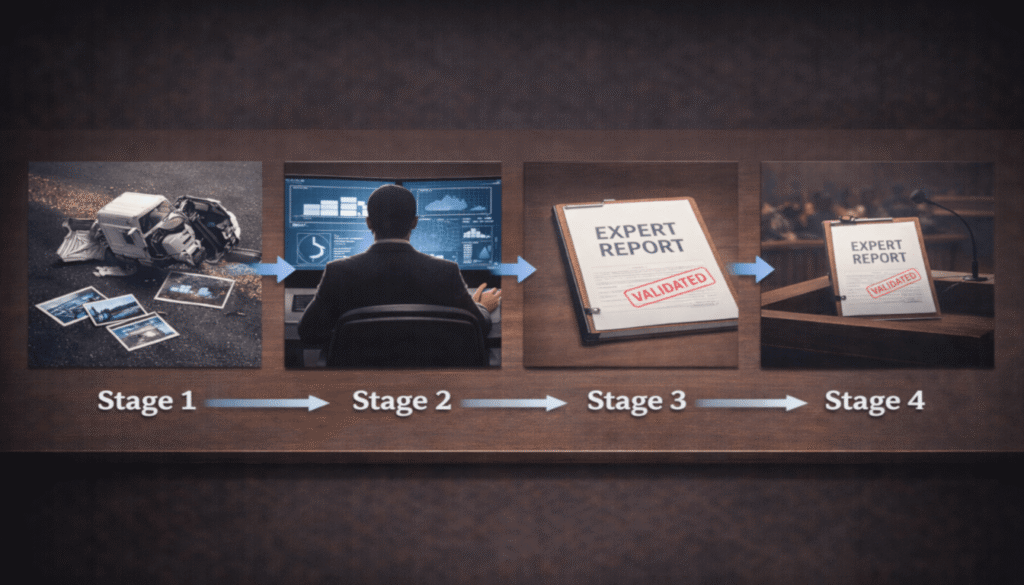
From Crash Scene to Courtroom: The Expert Witness Investigation Workflow in Semi‑Truck Accident Cases
A careful workflow links the field, the lab, and the courtroom so technical findings hold up under scrutiny. Immediate steps set the tone for later analysis and admissibility in semi‑truck accident claims.
Crash Scene Review: Skid Marks, Debris, And Impact Angles
Teams document skid patterns, gouge marks, and debris fields with measurements and high‑resolution photos. Best practice calls for a measured grid, scale references, and sequential photos to map the scene for later comparison with reports. The NTSB Investigative Process explains how federal investigators structure crash scene documentation to ensure accuracy and reliability.
Best practice calls for a measured grid, scale references, and sequential photos to map the scene for later comparison with reports.
Vehicle Inspections: Brakes, Tires, Steering, and Maintenance Logs
Inspectors examine brakes, tires, and steering components, correlating findings with maintenance records. Load weight and distribution are checked to see how they changed stopping distance and vehicle stability. For more on how liability is proven through mechanical and regulatory failures, see Liability in Semi‑Truck Accidents.
Reconstruction Visuals: Diagrams, Animations, and Models
Analysts synthesize scene marks, digital logs, component tests, and witness notes into time‑sequenced models.
- Preserve chain of custody for all physical and digital evidence to protect admissibility.
- Reconcile damage patterns with occupant kinematics and vehicle deformation to test hypotheses.
- Use diagrams and animations to make complex factors clear for adjusters and jurors.
- Send early preservation letters to carriers and the company to prevent spoliation.
Collaboration across disciplines closes analytical gaps and produces defensible, court-ready reconstructions.
Selecting Semi‑Truck Accident Lawyers Who Effectively Leverage Expert Witnesses
A firm’s track record with technical testimony often predicts how well it will handle semi‑truck accident cases. Clients should look for lawyers who pair credentials with trial experience and clear courtroom presentations.

Vetting Experts’ Credentials, Trial Experience, and Prior Testimony
Request CVs, peer‑reviewed publications, and a history of prior testimony. Ask about any Daubert or gatekeeping motions and how the firm handled them. The Cornell Law School Legal Information Institute – Rule 702 (Testimony by Expert Witnesses) outlines the federal standard for admitting expert testimony, emphasizing sufficient data, reliable methods, and relevance to the facts.
Integrating Expert Evidence into a Jury‑Friendly Narrative
Successful teams turn technical reports into plain‑language storylines. They use demonstratives, timelines, and rehearsed testimony to keep jurors focused on causation and loss. For more on how to select the right attorney for trucking cases, see Choosing the Best Semi‑Truck Accident Lawyer.
“Clear, methodical preparation makes complex evidence believable to jurors.”
| Evaluation Item | What To Request | Why It Matters |
|---|---|---|
| Credentials | CV, publications, certifications | Shows subject-matter depth |
| Trial Record | List of cases, sample reports | Indicates courtroom effectiveness |
| Team Depth | Network across reconstruction, medical, economic | Ensures complete evidence coverage |
| Budget Planning | Fee estimates and scope | Prevents surprises during litigation |
Final checks: confirm the firm understands trucking operations and the company safety culture. Ask for examples where expert work changed case outcomes.
Challenges and Limitations: Managing the “Battle of the Experts” in Semi‑Truck Accident Litigation
A clear, plain‑language presentation can turn a technical dispute into a straightforward finding for the jury. Defense teams often produce counter‑analysts, and that clash shifts focus from data to credibility in semi‑truck accident litigation.

Credibility, Communication Style, and Juror Perception
When opposing testimony arrives, jurors judge tone, consistency, and how well facts line up with the scene. Judges also limit scope with evidentiary rulings that narrow what can be said in court. The Federal Judicial Center’s Reference Manual on Scientific Evidence explains how courts evaluate competing expert testimony and manage evidentiary disputes.
- Dynamics of conflict: Jurors weigh competing opinions by checking methods, sources, and whether conclusions match corroborating facts.
- Plain language and visuals: Simple charts and short explanations reduce confusion and increase persuasive impact.
- Perceived bias: Transparent data handling and open method descriptions cut skepticism about motives.
- Align testimony to facts: Tie technical points to scene evidence, maintenance records, and known actions by the driver or other parties.
- Preparation: Mock trials and focus groups refine tone, predict attacks, and sharpen core messages for cases that go to trial.
- Limits and objections: Anticipate limiting instructions and prepare to narrow opinions when courts restrict scope.
- Cross‑examination tactics: Teach witnesses to concede minor points, reinforce main conclusions, and handle hypotheticals without overreaching.
- Demeanor matters: Consistency, calm delivery, and professionalism strongly influence juror trust and the ultimate impact on verdicts.
Jurors often resolve conflicting expert opinions by apportioning fault among parties. For more on how shared blame impacts settlement outcomes, see Comparative Fault in Semi‑Truck Accidents..
“Trial-tested preparation and mock examinations help align testimony with case themes and juror expectations.”
Real‑World Case Studies: How Expert Witness Evidence Turns Semi‑Truck Accident Claims Around
Objective inspections and downloads frequently force carriers to re‑evaluate liability and settlement offers. This happens when physical testing, timeline data, and technical review align to make fault clear in semi‑truck accident claims.

Brake Failure Claims Versus Mechanical Findings
Mechanical inspections can rebut brake‑failure defenses and refocus fault on human error. In a Northern Virginia case, a mechanical engineer confirmed brakes worked. An accident reconstruction analysis then showed the driver failed to slow. A trucking safety review found hours‑of‑service violations that increased pressure to settle for medical care and lost income.
Speed, Fatigue, and FMCSA Violations Proven Through Data
EDR and ELD timelines often corroborate speeding, delayed braking, or fatigue. In a fatal crash, black box downloads showed no braking input before impact, proving unsafe speed and an avoidable collision. The FMCSA Hours‑of‑Service Regulations detail how fatigue and duty‑hour violations are tracked and enforced, underscoring the role of expert data analysis in proving liability.
- Reconstruction and data analysis align to show avoidability and causation.
- Coordinated findings make carriers reassess exposure and adjust reserves.
- Quantified future care and earnings loss drive higher compensation offers.
- Early preservation of evidence enables these impactful conclusions.
- Demonstratives bridge technical details for mediators and jurors.
For more on how federal safety rules shape liability in trucking cases, see Hours‑of‑Service Violations in Semi‑Truck Accidents.
“Clear, corroborated reports and matched scene marks reduce jury risk and accelerate resolution.”
Regional insights: How Expert Witness Testimony Varies Across U.S. Semi‑Truck Accident Litigation
Local procedures and judicial preferences often determine which reports and timelines carry weight at trial. Regional insights matter because courts and juries across the United States react differently to styles of proof in semi‑truck accident cases. Lawyers and technical teams adapt by collecting the right records early and tailoring narratives to local practice. The CSA: FMCSA’s Compliance, Safety, Accountability program provides a nationwide framework for safety measurement and enforcement, reinforcing how EDR/ELD data, maintenance logs, and carrier compliance affect expert analysis across jurisdictions.

Complex litigation and high‑value semi‑truck accident cases
In complex, high‑value semi‑truck accident lawsuits, practitioners coordinate multi‑discipline review early. They rely on black box downloads, ELD timelines, maintenance reports, toxicology, and regulatory compliance to push settlements and verdicts. For a broader look at how federal trucking rules impact liability and proof, see How Federal Trucking Regulations Affect Semi‑Truck Accident Cases.
Juror perception and expert witness credibility in semi‑truck accident trials
Courts and juries nationwide place strong emphasis on expert credibility and consistent testimony. In semi‑truck accident litigation, statements are cross‑checked against damage patterns, police reports, and vehicle condition data. Aligning eyewitness accounts with technical reports strengthens credibility and increases persuasive impact.
Practical takeaways for nationwide semi‑truck accident strategy
- Coordinate early: Assemble accident reconstruction, mechanical, human factors, and regulatory experts at the outset.
- Anticipate challenges: Expect rigorous Daubert and gatekeeping scrutiny in complex semi‑truck accident cases.
- Align proof: Integrate eyewitness accounts with EDR/ELD data, maintenance logs, and scene documentation.
- Plan for context: Factor logistics corridors, traffic density, and carrier operations into timelines and case theory.
- Leverage public data: Use police reports, FMCSA records, and state bar resources to strengthen posture.
Expert Witnesses as the Cornerstone of Semi‑Truck Accident Litigation
Preserving perishable data early transforms fragmented reports into a clear causation timeline. Timely, technical analysis is essential to prove fault, value damages, and strengthen negotiation leverage in semi‑truck accident cases.
Reconstruction, mechanical, medical, vocational, economic, and toxicology inputs must interlock to establish liability and improve settlement outcomes. Coordinated review often shortens litigation and raises compensation offers.
Victims and families should seek attorneys who routinely deploy and defend specialists under Daubert/Frye standards and schedule a prompt consultation to protect evidence and scope expert work. For practical answers and preservation steps, review the Semi‑Truck Accident FAQs: Legal Rights and Answers for Victims.
Nationwide strategy matters — courts across the U.S. apply different evidentiary preferences, but the common thread is credibility. Aligning with a team ready to integrate objective methods increases trust with insurers and courts and secures the strongest possible case and settlement. For a full roadmap of the litigation process, see Semi‑Truck Accident Lawsuits Explained.
Frequently Asked Questions About Semi‑Truck Accident Experts
What is a semi accident expert?
A ‘semi accident expert‘ is typically an accident reconstructionist or trucking regulations expert hired to investigate a crash. They analyze data like black box (ECM) readings, driver logs, and federal safety compliance to prove how the accident happened and who was at fault.
How do trucking safety specialists and FMCSA reviews affect semi‑truck accident claims?
Safety specialists interpret Federal Motor Carrier Safety Administration rules, including hours‑of‑service, driver qualification, and maintenance obligations. They identify regulatory breaches, analyze carrier compliance programs, and tie policy violations to crash causation and corporate liability in semi‑truck accident lawsuits.
What role does an accident reconstruction specialist play in proving fault for a semi‑truck accident?
Reconstruction specialists analyze skid marks, vehicle damage, impact angles, and scene measurements to recreate the sequence of events. They use physics, video, and simulation tools to estimate speed, point of impact, and contributing maneuvers. Their findings help establish negligence, refute defense theories, and support liability claims against the driver or carrier in semi‑truck accident litigation.
When should a family or attorney hire mechanical engineers for brake or component failure claims in a semi‑truck accident?
Mechanical engineers should be retained early when preliminary evidence suggests brake, tire, steering, or component defects. Early inspection preserves critical parts, maintenance records, and electronic data. Engineers can test components, evaluate repair histories, and link failures to improper maintenance, manufacturer defects, or improper loading in semi‑truck accident cases.
What types of medical and economic experts are needed to value catastrophic injuries in semi‑truck accident cases?
A coordinated team often includes treating physicians, life‑care planners, vocational rehabilitation specialists, and forensic economists. Medical experts project prognosis and treatment needs. Economists quantify lost earnings and future medical costs. Vocational experts assess employability and earning capacity to calculate fair damages in semi‑truck accident claims.
How is EDR/ELD data used to prove speed, braking, or hours‑of‑service violations in semi‑truck accidents?
Event Data Recorders and Electronic Logging Devices capture speed, braking inputs, engine RPM, and driving hours. Specialists download and authenticate this data to demonstrate excessive speed, unrecorded rest breaks, or driver fatigue. Courts and insurers rely on this objective evidence to corroborate findings in semi‑truck accident litigation.
What must be proven for expert testimony to be admissible under Daubert or Frye standards in semi‑truck accident cases?
Courts require experts to show relevant, reliable methods and sufficient data. Qualifications, peer‑reviewed methodology, error rates, and acceptance in the field matter. Counsel should prepare thorough reports, disclose bases for opinions, and be ready for gatekeeping hearings to establish admissibility in semi‑truck accident trials.
How do experts turn technical findings into persuasive evidence for settlement or trial in semi‑truck accident lawsuits?
Effective experts translate complex analysis into clear visuals, demonstrations, and plain‑language testimony. They focus on causation, economic impact, and human consequences. Combining animations, charts, and succinct reports helps negotiators and jurors grasp why the technical facts justify higher case value in semi‑truck accident claims.
What liability parties are commonly implicated in semi‑truck accidents?
Potentially liable parties include the truck driver, trucking company, freight loader, maintenance provider, and component manufacturers. Experts trace causation through logs, maintenance records, loading reports, and forensic inspection to assign responsibility among these entities in semi‑truck accident litigation.
In wrongful death cases, how do forensic timelines and expert analysis support family claims after a semi‑truck accident?
Forensic timelines establish the sequence that led to fatal injuries and identify critical decision points. Medical examiners, collision analysts, and safety auditors quantify when and how failures occurred. Their work supports claims for loss of support, funeral expenses, and punitive considerations when gross negligence is shown in semi‑truck accident cases.
How should plaintiffs preserve evidence at the scene of a semi‑truck accident to strengthen expert review?
Prompt steps include hiring counsel, securing the vehicle for inspection, documenting photos and videos, obtaining maintenance and driver logs, and preserving EDR/ELD data. Early preservation prevents loss, alteration, or repairs that can hinder expert analysis in semi‑truck accident litigation.
Can competing technical experts create confusion, and how do lawyers manage the “battle of the experts” in semi‑truck accident trials?
Conflicting testimony can confuse factfinders. Effective counsel limits disputes by vetting experts’ credentials, focusing testimony on agreed facts, and using demonstrative exhibits to highlight credibility. Cross‑examination targets methodology flaws and data gaps to weaken opposing opinions in semi‑truck accident cases.
Are regional court practices important when selecting consultants for semi‑truck accident litigation?
Yes. Jurisdictions vary on admissibility standards, jury expectations, and local litigation culture. Experienced counsel often choose experts with prior testimony in the same district to ensure familiarity with local judges and juror sensibilities in semi‑truck accident lawsuits.
What is the typical cost‑benefit of retaining multiple specialists for a complex semi‑truck accident claim?
While specialists add cost, they frequently increase settlement value by clarifying causation, projecting future damages, and exposing regulatory violations. Counsel should align expert scope with case needs—using focused analyses to balance expense and evidentiary impact in semi‑truck accident litigation.
How do forensic toxicologists contribute to impairment‑related semi‑truck accident investigations?
Toxicologists analyze biological samples, interpret metabolite timelines, and assess impairment relative to observed driving. Their reports can link substances to degraded performance and support claims of driver intoxication or prescription‑related impairment in semi‑truck accident cases.
What role do visual reconstructions and animations play in persuading juries during semi‑truck accident trials?
Visual reconstructions distill technical findings into intuitive scenes that jurors can understand. Animations showing speeds, impact points, and occupant trajectories make causation and injury mechanisms tangible, enhancing comprehension and persuasive force in semi‑truck accident litigation.
⚖️ Disclaimer: The content of this article is for informational purposes only and does not constitute legal advice. The information provided is based on general research and is not intended to be a substitute for professional legal advice or consultation with a qualified attorney. Always consult with a lawyer regarding your specific legal situation.