

The U.S. trucking industry generates nearly $987 billion annually and supports about 5% of full‑time jobs. Yet many carriers hire drivers who appear qualified on paper but lack the real‑world skills needed to safely operate massive vehicles.
This gap turns routine routes into high‑risk situations where a single poorly prepared operator can cause devastating accidents.
This article explains how trucking companies’ failures in screening and training raise preventable risks and expand exposure under the law for personal injury victims. These practices are framed as systemic company problems, not isolated mistakes by individual drivers.
Readers will see how FMCSA rules, Entry‑Level Driver Training (ELDT) standards, and 49 CFR §391.51 driver qualification file requirements anchor liability claims. The guide previews evidence types — personnel files, telematics, and maintenance logs — that show when a company knew or should have known about risks. Finally, it offers practical next steps for victims and families to evaluate counsel, begin an investigation, and position a case for maximum recovery. For a deeper legal foundation, see Semi‑Truck Accident Law Explained.
Key Takeaways
- The scale of the U.S. trucking industry magnifies the danger of poor screening and inadequate instruction.
- Systemic company practices often drive risks more than isolated driver error.
- FMCSA regulations, Entry‑Level Driver Training (ELDT) standards, and 49 CFR §391.51 driver qualification file requirements provide strong legal anchors for liability claims.
- Evidence from personnel records, telematics, and maintenance logs can prove corporate knowledge of risk.
- Victims should follow clear steps to protect a personal injury claim and seek counsel.
Understanding Negligent Hiring And Training In Semi-Truck Accidents
Company decisions about who drives and how they are prepared shape the risk that a vehicle will crash and cause harm.
Negligent hiring occurs when a carrier fails to vet a truck driver’s record, health, or drug testing before assigning road duty. Even a licensed commercial driver can lack the real‑world experience to handle heavy rigs without structured training.
Poor screening and weak instruction create predictable hazards: fatigue, misjudged braking distance, and sudden load shifts. These risks make personal injury far more severe when a semi‑truck is involved.
Red flags include DUIs, repeated moving violations, lapsed credentials, and untreated medical issues. A company’s duty extends past onboarding to active monitoring of drivers and vehicle performance on the road.
A clear theory of the case links company choices to the accident mechanism and strengthens liability claims. Victims should check whether trucking companies followed industry standards. For more on how courts weigh company versus driver fault, see Liability in Semi‑Truck Accidents.
Regulatory Framework: FMCSA Rules, ELDT Standards, and Semi‑Truck Driver Qualification Files
A strong federal framework governs how semi‑truck driver skill, medical fitness, and employer records protect public safety. The Federal Motor Carrier Safety Administration (FMCSA) enforces the Federal Motor Carrier Safety Regulations (FMCSRs), holding carriers accountable when they fail to meet national standards.
FMCSA Compliance and Safety Obligations
The FMCSA requires carriers to follow strict practices for driver screening, hours of service, vehicle maintenance, and recordkeeping. When companies ignore these obligations, they expose themselves to significant liability after a crash.
49 CFR §391.51 Semi-Truck Driver Qualification Files and Medical Certification
Under 49 CFR §391.51, carriers must keep driver qualification files (DQFs) that include the application, driving history, multi‑state MVRs, a medical examiner’s certificate, and skill performance evaluations. Courts often treat gaps in these files as probative evidence when a case alleges company fault.
Entry‑Level Semi-Truck Driver Training and Qualification Files
Recent Entry‑Level Driver Training (ELDT) updates require new drivers to demonstrate competence through skills testing on range courses and public roads. Under 49 CFR §391.51, carriers must also maintain driver qualification files (DQFs) containing applications, driving histories, medical examiner certificates, and performance evaluations. Courts often treat missing or incomplete files as evidence that a company tolerated unsafe practices.
Official guidance from the FMCSA – Safety Regulations Overview outlines the federal standards that shape liability claims nationwide.

| Regulatory Element | Required Records | Legal Relevance |
|---|---|---|
| ELDT Standards | Skills test results, instructor certifications | Shows driver competence; absence weakens defense |
| 49 CFR §391.51 DQF | Application, MVRs, medical certificate, violation list | Core evidence of background and fitness for duty |
| FMCSR Compliance | Hours logs, maintenance records, audit reports | Reflects company safety culture and patterns |
What Negligent Hiring And Inadequate Training Look Like In Trucking Companies
Clear warning signs in a carrier’s files often predict future crashes when boxes are checked but critical steps are skipped. Records that show gaps or prior violations reveal risks a company should have addressed long before a driver was placed on the road.

Hiring Red Flags: CDL Issues, DUIs, Poor Driving Records, and Drug Testing Failures
Common red flags include invalid CDLs, prior DUIs, repeated moving violations, unexplained employment gaps, and skipped pre‑employment drug screens. A thorough review of background and driving history should have prevented unsafe placements.
Training Failures: Hours‑of‑Service, Weather, Defensive Driving, and Cargo Handling
Insufficient guidance on hours‑of‑service rules, missing severe‑weather procedures, and skipped cargo securement drills make accidents more likely. Deposition records often reveal that drivers received little real‑world coaching, leaving them unprepared for high‑risk scenarios.
Negligent Retention and Entrustment When Drivers Break the Rules
When a company keeps a problem driver on duty after violations, that choice creates corporate exposure. Examples include jackknife crashes after skipped road tests or logbook fraud uncovered through phone data.
Patterns such as missed drug tests, ignored medical flags, or repeat rule‑breaking show foreseeability — prior records should have prompted removal or retraining. For a deeper look at how courts weigh employer responsibility, see Employer vs Driver Liability in Semi‑Truck Accidents.
Additional guidance on safety standards is available from the FMCSA – Driver Qualification Requirements, which outlines the federal rules carriers must follow to ensure drivers are fit for duty.
Building A Semi-Truck Accident Case: Evidence That Proves Company Liability
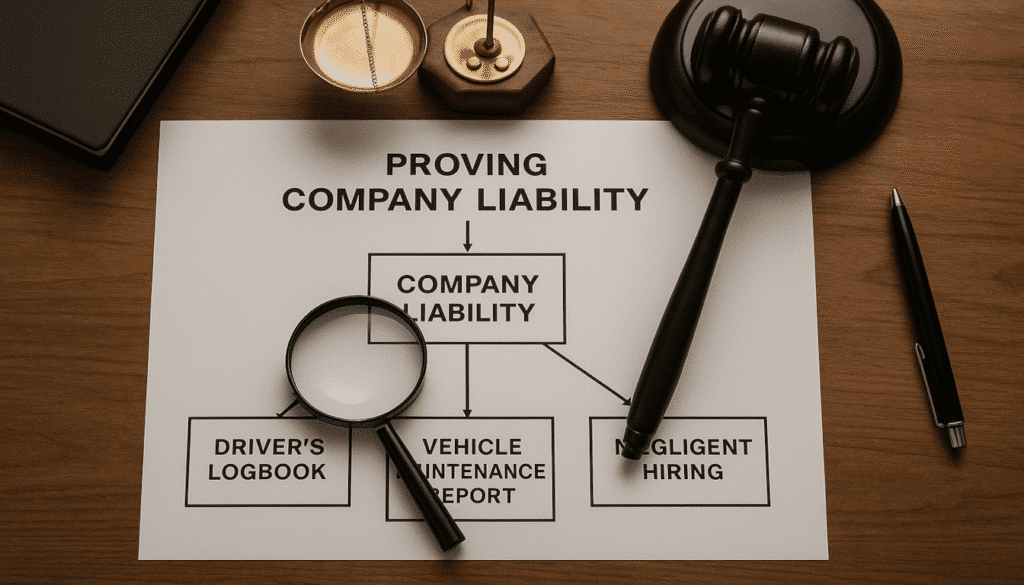
To establish a trucking company’s liability, attorneys assemble documentary and electronic proof that ties corporate decisions directly to the crash.
Personnel, Qualification, And Employment Files
Key records include the driver’s CDL copy, complete driver qualification files (DQFs), background check results, training certificates, and motor vehicle records (MVRs). These materials show what the company knew — and when it knew it — about a driver’s risk profile.
Logs, Telematics, and Hours‑of‑Service Violations
Electronic logging device (ELD) feeds, telematics, and handwritten logs reconstruct hours, routes, and patterns of falsification. Cross‑referencing cell phone metadata with dispatch records can expose hours‑of‑service violations that led to fatigue‑related crashes.
FMCSA Violations, Safety Audits, and Prior Citations
FMCSA audits, prior citations, and §391.51 production failures often reveal systemic safety gaps. Courts treat missing DQFs or delayed production as strong circumstantial evidence of broader noncompliance.
For a deeper look at how attorneys prove negligence through records and testimony, see How to Prove Negligence in Semi‑Truck Accident Lawsuits.
Litigation and Insurance Strategy
Document types such as employment files, training attendance records, background checks, and maintenance logs form the backbone of liability claims. Corroboration comes from matching ELD data to phone records or aligning maintenance logs with inspection reports. Attorneys issue preservation letters, conduct early forensics, and prevent spoliation to protect evidence. Insurance policy layers and documented company fault ultimately shape settlement value and claim strategy.
For official regulatory text on driver qualification file requirements, consult eCFR – 49 CFR §391.51.
Liability, Damages, And Insurance In Semi-Truck Accident Claims
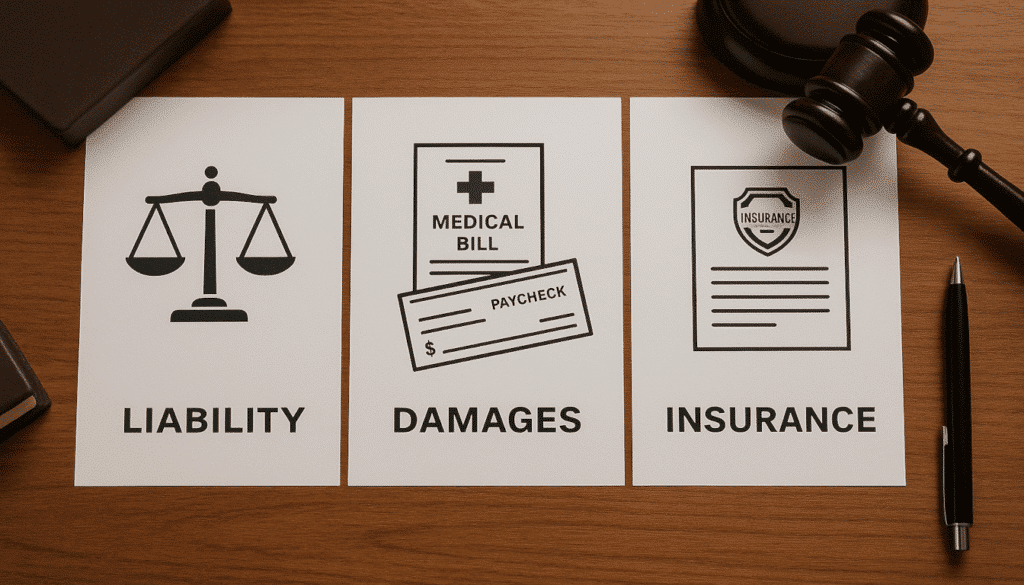
Liability claims after a commercial rig crash often hinge on whether the trucking company failed at core safety duties. Establishing fault at the corporate level changes how insurance negotiations and settlement talks proceed.
Direct Corporate Negligence versus Vicarious Liability
Direct corporate negligence covers failures such as poor screening, weak supervision, retention after violations, or unsafe entrustment of a vehicle. Vicarious liability, by contrast, holds the company responsible for a driver’s negligence while on the job.
- Direct fault: unsafe policies, hours‑of‑service oversight failures, training gaps, and maintenance lapses.
- Vicarious liability: the motor carrier is legally responsible for employee actions within the scope of employment.
For how courts distinguish these liability theories in truck cases, see Vicarious Liability in Semi‑Truck Accidents.
Compensation for Medical Bills, Lost Wages, and Long‑Term Care
Damages in semi‑truck accident claims often include acute medical care, surgeries, therapy, lost wages, diminished earning capacity, and life‑care plans for long‑term support. Clear proof of rule violations — such as hours‑of‑service noncompliance — can strengthen a personal injury claim and pressure insurers to offer higher compensation.
Early evidence of vehicle inspections, maintenance history, and documented training gaps helps maximize recovery. Official guidance on insurance filing and minimum financial responsibility is available at FMCSA — Insurance Filing Requirements.
How to Choose a Semi‑Truck Accident Lawyer and Start Your Claim
Who represents a victim directly affects access to driver qualification files, telematics, and FMCSA audit records that are vital to building a strong claim.

Key Qualities of a Semi‑Truck Accident Law Firm
The ideal law firm has a proven record of handling semi‑truck accident cases and understands FMCSA rules, ELDT standards, and driver qualification file requirements. Victims should ask focused questions about prior cases, the use of reconstruction experts, and the firm’s process for rapid electronic logging device (ELD) data capture.
First Steps: Investigation, Preservation Letters, and Insurance Notifications
Early action is critical. Counsel should send preservation letters, notify insurers, and secure access to vehicles and records quickly.
- Preserve evidence: driver qualification files, training records, hours‑of‑service logs, ELD feeds, and cell phone records.
- Notify insurers: prompt notice triggers coverage duties and limits spoliation risk.
- Ensure resources: investigators and experts for reconstruction and records analysis.
| Priority | What Counsel Should Do | Why It Matters |
|---|---|---|
| Immediate | Issue preservation letters; notify insurers; secure vehicle | Prevents loss of ELD data and personnel records |
| Short Term | Collect DQFs, training records, HOS logs, telematics | Builds proof that a company’s policies affected the case |
| Ongoing | Hire reconstruction experts; review FMCSA audits | Strengthens negotiation leverage and case valuation |
Victims should also vet transparency about fees, timelines, and responsiveness when choosing a lawyer. For more guidance on selecting counsel, see Choosing the Best Lawyer for Your Semi‑Truck Accident Case.
Negligent Hiring and Training in Semi‑Truck Accidents: Legal Options
Victims increasingly rely on corporate records to show that a carrier’s systemic failures caused a serious semi‑truck crash. These claims shift the focus beyond driver error and place responsibility squarely on company policies and oversight.
How Corporate Failures Become Legal Exposure
Evidence of gaps in screening, inadequate skills training, and poor medical oversight can transform a case from blaming an individual driver to challenging the trucking company itself. Quick action matters: early consultation with counsel helps preserve electronic logging device (ELD) feeds, telematics, logs, and personnel files — all of which courts treat as critical evidence.
Evidence That Strengthens a Claim
Documented FMCSA violations, missing driver qualification files (DQFs), or hours‑of‑service breaches often change how insurers view a case. These proofs can increase the likelihood of fair compensation tied to the severity of the injury.
Legal options include asserting direct claims against the company for policy and recordkeeping failures. Patterns such as repeat citations or poor audit results signal corporate practices ripe for challenge under FMCSA rules and federal law.
| Step | Action | Why It Matters |
|---|---|---|
| Immediate | Contact counsel; issue preservation notices | Protects telematics, logs, and HR records |
| Short Term | Collect DQFs, ELD data, audit history | Builds proof of policy failures |
| Ongoing | Hire experts; press insurers early | Strengthens settlement leverage |
For a deeper look at the records victims must preserve and present, see Evidence in Semi‑Truck Accident Cases.
Semi‑Truck Accident Law, Liability, and Recovery
Clear documentary links between driver qualification files (DQFs), hours‑of‑service (HOS) feeds, training records, and audit histories allow victims to convert company paperwork into proof that corporate choices caused a crash. For broader compliance guidance, the FMCSA Motor Carrier Safety Planner offers carriers and victims insight into how federal safety rules are applied in practice.
When a motor carrier skips proper screening, hiring checks, or skill development, harm from a heavy vehicle becomes foreseeable — and enforceable under federal law. Early evidence capture is critical to preserving claims.
Successful cases often combine vicarious liability with direct corporate fault to pursue full compensation for medical costs, lost wages, and long‑term damages. Victims should seek counsel with trucking experience and investigative depth, ensuring that expert analysis and focused records work expose company conduct as clear liability.
To explore how liability, compensation, and case building fit together, review Semi‑Truck Accident Law Explained.
Frequently Asked Questions: Negligent Hiring, Training, and Liability in Semi‑Truck Accident Cases
What constitutes negligent hiring and training by a trucking company in a semi‑truck accident case?
A trucking company may be negligent if it fails to properly screen applicants, verify commercial driver’s licenses, check driving records, or conduct drug and alcohol testing. Negligence also includes inadequate behind‑the‑wheel instruction, skipping defensive driving or cargo securement training, or ignoring hours‑of‑service rules. These lapses can make the company legally responsible when a semi‑truck accident occurs.
Which federal rules govern carrier responsibilities and driver qualification in semi‑truck accidents?
The Federal Motor Carrier Safety Administration (FMCSA) enforces Federal Motor Carrier Safety Regulations (FMCSR), including entry‑level driver training (ELDT) standards and requirements for driver qualification files (DQFs). Carriers must maintain records of licensing, medical certificates, background checks, and training outcomes to remain compliant.
What documents or records are most useful to prove negligent hiring or training in a semi‑truck accident claim?
Key evidence includes personnel files, CDL and medical certificates, drug test results, onboarding documents, training logs, safety meeting minutes, and performance reviews. Telematics, dashcam footage, and maintenance records can also reveal systemic safety problems tied to semi‑truck accidents.
How do hours‑of‑service and logbook violations factor into semi‑truck accident liability?
Hours‑of‑service violations increase crash risk and demonstrate operational shortcuts. Inaccurate or falsified logs, pressure to exceed limits, or missing ELD data can show that a carrier prioritized schedules over safety, strengthening a semi‑truck accident claim.
Can a trucking company be held directly responsible for a driver’s misconduct in a semi‑truck accident?
Yes. A trucking company may face direct corporate liability for negligent hiring, retention, or supervision if it knew or should have known a driver posed a risk. Vicarious liability also applies when drivers act within the scope of employment during a semi‑truck accident.
What role do FMCSA safety audits and prior citations play in semi‑truck accident cases?
Safety audits, inspection results, and prior citations reveal patterns of noncompliance. These records can show management knew about safety defects yet failed to correct them, supporting liability in semi‑truck accident claims.
How soon should a victim preserve evidence and notify insurers after a semi‑truck accident?
Prompt action is critical. Victims should preserve vehicle damage photos, witness contacts, and electronic data immediately. Insurers must be notified according to state deadlines, but legal counsel should be consulted before giving recorded statements. Preservation letters help prevent spoliation of records in semi‑truck accident cases.
What compensation can victims seek after a semi‑truck accident tied to company failures?
Victims may recover medical expenses, lost wages, reduced earning capacity, pain and suffering, and future care needs. Punitive damages may apply when carrier conduct shows gross negligence or reckless disregard for safety in semi‑truck accident claims.
How should someone choose a lawyer for a semi‑truck accident involving company wrongdoing?
Select a law firm with specific motor carrier experience, courtroom history, and resources to subpoena records and hire accident reconstruction experts. Ask about prior verdicts, trial readiness, and how the lawyer handles insurer negotiations in semi‑truck accident cases.
What are common red flags during driver screening that increase semi‑truck accident risk?
Red flags include repeated traffic convictions, DUI or drug offenses, unexplained employment gaps, falsified logbooks, inconsistent CDL status, and failed substance tests. These indicators suggest higher crash potential and warrant closer investigation.
Can evidence from telematics and onboard cameras be obtained in a semi‑truck accident claim?
Yes. Telematics, ELD downloads, and dashcam footage are critical. Counsel can issue preservation demands and subpoenas to secure this data before carriers delete or overwrite it.
What is entry‑level driver training (ELDT) and why does it matter in semi‑truck accident litigation?
ELDT sets national training standards for new commercial drivers, covering essential skills and safety topics. Proof that a driver lacked compliant ELDT or that an employer bypassed training helps show a company’s failure to meet minimum safety obligations in semi‑truck accident cases.
How do investigators prove a carrier ignored background checks or falsified files in a semi‑truck accident claim?
Investigators cross‑check employment histories, compare third‑party verification with company records, and interview former employees. Forensic review and expert testimony can reveal inconsistencies and demonstrate deliberate shortcuts that contributed to a semi‑truck accident.
Are punitive damages possible against a trucking company for unsafe hiring practices in semi‑truck accident cases?
Yes. Punitive damages may be awarded when conduct rises to willful or reckless indifference to safety. Courts consider the carrier’s knowledge of risks, prior violations, and whether management ignored clear hazards in semi‑truck accident claims.
What immediate steps should a victim take after a semi‑truck accident?
Seek medical care, document the scene with photos, collect witness names, and preserve vehicle evidence. Avoid detailed statements to insurers without counsel. Contact a lawyer experienced in semi‑truck accident claims to begin record preservation and investigation.
⚖️ Disclaimer: The content of this article is for informational purposes only and does not constitute legal advice. The information provided is based on general research and is not intended to be a substitute for professional legal advice or consultation with a qualified attorney. Always consult with a lawyer regarding your specific legal situation.