
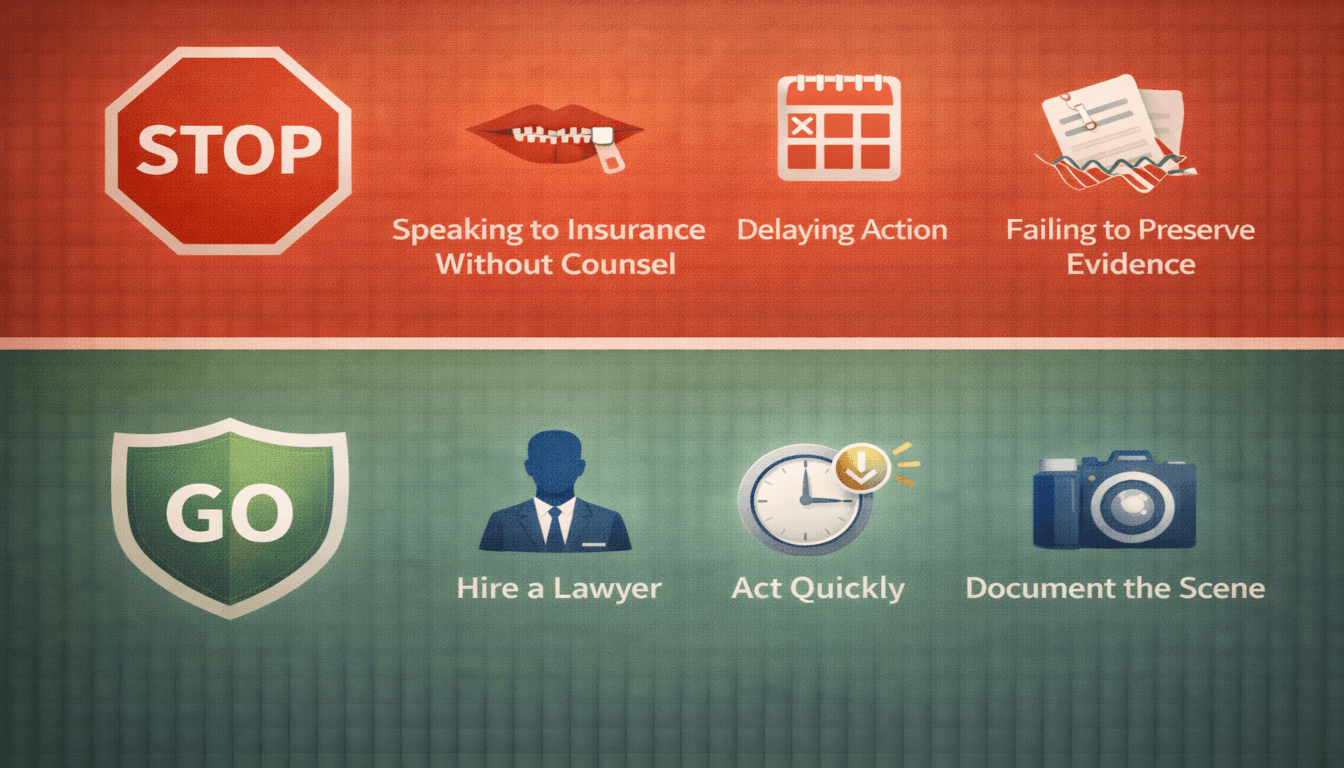
Many victims are not aware of the critical mistakes to avoid after a semi‑truck accident — errors that can weaken evidence, delay medical recovery, and jeopardize compensation. The reality is simple: prompt action often determines the strength of a claim.
In states like Arkansas and South Carolina, modified comparative fault rules can bar recovery at or above 50% fault. Georgia commonly enforces a two‑year deadline for filing claims. Missing these timelines or making early missteps can dramatically reduce compensation.
Survivors who acted quickly protected their rights by seeking immediate medical care, preserving scene evidence, and avoiding detailed statements to insurers. Photographs, witness contacts, truck identifiers, ELD data, and maintenance logs often became decisive proof.
Sending spoliation letters helped preserve black box and dashcam data before it was overwritten. Speaking with a lawyer before insurer interviews reduced the risk of harmful admissions. These steps strengthened records in life‑changing cases and supported fuller compensation.
For a deeper breakdown of what to do in the hours and days after a crash, see What to Do After a Semi‑Truck Accident.
Key Takeaways
- Act quickly: document the scene and seek immediate medical care.
- Preserve electronic data like ELDs and black box records with spoliation letters.
- Limit statements to insurers; direct communications through a lawyer.
- Know state timelines and comparative fault rules; they directly affect recovery.
- Collect witness information, photos, and truck details to strengthen evidence.
What to Do Immediately After a Semi‑Truck Accident to Protect Your Rights
Prompt, clear steps after a semi‑truck accident help preserve evidence and protect your legal rights. Federal safety guidance underscores the importance of accurate reporting and early documentation, especially when trucking companies and insurers begin their investigations immediately.
Prioritize Safety, Call 911, and Create an Official Record
Call 911 right away and allow officers to document the crash. Police reports often capture DOT numbers, trailer markings, witness statements, and initial observations that later support liability findings. Avoid moving vehicles unless they pose a safety risk, as preserving the scene helps ensure accurate documentation.
Seek Immediate Medical Care and Document Every Symptom
Adrenaline can mask injuries, so same‑day medical care is essential. Early notes about headaches, dizziness, numbness, or pain help link injuries to the crash and strengthen personal injury records.
Protect Evidence and Avoid Common Mistakes
- Do not admit fault or offer opinions; provide only factual identifiers to police.
- Photograph the scene from wide and close angles, including skid marks, debris, road conditions, and vehicle identifiers.
- Keep social media silent to avoid statements that insurers may misinterpret.
- Save all medical bills, diagnostic images, and appointment records to support future damages.
For a deeper look at the evidence that strengthens a claim, see Evidence in Semi‑Truck Accident Cases.
Common Mistakes to Avoid After a Semi‑Truck Accident
Immediate choices at the scene can determine whether a semi‑truck accident claim succeeds or fails. Federal driver safety guidance highlights how early statements, delayed medical care, or missing evidence can undermine credibility and weaken liability arguments. The following mistakes frequently harm recovery.

Avoid Admitting Fault or Apologizing at the Scene
Do not apologize, speculate, or offer opinions. In states like Arkansas, modified comparative fault rules mean even polite remarks may be interpreted as admissions. Keep statements factual and brief.
Do Not Delay Diagnosis or Miss Follow‑Up Treatment
Seek prompt medical evaluation. Delays give insurers opportunities to dispute causation. Consistent treatment notes help document injuries, symptoms, and recovery progress.
Failing to Gather and Preserve Evidence at the Crash Site
Document vehicle positions, skid marks, truck identifiers, and witness contacts. Practitioners in states like South Carolina emphasize securing ELD and ECM data quickly before it is overwritten or altered.
Speaking With Insurance Companies or Giving Recorded Statements
Adjusters often request recorded interviews within days. These statements can be used to highlight inconsistencies or minimize injuries. Refer calls to your lawyer or decline until you have representation.
Posting on Social Media About the Accident or Injuries
Public posts can contradict medical records or be used to downplay injuries. Stay off social platforms until the case is resolved. Preserve photos, symptom diaries, medical notes, and all crash‑related documentation.
“Consistent records, early preservation, and legal guidance protect recovery potential.”
- Collect driver license, employer info, and note visible mechanical issues.
- Preserve photos, symptom diaries, and physician notes.
- Coordinate early with an accident attorney.
Semi‑Truck Accident Mistakes and Fast Fixes
| Action | Risk | Quick Fix |
|---|---|---|
| Apologizing | Assigns perceived fault | Give facts only |
| Delayed care | Weakens injury claims | See a doctor same day |
| No evidence preservation | Loss of ELD, dashcam | Record details, send preservation notice |
For more insight into how small mistakes can jeopardize a claim, see Top Reasons Semi‑Truck Accident Claims Are Denied and How to Fight Back.
Legal Deadlines and Evidence Preservation That Can Make or Break Your Semi‑Truck Accident Case
Time limits under the law set the outer boundaries for filing a semi‑truck accident claim, but perishable evidence and rapid defense response teams make early organization essential. Federal crash data and safety statistics show how quickly critical information can disappear, underscoring the need for immediate action.

Understanding Statutes of Limitations and Special Notice Requirements
Statutes of limitations determine how long victims have to file a claim. Arkansas and South Carolina commonly allow three years, while Georgia typically allows two. Claims involving government entities may require much earlier notice, making calendar awareness crucial even when evidence is still available.
The Critical 48‑Hour Window to Secure Time‑Sensitive Evidence
The first 48 hours after a semi‑truck accident are often decisive. Trucking companies frequently deploy rapid‑response teams to collect onboard video, logs, and telematics data. Victims who act quickly can secure police reports, witness contacts, and scene photos before materials are lost or altered.
Black Box, ELD, and Maintenance Records: Protecting Specialized Trucking Evidence
Spoliation letters sent within days help preserve ELD/ECM data, black box downloads, dashcam footage, maintenance files, driver qualification records, and hours‑of‑service logs. Identifying all custodians — including the carrier, broker, shipper, and maintenance vendors — ensures a complete evidence chain for admissibility.
Semi‑Truck Accident Deadlines and Evidence Checklist
| Deadline/Record | Risk If Lost | Immediate Action |
|---|---|---|
| Statute Limitations (AR/SC 3 yrs; GA 2 yrs) | Claim barred if missed | Note filing date; consult counsel |
| ELD/ECM and Black Box | Overwrites erase event data | Send preservation letter; download copies |
| Dashcam and Surveillance | Routine deletion or overwrite | Request footage; preserve custodian chain |
| Maintenance & Driver Files | Hidden causation evidence | Issue spoliation notice to carrier |
For a deeper look at how filing deadlines affect your rights, see Statute of Limitations for Semi‑Truck Accidents.
Insurance Company Tactics, Settlement Traps, and How to Protect Your Semi‑Truck Accident Claim
Early calls from insurance companies are not friendly check‑ins — they are strategic attempts to shape the case. Federal consumer protection guidance highlights how carriers and insurers often act quickly to limit their exposure, and adjusters frequently call within hours seeking recorded statements that can later be used against victims.
Redirect Adjusters and Recorded Statements to Your Legal Team
Victims protected their claims by routing all communication from insurance companies to their lawyer. Saying little and refusing recorded statements prevents misunderstandings, misquotes, and credibility attacks. Always document who called, when they called, and what they asked. A simple call log can become critical if disputes arise later.
Why Early Settlement Offers Often Undervalue Long‑Term Injuries and Losses
Early settlement offers rarely account for future medical care, long‑term wage loss, diminished earning capacity, or pain and suffering. Commercial insurers often push quick resolutions to minimize payouts. Before accepting any offer, a lawyer should evaluate damages with medical and financial specialists and prepare a demand that reflects lifetime needs.
Common Insurer Tactics and How to Respond
| Insurer Move | Risk | Response |
|---|---|---|
| Early recorded call | Creates conflicting statements | Decline; document caller details |
| Quick settlement offer | Undervalues long‑term medical needs | Request full life‑care and damages assessment |
| Repeated questioning | Used to challenge credibility | Direct all communication to your lawyer |
To understand how insurers deny or devalue claims — and how victims can push back — see Bad Faith Insurance Tactics in Semi‑Truck Accident Claims.
Why Hiring a Semi‑Truck Accident Lawyer Early Can Change the Outcome of Your Case
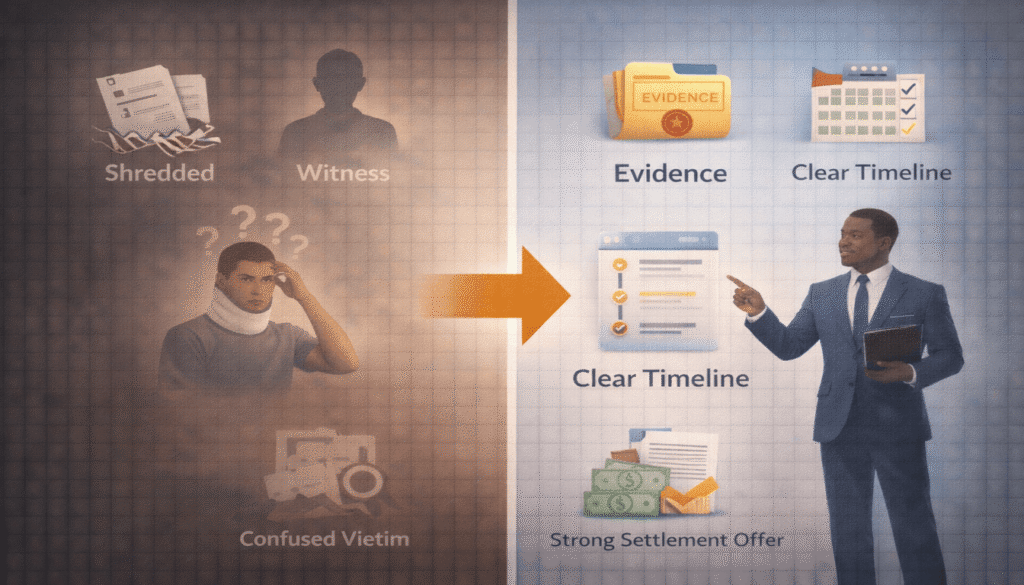
Securing a semi‑truck accident lawyer early can prevent critical evidence from disappearing and counter the rapid response efforts of trucking companies. Federal commercial motor vehicle safety requirements highlight how heavily regulated the industry is — and why early legal intervention shapes evidence collection, medical documentation, and negotiation strategy.
Leveling the Field Against Trucking Companies and Their Insurers
Large trucking companies often deploy rapid‑response teams, investigators, and insurance adjusters within hours of a crash. Hiring a lawyer early gives injured victims comparable resources and prevents insurers from controlling the narrative.
Skilled lawyers immediately redirect all insurer contact, document every call, and authorize expert involvement before evidence is lost or altered.
Identifying All Liable Parties to Maximize Compensation
An experienced legal team looks far beyond the truck driver when determining fault. They may identify additional responsible parties such as:
- The motor carrier
- Brokers and shippers
- Cargo loaders
- Maintenance contractors
- Vehicle or parts manufacturers
This broader investigation increases potential compensation and uncovers additional insurance coverage — a critical factor in severe injury cases.
Using Spoliation Letters to Preserve Critical Trucking Evidence
Early legal action ensures that spoliation letters are sent quickly to preserve:
- ELD/ECM downloads
- Onboard and dash‑camera footage
- Maintenance logs
- Driver qualification files
- Hours‑of‑service records
Acting fast prevents automatic overwrites and secures the data needed to prove causation, negligence, and regulatory violations.
Real‑World Examples of Early Legal Intervention
- They retained a semi‑truck accident lawyer promptly to match the trucking company’s rapid‑response team.
- They relied on their legal team to identify all liable companies and uncover additional policy limits.
- They watched as their lawyer issued spoliation letters that preserved ELD data, black box downloads, and maintenance records before they were lost.
To ensure the lawyer you hire has the right background for a complex trucking case, see How to Know If Your Lawyer Specializes in Semi‑Truck Accident Cases.
Protecting Your Case by Avoiding Common Semi‑Truck Accident Mistakes
A clear, fast plan for health, evidence preservation, and legal protection gives injured victims the strongest chance at a fair recovery. Federal consumer rights guidance reinforces how important it is for individuals to understand their protections when dealing with carriers, insurers, and commercial transportation companies.
Act quickly. Preserve scene data within the first 48 hours, avoid recorded statements and public posts, and maintain consistent medical care that clearly links injuries to the crash. Georgia often applies a two‑year statute of limitations, while Arkansas and South Carolina commonly allow three years. Under modified comparative fault rules, reaching 50% fault can block recovery entirely — making disciplined steps essential.
Resist early settlement offers that undervalue long‑term medical needs and future losses. Broad liability investigations, timely spoliation letters for ELD, black box, and maintenance records, and coordinated legal strategy all strengthen a semi‑truck accident claim.
For a deeper breakdown of what to do in the hours and days after a crash, see What to Do After a Semi‑Truck Accident.
Frequently Asked Questions About Mistakes to Avoid After a Semi‑Truck Accident
What should a victim do first at the crash scene after a semi‑truck accident?
Prioritize safety, call 911, and allow law enforcement and paramedics to document the scene. Their reports create an official record that supports later claims. If safe, take photos of vehicle positions, skid marks, road signs, and visible injuries. Collect contact information for drivers, witnesses, and the trucking company. Avoid admitting fault or speculating about what caused the semi‑truck accident.
How important is immediate medical care after a semi‑truck accident?
Immediate medical evaluation is essential for both health and legal reasons. Some injuries appear hours or days later. Diagnostic imaging, treatment notes, and detailed medical records help link symptoms to the semi‑truck accident. Keep all bills, records, and a symptom journal. Missing follow‑up appointments can give insurers grounds to argue the injury is unrelated or less severe.
Why should a person avoid apologizing or admitting fault at the scene of a semi‑truck accident?
Apologies or casual remarks can be used by insurers or defense lawyers to shift blame. Even a simple “I’m sorry” may be interpreted as accepting responsibility. Limit statements to factual information, such as exchanging contact details and describing injuries to first responders. Leave fault determinations to investigators and legal professionals.
What evidence is most important to gather and preserve immediately after a semi‑truck accident?
Time‑sensitive evidence includes photographs, witness names and statements, driver logs, cargo manifests, and skid marks. Electronic data such as the truck’s event data recorder (black box) and Hours‑of‑Service information from the Electronic Logging Device (ELD) are crucial. Preserve the vehicle’s condition for inspection and avoid repairs until a lawyer advises otherwise.
Can speaking with insurance adjusters without a lawyer harm a semi‑truck accident claim?
Yes. Adjusters aim to limit payouts. Recorded statements or broad medical authorizations can be used to deny or devalue claims. Redirect all insurer contact to your legal team or provide only basic policy and contact information. A lawyer who handles semi‑truck accident cases understands these tactics and protects the injured person’s interests.
How does social media activity affect a semi‑truck accident case?
Social media posts, photos, or check‑ins can undermine injury claims by suggesting the victim is less injured than alleged. Insurers and defense teams routinely monitor online activity. Avoid posting about the crash, treatment, or daily activities until the case is resolved. Adjust privacy settings and ask friends and family not to post about the incident.
What deadlines and evidence preservation rules apply in semi‑truck accident cases?
State statutes of limitations set strict filing deadlines; missing them usually bars recovery. Some trucking cases require special notice to a motor carrier within a shorter timeframe. Evidence preservation is time‑sensitive—EDR downloads, ELD logs, and maintenance records can be lost or overwritten quickly. Prompt legal action triggers preservation notices and spoliation letters to protect these materials.
Why is the first 48 hours after a semi‑truck accident so critical?
The first 48 hours are crucial because witnesses may leave, video footage can be overwritten, and electronic data may be erased. Securing witness contacts, obtaining police reports, and preserving ELD or black box data early prevents evidence loss. Early involvement from a lawyer ensures immediate preservation efforts and avoids accidental spoliation.
What specialized trucking records should be preserved after a semi‑truck accident?
Preserve ELD data, event data recorder (EDR) downloads, maintenance logs, driver qualification files, drug and alcohol test results, and cargo manifests. These records reveal hours‑of‑service violations, mechanical defects, or driver impairment. They often provide the strongest support for liability, especially when witness accounts conflict.
How do insurers try to settle semi‑truck accident claims, and how should someone respond?
Insurers may offer quick, low settlements before the full extent of injuries is known. They may also pressure victims to sign broad releases. Avoid accepting early offers without consulting a semi‑truck accident lawyer. A lawyer evaluates long‑term medical needs, lost wages, and pain and suffering to pursue fair compensation.
When should an injured person hire a semi‑truck accident lawyer?
As soon as possible—ideally within days of the crash. Early legal representation preserves evidence, manages insurer communication, and identifies all potentially liable parties, including the driver, carrier, cargo owner, and maintenance contractors. Prompt action levels the playing field against well‑resourced trucking companies.
How does identifying all liable parties affect compensation in a semi‑truck accident case?
Identifying every responsible party increases available insurance coverage and recovery potential. Liability may extend to the motor carrier, vehicle owner, loader, broker, or maintenance provider. A thorough investigation uncovers contract relationships, leasing arrangements, and safety violations that expand the claim and support higher compensation.
What is a spoliation letter, and how does it protect evidence in a semi‑truck accident case?
A spoliation letter (preservation letter) is a formal legal demand instructing parties to retain documents, electronic data, and physical evidence. Sending these letters early prevents destruction or alteration of critical materials such as ELD logs, maintenance files, or surveillance footage. Courts may impose sanctions if evidence is destroyed after a preservation demand is received.
⚖️ Disclaimer: The content of this article is for informational purposes only and does not constitute legal advice. The information provided is based on general research and is not intended to be a substitute for professional legal advice or consultation with a qualified attorney. Always consult with a lawyer regarding your specific legal situation.