
When a semi‑truck accident happens, a harmed motorist is suddenly up against insurance carriers and corporate defense teams that mobilize within hours. These cases move quickly, and the first steps a victim takes can shape the entire outcome of a claim.
After a semi‑truck collision, well‑funded companies work to protect their interests. A prompt, organized response is essential. Critical evidence—such as black box data, electronic logging records, maintenance files, and hours‑of‑service logs—can be lost or overwritten if not preserved early. These records often determine liability and influence the value of a personal injury claim.
Semi‑truck accidents differ from standard vehicle crashes because federal regulations, multiple potentially responsible parties, and severe injuries make each case more complex. Understanding how investigations work, how fault is proven, and how insurers defend these claims helps victims protect their rights from the very first interaction.
This guide outlines the core elements of a semi‑truck accident case: types of crashes, applicable laws, proving negligence, gathering evidence, dealing with insurance companies, and pursuing fair compensation.
Before diving in, victims may also find this resource helpful: What to Do After a Semi‑Truck Accident.
Key Takeaways
- Act quickly to preserve electronic logging and black box data.
- Investigations often require reconstruction experts and technical analysis.
- Federal trucking rules and company safety policies shape liability.
- Insurers may move fast; early legal guidance helps level the field.
- Evaluating injuries, coverage, and long‑term damages is essential for fair compensation.
Why Early Actions Matter After a Semi‑Truck Accident
Choosing the right semi‑truck accident lawyer begins with understanding how quickly these cases move. Evidence can disappear fast, and trucking companies often act immediately to protect their interests. According to Heavy Duty Trucking, early evidence preservation—such as securing black box data and electronic logs—is critical after a crash.

The first priority is always medical care. Even if injuries seem minor, a professional evaluation creates essential documentation that supports any future claim. Medical records often become the foundation of a semi‑truck accident case.
When safe, report the collision to law enforcement and document the scene. Photos of vehicle damage, skid marks, road conditions, and license plates help establish what happened. Gathering witness names and contact information early prevents key details from being lost.
Reaching out to a semi‑truck accident lawyer early in the process can help protect time‑sensitive evidence. Lawyers familiar with commercial vehicle cases understand how to obtain electronic logging data, maintenance records, and diagnostic downloads before they are altered or overwritten. They can also guide victims on how to handle insurance calls and avoid recorded statements that may be used against them.
A knowledgeable lawyer evaluates all available insurance policies, identifies potentially responsible parties, and works with medical and economic experts to understand long‑term care needs. Treating every case as if it may go to trial ensures that investigations begin immediately and leverage is preserved during settlement discussions.
Key Steps for Victims
- Prioritize medical attention and follow‑up care.
- Preserve evidence through photos, witness information, and documentation.
- Avoid posting about the crash on social media.
- Consult a lawyer promptly to protect deadlines and critical electronic data.
For guidance on evaluating legal representation, see: How to Know If Your Lawyer Specializes in Semi‑Truck Accident Cases
Why It’s Important to Hire a Lawyer Experienced in Semi‑Truck Accident Cases
Semi‑truck accident cases involve federal regulations, commercial carrier policies, and complex evidence that most motorists never encounter. The Federal Motor Carrier Safety Administration (FMCSA) publishes nationwide safety rules for trucking companies, and understanding these regulations is essential when evaluating liability in a semi‑truck accident case. An experienced semi‑truck accident lawyer knows how these rules apply and how to use technical evidence effectively.

Experience With High‑Stakes Semi‑Truck Accident Cases
Lawyers who regularly handle semi‑truck accident claims know how to analyze hours‑of‑service logs, maintenance records, and electronic data from commercial vehicles. They work with reconstruction specialists, telematics experts, and medical professionals to build a clear picture of what happened and how the crash caused the victim’s injuries. This level of analysis is crucial in cases involving severe injuries or disputed fault.
Resources to Match Large Trucking Companies and Insurers
Commercial carriers and their insurers often have significant resources, including legal teams, investigators, and industry experts. A lawyer experienced in semi‑truck accident cases understands how to respond quickly, secure evidence, and challenge defense strategies. These cases may require funding for inspections, black box downloads, expert testimony, and accident reconstruction—resources that general personal injury practices may not always have available.
Key Capabilities That Strengthen a Semi‑Truck Accident Claim
| Capability | Why It Matters | Outcome |
|---|---|---|
| FMCSR Knowledge | Identifies safety and regulatory violations | Expands liability options |
| Data Preservation | Secures ELD, ECM, and dash‑cam evidence | Prevents spoliation |
| Reconstruction & Experts | Tests and challenges defense narratives | Stronger settlement leverage |
| Litigation Resources | Supports inspections, motions, and expert work | Maintains pressure on insurers |
Before choosing a semi‑truck accident lawyer, victims should review the lawyer’s experience with trucking‑specific cases, their investigative process, and their ability to manage complex evidence.
For a deeper look at why these cases require specialized knowledge, see: Why Semi‑Truck Accident Cases Are Unique.
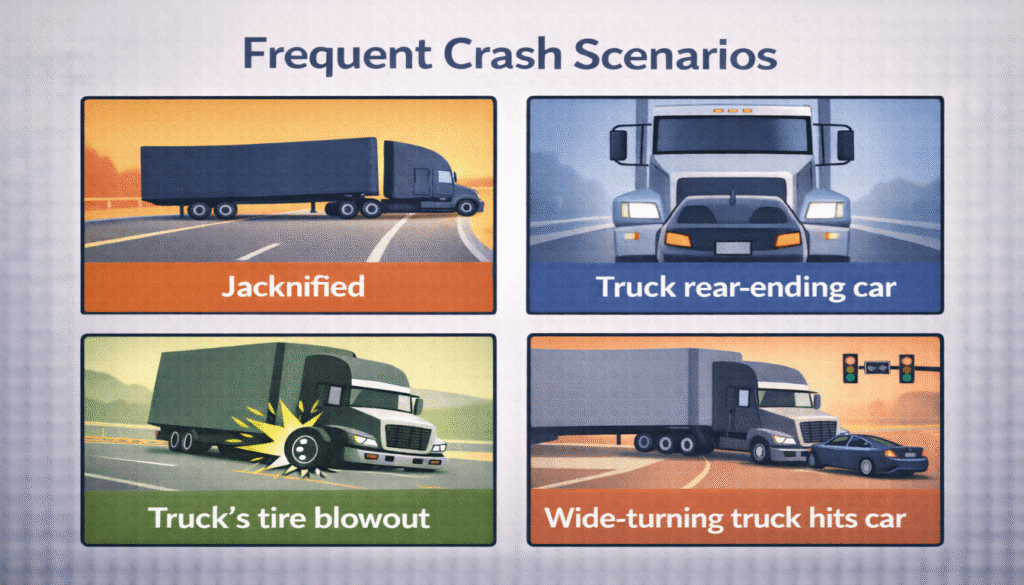
Common Types of Semi‑Truck Accidents Involved in Legal Claims
Different types of semi‑truck accidents leave distinct damage patterns that influence how investigators determine fault and how legal claims are built. Federal cargo tank safety regulations outline how hazardous materials and liquid loads must be transported, and violations of these standards can play a major role in certain crash investigations.
Jackknife, Rollover, and Wide‑Turn Crashes
A jackknife crash occurs when a trailer swings outward from the cab, often due to sudden braking, poor traction, or shifting cargo. Investigators typically review skid marks, trailer yaw angles, and electronic control module (ECM) hard‑braking data to understand driver inputs.
Rollover crashes frequently stem from uneven or unsecured loads. Wide‑turn collisions happen when a semi‑truck’s large turning radius causes the trailer to sweep into adjacent lanes or strike curbs, poles, or vehicles. Scene evidence—such as curb strikes, tire tracks, and intersection geometry—helps reconstruct these events.
Underride Crashes in Semi‑Truck Accidents
Underride crashes occur when a smaller vehicle becomes lodged beneath a trailer, often resulting in severe or fatal injuries. Forensic analysis may include examining underride guards, trailer height, impact angles, and deformation patterns to determine whether safety equipment functioned properly.
Unsecured or Lost Loads
Improperly secured cargo can fall into the roadway, causing multi‑vehicle collisions or forcing drivers to swerve into dangerous positions. Load bills, securement logs, and weight distribution records become critical evidence in these cases.
Tire Blowouts and Mechanical Failures
Tire blowouts, brake failures, and steering malfunctions often point to inadequate maintenance or defective parts. Investigators may analyze tire fragments, inspection reports, repair invoices, and maintenance schedules to identify whether neglect or mechanical defects contributed to the crash.
Key Evidence Considerations in Semi‑Truck Accident Cases
Effective case preparation often includes:
- Photographic documentation of the scene and vehicle damage
- Mapping skid marks, debris fields, and impact points
- Retrieving failed components for defect testing
- Identifying whether drivers, carriers, maintenance providers, manufacturers, or shippers may share responsibility
Crash type influences injury severity, liability, and the overall value of a semi‑truck accident claim.
For a deeper look at how responsibility is determined in these cases, see: Liability in Semi‑Truck Accidents.
Why Knowledge of Federal Trucking Regulations (FMCSA/FMCSRs) Matters in Your Case
Federal trucking regulations shape nearly every aspect of a semi‑truck accident investigation. These rules govern driver hours, vehicle maintenance, cargo securement, and safety compliance. When a lawyer understands how these regulations work, they can identify violations that point to systemic failures by drivers or trucking companies.
Hours‑of‑Service, Driver Qualification, and Safety Ratings
The Federal Motor Carrier Safety Regulations (FMCSRs) set strict limits on how long a commercial driver can remain on duty. Drivers may operate within a 14‑hour on‑duty window, drive up to 11 hours, and must take at least 10 consecutive hours off duty. A 34‑hour restart applies after reaching 60 hours in 7 days or 70 hours in 8 days. These limits directly relate to fatigue—a major factor in many semi‑truck accidents.
Driver qualification files also matter. Federal commercial driver qualification standards outline medical, training, and safety requirements carriers must follow. Safety ratings and the Safety Measurement System (SMS) can reveal patterns such as falsified logs, repeated brake violations, or out‑of‑service orders. These patterns may support claims involving negligent hiring, inadequate supervision, or broader company‑wide safety failures.
Weight, Maintenance, and Cargo Securement Rules
Commercial carriers must comply with weight limits, routine brake inspections, and proper cargo securement. Violations in these areas often contribute to rollovers, shifting‑load crashes, and underride events. Missing maintenance logs, overdue inspections, or improper load securement can indicate systemic issues within a trucking company or its contractors.
Key connections investigators look for include:
- Weight and securement violations that increase rollover and underride risk
- Maintenance history that links mechanical failures to liability
- Safety data showing whether a company had prior notice of recurring problems
Why These Rules Matter in a Semi‑Truck Accident Claim
A strong command of federal trucking regulations helps identify every potentially responsible party—drivers, carriers, maintenance providers, or shippers. This knowledge strengthens negotiations with insurers and improves leverage if a case proceeds toward litigation.
For a deeper look at how federal rules shape these cases, see: Hours‑of‑Service Violations in Semi‑Truck Accidents.
How Fault Is Proven in Complex Semi‑Truck Accident Claims
Proving fault in a semi‑truck accident requires a structured review of driver behavior, company practices, vehicle condition, and third‑party involvement. Investigators build a fault theory by connecting specific acts or omissions to the crash and resulting injuries.

Truck Driver Negligence and Driving Under the Influence
Driver negligence often involves speeding, distraction, fatigue, or impairment. Electronic logging device (ELD) data, witness statements, and post‑crash toxicology reports help determine whether the driver violated safety rules or breached the standard of care.
Trucking Company Liability and Non‑Delegable Duties
Trucking companies have legal responsibilities that cannot be shifted to drivers or contractors. Fault may arise from negligent hiring, inadequate training, unrealistic delivery schedules, or violations of safety regulations. Early discovery typically focuses on driver qualification files, internal safety policies, dispatch communications, and compliance records that reveal whether company practices contributed to foreseeable crash risks.
Maintenance Providers, Cargo Loaders, Brokers, and Manufacturers
Semi‑truck accident claims often involve multiple parties beyond the driver and carrier. Maintenance shops may be responsible for faulty repairs, cargo loaders for improper securement, brokers for inadequate vetting, and manufacturers for defective components. Research on the impact of truck and bus maintenance on safety underscores how poor inspection and repair practices can increase crash risk.
Maintenance logs, load manifests, broker contracts, and expert defect testing help establish these connections.
Key evidence used to establish fault
- ELD and ECM downloads
- Driver qualification and personnel files
- Maintenance and inspection records
- Cargo securement documentation
- Broker and shipper contracts
- Expert reconstruction and defect analysis
When several vehicles or parties are involved, comparative fault principles determine how responsibility is allocated and how compensation is distributed.
For a deeper look at how shared responsibility affects outcomes, see: Comparative Fault in Semi‑Truck Accidents.
The Importance of Rapid Evidence Preservation in Semi‑Truck Accident Cases
Critical evidence in a semi‑truck accident case can start disappearing within days. Digital records, maintenance logs, and onboard recordings are often overwritten or changed during routine fleet operations. Federal Electronic Logging Device (ELD) rules explain how driving data is recorded and stored, highlighting why early action is crucial before logs and related records are altered or lost.
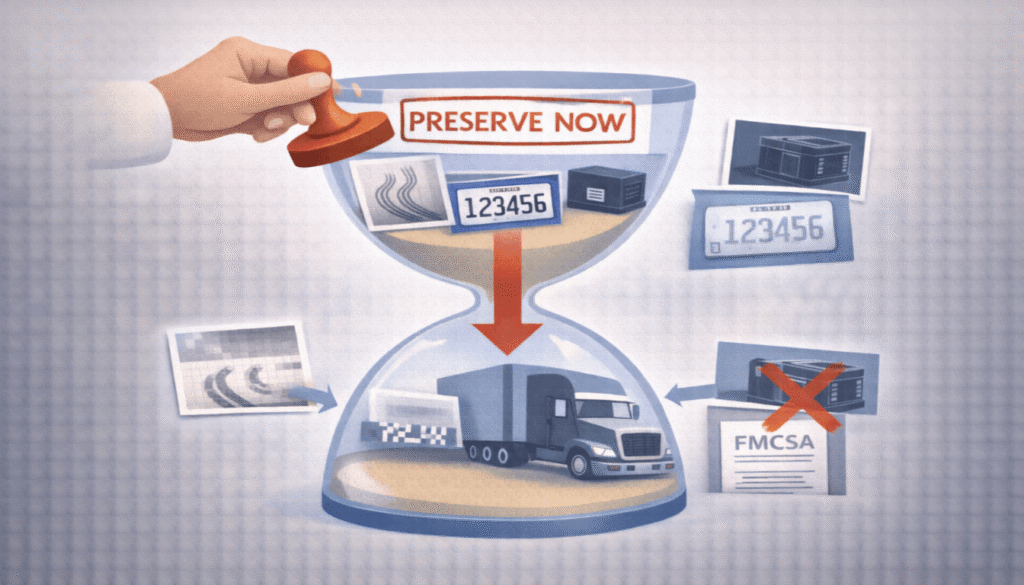
Spoliation occurs when evidence—such as dashcam clips, diagnostic data, or inspection records—is destroyed, altered, or allowed to be erased through normal business processes. Because commercial carriers often repair vehicles quickly and return them to service, immediate steps to preserve both digital and physical evidence are essential to maintaining a strong record.
Litigation Holds, Inspections, and Data Retention Demands
Issuing litigation holds and prompt inspection notices is one of the most effective ways to stop routine deletion. A preservation letter should:
- Identify Systems: Specify dashcams, ELD/ECM devices, GPS platforms, and fleet safety software.
- Define Time Ranges: State the dates and times surrounding the crash.
- Clarify Formats: Request native files, backups, and associated logs or metadata.
Clear, detailed instructions reduce ambiguity and help ensure that critical data and records remain intact.
Protecting Dashcam, ELD, and Maintenance Records
High‑priority evidence sources in semi‑truck accident cases often include:
- Dashcam and In‑Cab Video Systems
- ELD and ECM Modules capturing speed, braking, and hours of service
- GPS and Telematics Data from fleet safety platforms
- Maintenance and Inspection Files, including repair orders and defect notes
Effective preservation typically involves coordinating forensic imaging of devices, documenting chain of custody, and ensuring qualified experts are present during physical inspections to capture measurements, photographs, and detailed observations.
Why Speed Matters
- Compel Retention Before Repair or Sale so damaged components are not discarded.
- Forensically Image Devices before data is overwritten or reset.
- Document the Scene and Vehicles before they are moved, cleaned, or modified.
While courts can impose sanctions for spoliation, preventing evidence loss is far more effective. A focused early‑action checklist—sending a preservation letter, scheduling an inspection within roughly 72 hours when feasible, arranging expert imaging, and logging custody at every step—reduces the risk of lost evidence and strengthens the foundation of any future semi‑truck accident claim.
For a broader look at how evidence supports recovery in these cases, see The Importance of Evidence in Semi‑Truck Accident Claims.
How Black Box and Telematics Data Can Strengthen a Semi‑Truck Accident Claim
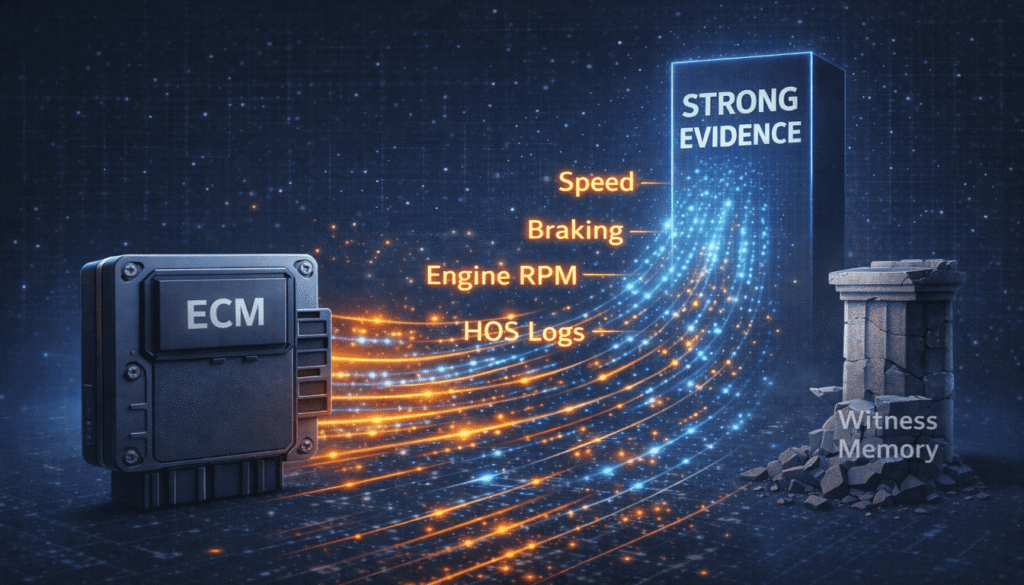
Digital records from a semi‑truck can reveal exactly how the vehicle and driver behaved in the seconds leading up to a crash. Research on event data recorders (EDRs) shows that these systems capture technical vehicle and occupant information immediately before, during, and after a collision, providing objective data that can clarify disputed facts and support a semi‑truck accident claim.
ECM/EDR Downloads, GPS, and Hard‑Braking Events
Electronic Control Modules (ECM) and Event Data Recorders (EDR) can record throttle percentage, brake application, vehicle speed, and hard‑braking or sudden‑deceleration events. GPS logs supply speed profiles and route traces that help reconstruct how the truck was operated over time. Lane‑departure alerts, throttle changes, and braking patterns may indicate distraction, fatigue, or other unsafe driving behaviors when analyzed alongside the timeline of the crash.
Because many systems overwrite data on a rolling basis, counsel must act quickly to request and secure raw files before onboard memory is reused. Early preservation demands often specify ECM/EDR downloads, GPS data, and any third‑party telematics platforms used by the fleet to monitor driver performance.
Correlating Digital Proof With Medical and Scene Evidence
Telematics data is most persuasive when it aligns with other forms of evidence. A hard‑braking event logged at a specific time that matches skid marks, impact points, and a documented injury timeline can create a cohesive narrative of what happened. Scene photographs, police diagrams, and medical records help give context to the digital trace of the crash.
Protocols matter. Effective requests ask for raw data, associated metadata, calibration records, and any software needed to interpret the files. Experts then validate the data, animate vehicle movements, and test alternative explanations, such as mechanical defects versus driver error.
Why Telematics Evidence Matters
- ECM/EDR and GPS data help reconstruct driver inputs and vehicle motion.
- Raw metadata and calibration files support the reliability and admissibility of downloaded evidence.
- Maintenance histories can be compared against anomalies in the data to identify potential mechanical contributions.
- Objective telematics may confirm or contradict witness accounts and speed estimates.
Time is critical. Some systems overwrite or purge data within days, so immediate preservation efforts are essential to protect key proof and strengthen negotiation leverage in a semi‑truck accident claim.
For a deeper look at how digital evidence supports fault findings, see How to Prove Negligence in Semi‑Truck Accident Lawsuits.
Common Causes of Semi‑Truck Accidents Examined in Legal Investigations
Legal investigations into semi‑truck accidents often uncover a combination of driver behavior, equipment failures, and company‑level pressures. Federal crash reporting research highlights how multiple contributing factors frequently overlap, guiding investigators toward the evidence needed to establish liability.

Driver Fatigue, Speeding, And Distracted Driving
Driver fatigue appears in ELD logs, rest records, and delivery schedules. A forensic review of hours‑of‑service entries and medical evaluations helps determine when a driver exceeded legal limits or operated while impaired by exhaustion.
Speeding and braking patterns are revealed through telematics data and roadway evidence. Phone records, in‑cab system logs, and app‑usage timestamps can expose distracted driving and pinpoint when a driver interacted with a device before the crash.
Negligent Maintenance and Overweight Trucks
Poor maintenance can lead to brake failures, tire blowouts, steering issues, and other mechanical defects. Investigators review inspection reports, repair invoices, and diagnostic fault codes to determine whether a preventable mechanical issue contributed to the collision.
Overweight or improperly loaded trailers affect stopping distance, stability, and rollover risk. Load manifests, scale tickets, and cargo securement records help show how excess weight or shifting cargo altered the truck’s handling on the road.
How Causes Guide the Investigation
- Match telematics data to injuries and scene photographs
- Compare maintenance logs to fault codes to establish neglect
- Review dispatch communications and company policies that pressure drivers to run late
- Analyze road conditions and load distribution to identify multi‑factor failures
A comprehensive review ensures no contributing factor is overlooked and helps tie each cause to resulting damages and corporate responsibility.
For more insight into how multiple failures can expand liability, see Multi‑Party Liability in Semi‑Truck Accidents.
Types of Damages Available in Semi‑Truck Accident Cases
A catastrophic semi‑truck accident can create layers of financial and personal losses that must be carefully documented. Federal crash statistics and safety data highlight how serious truck crashes often lead to extensive economic costs and long‑term personal harm, from immediate medical bills to lasting disability and reduced quality of life.
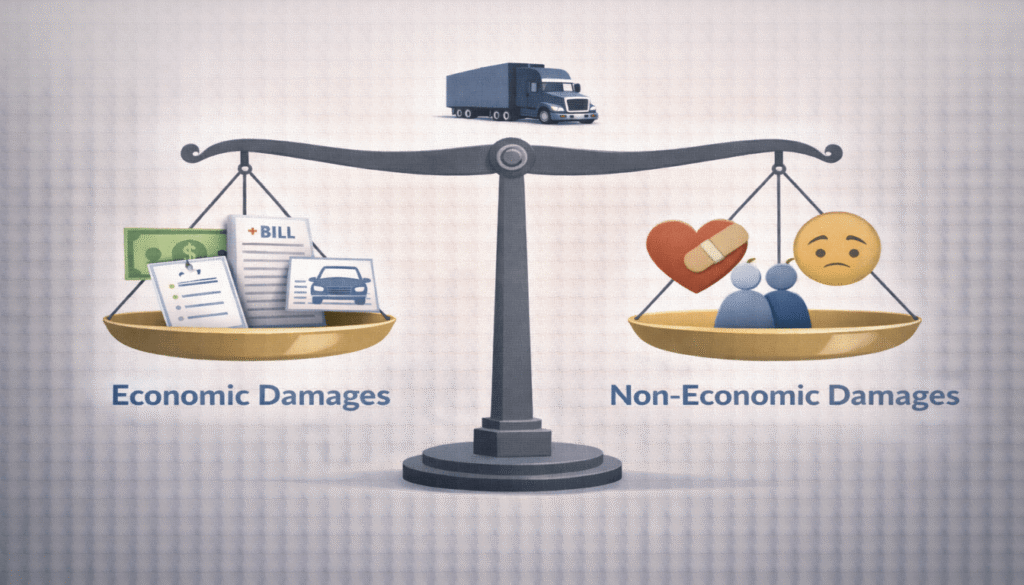
Medical Costs, Lost Wages, and Reduced Earning Capacity
Economic damages include past and future medical expenses, rehabilitation, therapies, and durable medical equipment. Medical records should clearly document diagnoses, treatment plans, prognosis, and anticipated future care needs.
Lost wages and diminished earning capacity are supported through payroll records, tax returns, employer statements, and vocational expert evaluations. Life‑care planners often calculate lifelong needs and associated costs when injuries result in permanent limitations.
Pain and Suffering, Emotional Distress, and Loss of Consortium
Non‑economic damages compensate for pain and suffering, emotional distress, loss of enjoyment of life, and loss of consortium. These harms are often shown through expert testimony, mental health evaluations, and detailed daily‑life journals that illustrate how the injuries affect relationships, independence, and day‑to‑day functioning.
Because injuries in semi‑truck accidents are frequently more severe than in typical car crashes, non‑economic valuations in these cases are often significantly higher.
Punitive Damages for Reckless FMCSA Violations
Punitive damages may be available when a trucking company or driver engages in reckless conduct, such as knowingly violating FMCSA safety rules, falsifying records, or ignoring repeated safety warnings. Courts look for evidence of conscious disregard for safety or systemic policies that place profits over compliance.
Other Recoverable Items
- Property damage and vehicle replacement
- Home modifications and accessibility improvements
- Transportation costs for medical appointments
- Funeral and burial expenses in wrongful death cases
- Vocational and life‑care planning reports to calculate future needs
Supporting evidence typically includes medical records, employer documentation, financial statements, and expert reports. Clear proof of damages increases leverage in settlement negotiations and helps identify all applicable insurance coverage, including excess or umbrella policies.
For a deeper breakdown of what victims may recover, see Economic and Non‑Economic Damages in Semi‑Truck Accident Claims.
How Lawyers Negotiate With Insurance Companies to Pursue Fair Compensation
Successful negotiation in a semi‑truck accident case depends on converting hard evidence into a valuation that insurance carriers cannot ignore. Federal insurance filing requirements help frame the financial stakes in commercial trucking, and attorneys use this context when building a data‑driven demand package. Telematics, medical forecasts, maintenance logs, and expert analyses are assembled into a single narrative that clearly establishes liability and quantifies damages.

Countering Delay, Denial, And Low Settlement Tactics
Insurance adjusters often rely on delay, denial, and low initial offers to pressure claimants into accepting less than full value. Effective counsel responds by documenting liability and damages early and thoroughly.
- Send a clear, evidence‑rich demand that includes ECM/ELD downloads, photographs, medical projections, and repair or maintenance records
- Use depositions and expert reports to increase punitive exposure when FMCSA violations or reckless company policies are uncovered
- Align timelines across multiple carriers so no insurer can shift responsibility by exploiting gaps in reporting or coverage
“Negotiation succeeds when counsel is trial‑ready and backed by objective evidence.”
Valuation includes past bills, future medicals, lost earnings, and non‑economic harms. Releases and settlement terms must protect long‑term compensation and health care needs.
| Negotiation Tool | Purpose | Expected Result |
|---|---|---|
| Telematics & ECM | Prove driver inputs and speed | Reduce dispute over fault |
| Medical Forecasts | Quantify future care | Increase settlement value |
| Expert Reports | Demonstrate negligence and damages | Force higher offers or trial |
By presenting a unified, well‑supported claim file, attorneys limit opportunities for insurers to dispute causation, minimize injuries, or undervalue long‑term losses.
For a deeper look at how insurers attempt to reduce payouts, see Semi‑Truck Accident Claims.
When Litigation Becomes Necessary in a Semi‑Truck Accident Case
Litigation becomes necessary when insurers refuse to offer fair compensation or when liability disputes cannot be resolved through negotiation. Attorneys prepare every case as if it will ultimately go to trial. Federal research and analysis on trucking safety and regulatory compliance often informs the evidentiary foundation, helping lawyers build a clear, persuasive narrative supported by reconstruction findings, medical expert reports, and FMCSR documentation.
Using Visual Evidence to Tell the Story
Courtroom presentations frequently rely on animated reconstructions, telematics timelines, and data‑driven exhibits that show jurors how the truck moved and why the collision occurred. These visuals translate complex technical information into compelling, easy‑to‑understand storylines.
Educating the Jury on Technical Rules
Jury education focuses on FMCSRs, maintenance standards, and driver conduct. The goal is to make technical rules accessible without overwhelming jurors. Experts are chosen for clarity, credibility, and the ability to explain industry practices in plain language rather than jargon.
Trial Strategy and Protection of Long‑Term Rights
- Witness preparation, exhibit strategy, and cross‑examination plans help neutralize corporate defenses
- Preservation of appellate issues ensures long‑term remedies remain available
- Management of multi‑defendant trials prevents blame‑shifting and protects the integrity of the case
Throughout the process, transparent counseling helps clients weigh risks, benefits, and potential outcomes before proceeding to court.
“Some companies only pay full value when faced with a credible trial threat.”
| Trial Element | Purpose | Typical Tools | Outcome |
|---|---|---|---|
| Motions & Disclosures | Limit surprises and define issues | Expert reports, ELD/ECM data | Cleaner record and strategic leverage |
| Demonstrative Exhibits | Explain mechanics to jurors | Reconstructed animations, telematics | Clear fault visualization |
| Expert Witnesses | Translate complex medicine and mechanics | Medical, reconstruction, vocational experts | Credible proof of damages and liability |
| Trial Tactics | Counter corporate defense playbooks | Cross-exam prep, exhibit sequencing | Increased settlement value or verdict |
Result: A trial-capable team preserves leverage and protects the client’s right to fair compensation when settlement stalls.
For a deeper look at how deadlines shape litigation strategy, see Statute of Limitations for Semi‑Truck Accidents.
How Expert Witnesses Support Semi‑Truck Accident Claims
Expert witnesses play a central role in transforming raw data into a clear, persuasive case narrative. Federal research and analysis on trucking safety and compliance often informs their evaluations, helping attorneys align early with specialists who can preserve critical proof and shape discovery strategy.

Accident Reconstruction, Trucking Safety, And Human Factors
Accident reconstructionists map the scene, measure vehicle deformation, and build simulations or animations that help jurors visualize how a collision occurred. They correlate skid marks, telemetry, and damage patterns to sequence events with scientific precision.
Trucking safety experts review FMCSR compliance, maintenance histories, and fleet policies to identify regulatory failures. Human factors specialists analyze perception, reaction time, fatigue, and distraction to explain why a driver behaved a certain way under real‑world conditions.
Medical, Vocational, and Life‑Care Planning Experts
Medical experts document causation, treatment needs, and long‑term prognosis. Vocational specialists assess return‑to‑work capacity, transferable skills, and lost earning potential.
Life‑care planners calculate future medical needs, home modifications, therapies, and supportive services. Their coordinated reports make complex damages understandable, measurable, and defensible in negotiations or at trial.
Why Expert Testimony Matters
- Unified expert analysis ties physical evidence to medical care and long‑term costs
- Early involvement preserves key data and strengthens negotiation leverage
- Credible testimony often resolves technical disputes before a case reaches trial
For a deeper look at how experts shape these cases, see Expert Witnesses in Semi‑Truck Accident Claims.
Step‑By‑Step Overview of the Legal Process After a Semi‑Truck Accident
Immediate, organized action can shorten the path from injury to recovery. Federal crash preventability guidance underscores how careful documentation and analysis shape decisions about fault, and the legal process typically begins with an initial case review and a structured plan that preserves key evidence and outlines realistic timelines. This allows injured individuals to focus on healing while their legal team secures perishable records and coordinates essential documentation.
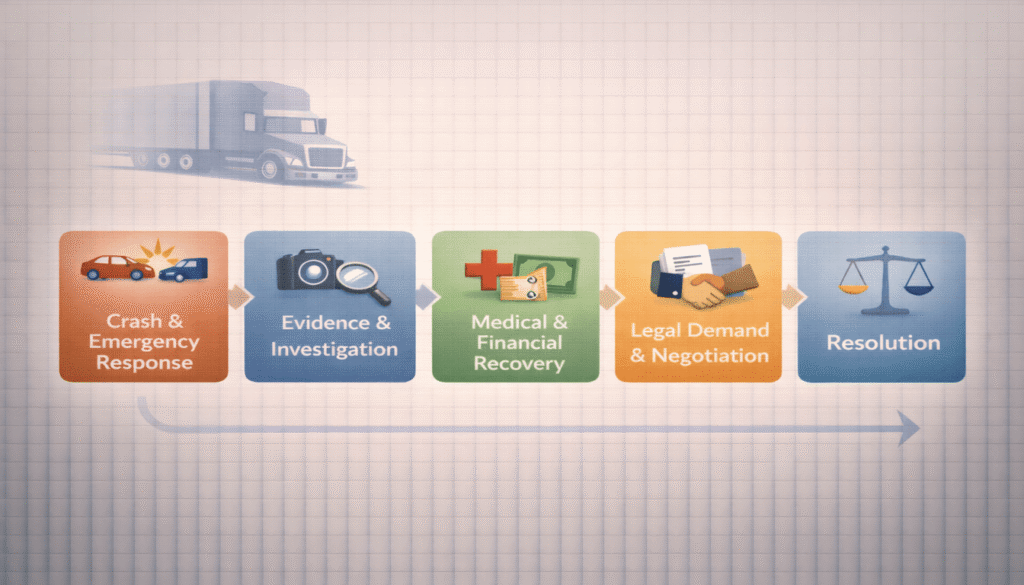
Free Consultation, Case Strategy, and Investigation Timeline
Initial Intake. During an initial consultation—often offered at no cost—legal representatives gather basic facts, medical records, photographs, and contact information. A simple checklist helps individuals collect documents that speed early evaluation.
Preservation and Early Notices. Preservation letters are sent to prevent routine deletion of ELD, ECM, dashcam, and other digital files. Insurers are notified, and requests are made for timely inspections of the vehicle and crash scene.
Evidence Retrieval. Forensic downloads of telematics data typically occur within days. An inspection plan sets target times for imaging onboard modules, photographing the vehicle, and documenting roadway evidence.
Medical Coordination. Hospital records, diagnostic reports, and specialist evaluations are collected to document injuries, treatment needs, and long‑term prognosis.
Discovery and Experts. During discovery, attorneys request company safety files, driver qualification records, maintenance logs, and other operational documents. Experts are brought in when technical explanation is needed, and depositions follow once evidence is developed.
Milestones and Reviews. Progress is reviewed regularly, with clear targets for negotiation, mediation, or filing suit if necessary. Timelines vary depending on the complexity of the case, the number of defendants, and the pace of medical recovery.
Common Pitfalls to Avoid
- Avoid social media commentary: Do not post about the incident or injuries online.
- Limit unsupervised insurer contact: Do not provide statements to insurers without guidance.
- Preserve medical proof: Keep all medical appointments and retain receipts, bills, and reports.
Simple cases may resolve within months, while multi‑defendant or medically complex matters often take longer due to extended discovery and treatment timelines.
For practical next steps and guidance on what documents help speed an investigation, see Mistakes to Avoid After a Semi‑Truck Accident.
Understanding Legal Options for Victims of Semi-Truck Accidents
Collisions involving big rigs and commercial fleets often leave individuals and families facing urgent medical, legal, and financial challenges. Federal cargo securement rules highlight how load type and securement affect crash dynamics, and legal options typically extend across regional and interstate corridors. These cases may involve heavy trucks, trailer combinations, and mixed fleets that operate across state lines, each presenting unique risks and evidence considerations.

Different vehicle configurations and cargo types can significantly influence how a crash occurs. Investigators review load bills, securement methods, and specialized cargo requirements to understand how weight distribution, hazardous materials, or oversized loads contributed to the collision and resulting property loss.
Support for grieving families may include wrongful‑death claims, funeral expense recovery, and calculations for loss of financial support. Legal representatives often coordinate with medical providers and insurers to stabilize immediate needs while documenting the full scope of damages.
Key Areas of Focus in Commercial Vehicle and Big‑Rig Cases
- Investigating company fleets that operate varied vehicles and trailer types
- Proving damages unique to heavy‑truck impacts, including enhanced property loss
- Navigating multi‑vehicle pileups and regulatory differences that affect liability
- Connecting clients with community resources that support recovery and long‑term care
A comprehensive approach seeks full accountability from all responsible parties and aims to secure outcomes that address both economic and non‑economic harms.
For more insight into how vehicle type affects liability, see Commercial Vehicle Classes in Semi‑Truck Accident Cases.
Key Qualities to Look for in a Semi‑Truck Accident Lawyer
A timely, technology‑driven investigation can turn unclear facts into decisive proof. Federal research initiatives highlight how data, analysis, and safety studies inform modern crash evaluation, and effective legal teams use telematics, 3D scene scans, and dynamic reconstructions to preserve evidence quickly and present it clearly.
Technology‑Driven Case Building and Client‑First Advocacy
Modern case development relies on capturing raw ELD and ECM data, securing dashcam footage, and creating animations that illustrate how a collision occurred. These tools reduce disputes over fault and often accelerate negotiations.
Client‑first advocacy emphasizes clear communication, accessible guidance, and aligned goals for medical care and compensation. Coordinating with qualified experts helps connect mechanical failures, driver behavior, and injury outcomes.
Qualities That Strengthen a Semi‑Truck Accident Case
- Rapid telematics capture and 3D scene imaging
- Disciplined evidence workflows that reduce the risk of spoliation
- Experience against national trucking companies and insurers
- Transparent fee structures and a trial‑ready posture when fair offers are refused
- Case‑building checklists that ensure no critical evidence is overlooked
What These Features Deliver
| Feature | Why It Matters | Result |
|---|---|---|
| Telematics & ECM | Objective driver and vehicle data | Sharper proof of events |
| 3D Scans & Animations | Clear juror visualization | Stronger settlement leverage |
| Expert Network | Specialized insight on mechanics/medicine | Credible testimony at trial |
| Client Communication | Transparent updates and aligned goals | Confident decision‑making |
Evaluating proven results, investigative processes, and responsiveness helps individuals choose the right counsel for a serious truck accident case. For additional guidance on legal rights and next steps, see Semi‑Truck Accident FAQs: Legal Rights and Answers for Victims.
How to Schedule a Consultation With a Semi‑Truck Accident Lawyer
Reaching out to a qualified attorney as soon as possible helps preserve evidence and protect legal rights. Federal consumer rights guidance emphasizes the importance of understanding protections and avoiding preventable mistakes, and a prompt consultation can prevent routine data loss and reduce the risk of insurer‑related missteps.

Many legal practices offer 24/7 intake and contingency‑fee arrangements, meaning clients do not pay upfront. Under these structures, attorneys advance case costs and collect fees only if they secure compensation.
What to Bring to the Consultation
- Photos, videos, or scene documentation
- Medical records, discharge papers, and treatment summaries
- Police reports or incident numbers
- Any letters, emails, or calls from insurers
Questions to Ask During the Meeting
- Expected timelines and early preservation steps
- Who will notify insurance companies and handle communications
- Whether consultations can be done by phone, video, or in person
- How the contingency‑fee structure works and what “no‑fee unless recovered” means
After the initial review, the attorney typically outlines the next steps, including preservation letters, requests for forensic downloads, and insurer notifications. Early legal guidance helps prevent risky statements, protects evidence, and strengthens the foundation of a future claim.
“Early outreach preserves evidence and strengthens the path to fair compensation.”
For a clearer picture of what happens after the consultation, see Semi‑Truck Accident Lawsuits Explained.
Making the Final Decision: Choosing the Right Semi‑Truck Accident Lawyer With Confidence
Reaching out to a qualified attorney quickly helps preserve evidence and protect your rights. Federal consumer rights guidance reinforces how early action can prevent avoidable mistakes, especially when insurers are already gathering information.
Most legal practices offer 24/7 intake and contingency‑fee arrangements, so clients don’t pay upfront. Bringing photos, medical records, police reports, and any insurer communications helps the attorney assess the case efficiently.
During the consultation, ask about timelines, preservation steps, communication preferences, and how the fee structure works. After the review, the attorney typically handles preservation letters, forensic data requests, and insurer notifications to protect the strength of the claim.
For practical steps to take before and after the consultation, see What to Do After a Semi‑Truck Accident.
Frequently Asked Questions About Semi‑Truck Accident Lawyers and Semi‑Truck Collision Claims
How soon should a person contact a lawyer after a semi‑truck collision?
As soon as possible. Rapid action preserves critical evidence such as electronic logging device (ELD) data, dashcam footage, and maintenance records. Early involvement helps secure witnesses, meet preservation deadlines, and prevent spoliation that insurers or carriers might inadvertently or intentionally cause.
What types of semi‑truck and commercial‑vehicle crashes do lawyers handle?
Lawyers handle jackknife, rollover, and wide‑turn crashes; underride collisions; unsecured or lost‑load incidents; tire blowouts; mechanical‑failure collisions; and other commercial‑vehicle crashes involving tractor‑trailers, straight trucks, and box trucks.
How does knowledge of federal trucking regulations affect a semi‑truck accident case?
A strong command of FMCSA regulations and the Federal Motor Carrier Safety Regulations (FMCSRs) is essential. Lawyers use hours‑of‑service rules, driver qualification files, maintenance standards, cargo‑securement rules, and safety ratings to establish negligence or regulatory violations that increase liability.
Who can be held liable in a big‑rig or semi‑truck wreck?
Liability may extend beyond the truck driver to the trucking company, independent contractors, maintenance providers, cargo loaders, brokers, and manufacturers. Non‑delegable duties and vicarious liability theories often apply when employers fail to supervise, train, or maintain vehicles properly.
What evidence matters most in semi‑truck accident claims?
Key evidence includes ELD/ECM downloads, GPS and telematics data, dashcam video, maintenance logs, driver logs, cargo manifests, witness statements, police reports, and medical records. Aligning digital telematics with scene evidence and medical findings strengthens causation and damages arguments.
Can telematics or “black box” data be used to prove fault?
Yes. ECM/EDR downloads, hard‑braking events, speed data, and GPS traces can show driver behavior, vehicle performance, and timeline. Forensic downloads and expert analysis often reveal discrepancies in carrier reports or driver statements.
What damages are recoverable after a semi‑truck accident?
Recoverable damages may include medical expenses, future treatment, lost wages, reduced earning capacity, pain and suffering, emotional distress, loss of consortium, and—in severe cases—punitive damages for reckless violations of FMCSA rules.
How do lawyers counter insurance delays and low settlement offers?
Effective lawyers document injuries and liability thoroughly, issue timely preservation and discovery demands, use expert reports, and build a compelling damages narrative. When insurers delay or deny, litigation‑ready strategies and trial preparation increase pressure for fair compensation.
Are consultations and case evaluations free?
Many legal practices offer free initial consultations to review facts, explain potential claims, and outline next steps. During the meeting, the lawyer assesses liability, damages, and applicable statutes of limitations.
What role do expert witnesses play in semi‑truck injury cases?
Experts in accident reconstruction, trucking safety, human factors, biomechanics, medicine, vocational rehabilitation, and life‑care planning provide technical opinions that connect cause and injury, quantify future needs, and rebut defense arguments.
How long does a typical semi‑truck accident claim take to resolve?
Timelines vary. Some claims settle within months when liability and damages are clear. Complex cases with severe injuries, multiple defendants, or regulatory issues may take a year or longer, especially if litigation or appeals are involved.
Can driver fatigue or hours‑of‑service violations increase compensation?
Yes. Documented hours‑of‑service violations and fatigue‑related logs can support negligence claims and justify higher damages, particularly when they show reckless disregard for FMCSA safety rules or repeated carrier noncompliance.
What should a victim avoid doing after a semi‑truck crash?
Victims should avoid admitting fault, giving recorded statements to insurers, signing releases, or posting about the crash on social media. They should seek medical attention and consult a lawyer before making formal statements or accepting settlement offers.
How do lawyers preserve perishable trucking evidence?
They send litigation‑hold and spoliation‑preservation letters, demand ELD and ECM data promptly, inspect vehicles and scene evidence, and coordinate with experts to obtain timely downloads and maintenance records before carriers alter or dispose of them.
Will the trucking company handle the investigation if the driver was their employee?
Trucking companies and insurers conduct internal investigations, often to limit liability. Victims should rely on independent legal representation to pursue unbiased discovery, subpoena records, and hire neutral experts to counter company narratives.
Can punitive damages apply in semi‑truck accident cases?
Punitive damages may apply when conduct is willful, reckless, or shows conscious disregard for safety—such as knowingly violating FMCSA rules, falsifying logs, or ignoring repeated mechanical defects. State law determines when punitive damages are available.
⚖️ Disclaimer: The content of this article is for informational purposes only and does not constitute legal advice. The information provided is based on general research and is not intended to be a substitute for professional legal advice or consultation with a qualified attorney. Always consult with a lawyer regarding your specific legal situation.